

of feed per kilogram of catalyst) or simply as
F per day (
C per day). During the
course of an operating cycle, the temperature required to obtain the desired product
quality will increase as a result of catalyst deactivation. The maximum catalyst
operating temperature determines the temperature cycle and cycle length of the
catalyst.
The metallurgical design temperature of the reactor(s) will determine the maximum allowable catalyst operating value. The axial and radial temperature rise
across the reactor(s) must be monitored continuously in order to assure that the
design limitation of the unit is not exceeded. This can be especially important when
changing feedstocks since olefin saturation results in considerably higher heats of
reaction. Units are typically designed for a maximum reactor bed temperature rise
<60
F (33
C).
Feed Quality and Rate
The amount of catalyst loaded into the reactors as well as other design parameters
are based on the quantity and quality of feedstock the unit is designed to process.
While minor changes in feed type and charge rate can be tolerated, wide variations
Table 8 Chemical basis
for product quality
Quality measurement
Chemical basis
High smoke point
Low concentration of aromatics
Low pour point
Low concentration of n-paraffins
Low freeze point
Low concentration of n-paraffins
Low cloud point
Low concentration of n-paraffins
Low CFPP
Low concentration of n-paraffins
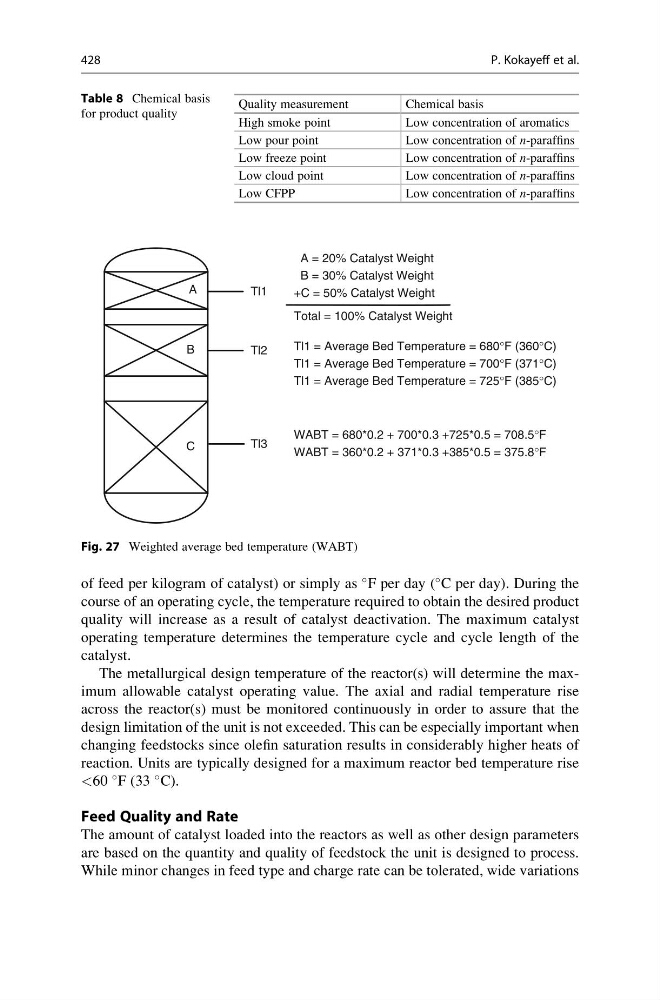
A
Tl1
Tl1 = Average Bed Temperature = 680°F (360°C)
Tl1 = Average Bed Temperature = 700°F (371°C)
Tl1 = Average Bed Temperature = 725°F (385°C)
WABT = 680*0.2 + 700*0.3 +725*0.5 = 708.5°F
WABT = 360*0.2 + 371*0.3 +385*0.5 = 375.8°F
Tl2
Tl3
B
C
A = 20% Catalyst Weight
B = 30% Catalyst Weight
+C = 50% Catalyst Weight
Total = 100% Catalyst Weight
Fig. 27 Weighted average bed temperature (WABT)
428
P. Kokayeff et al.
F per day (
C per day). During the
course of an operating cycle, the temperature required to obtain the desired product
quality will increase as a result of catalyst deactivation. The maximum catalyst
operating temperature determines the temperature cycle and cycle length of the
catalyst.
The metallurgical design temperature of the reactor(s) will determine the maximum allowable catalyst operating value. The axial and radial temperature rise
across the reactor(s) must be monitored continuously in order to assure that the
design limitation of the unit is not exceeded. This can be especially important when
changing feedstocks since olefin saturation results in considerably higher heats of
reaction. Units are typically designed for a maximum reactor bed temperature rise
<60
F (33
C).
Feed Quality and Rate
The amount of catalyst loaded into the reactors as well as other design parameters
are based on the quantity and quality of feedstock the unit is designed to process.
While minor changes in feed type and charge rate can be tolerated, wide variations
Table 8 Chemical basis
for product quality
Quality measurement
Chemical basis
High smoke point
Low concentration of aromatics
Low pour point
Low concentration of n-paraffins
Low freeze point
Low concentration of n-paraffins
Low cloud point
Low concentration of n-paraffins
Low CFPP
Low concentration of n-paraffins
A
Tl1
Tl1 = Average Bed Temperature = 680°F (360°C)
Tl1 = Average Bed Temperature = 700°F (371°C)
Tl1 = Average Bed Temperature = 725°F (385°C)
WABT = 680*0.2 + 700*0.3 +725*0.5 = 708.5°F
WABT = 360*0.2 + 371*0.3 +385*0.5 = 375.8°F
Tl2
Tl3
B
C
A = 20% Catalyst Weight
B = 30% Catalyst Weight
+C = 50% Catalyst Weight
Total = 100% Catalyst Weight
Fig. 27 Weighted average bed temperature (WABT)
428
P. Kokayeff et al.