

Gas-to-Oil Ratio
This is an important variable for the satisfactory performance of a hydrotreater.
If the unit is operated at lower than design ratios, more rapid catalyst deactivation
will result. The circulating gas also provides the heat sink for the removal of the
heat of reaction. Though various hydrotreating unit designers and catalyst manufacturers use different values, it is generally accepted that the minimum gas-to-oil
ratio should be at least three to four times the amount of hydrogen consumption,
although this may be lower for distillate and naphtha hydrotreating operations.
Liquid Hourly Space Velocity
The design quantity of catalyst per unit of feed will depend upon feedstock properties,
operating conditions, and product quality required. A simplified kinetic expression
based on sulfur and/or nitrogen removal determines the design liquid hourly space
velocity for most feedstocks and processing objectives. This initial value may be
modified due to other considerations such as unit size, extended catalyst cycle life,
abnormal levels of feed metals, and requirements of other processing units in the
refinery flow scheme. A unit design is based on operation to achieve optimum
performance. One criterion is liquid mass flux across the catalyst bed. At reduced
throughput, unit operation may become difficult due to hydraulic considerations.
Also, liquid distribution in the reactor may become unequal as preferential flow paths
are established. For these reasons, the unit should not be operated below the minimum turndown capacity for extended periods. Unit turndown will vary for each
design and is typically 50–70 % of design capacity. Operation at too high of space
velocity (compared to original design) is not advisable because of increased catalyst
deactivation rates as well as increased system pressure drop.
Recycle Gas Purity
The effective completion of the hydrogenation reactions occurring over the catalyst
requires that a certain quantity of hydrogen be present at a minimum hydrogen
partial pressure. As noted previously, both the quantity (gas-to-oil ratio) and partial
pressure are dependent upon the hydrogen content, i.e., purity, of the recycle gas.
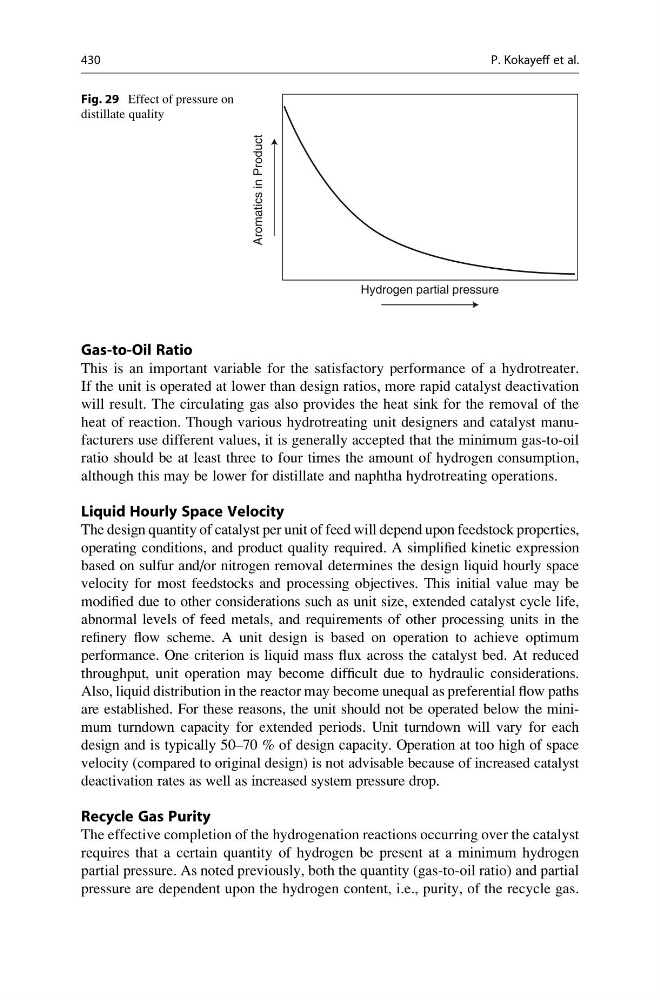
Hydrogen partial pressure
Aromatics in Product
Fig. 29 Effect of pressure on
distillate quality
430
P. Kokayeff et al.
This is an important variable for the satisfactory performance of a hydrotreater.
If the unit is operated at lower than design ratios, more rapid catalyst deactivation
will result. The circulating gas also provides the heat sink for the removal of the
heat of reaction. Though various hydrotreating unit designers and catalyst manufacturers use different values, it is generally accepted that the minimum gas-to-oil
ratio should be at least three to four times the amount of hydrogen consumption,
although this may be lower for distillate and naphtha hydrotreating operations.
Liquid Hourly Space Velocity
The design quantity of catalyst per unit of feed will depend upon feedstock properties,
operating conditions, and product quality required. A simplified kinetic expression
based on sulfur and/or nitrogen removal determines the design liquid hourly space
velocity for most feedstocks and processing objectives. This initial value may be
modified due to other considerations such as unit size, extended catalyst cycle life,
abnormal levels of feed metals, and requirements of other processing units in the
refinery flow scheme. A unit design is based on operation to achieve optimum
performance. One criterion is liquid mass flux across the catalyst bed. At reduced
throughput, unit operation may become difficult due to hydraulic considerations.
Also, liquid distribution in the reactor may become unequal as preferential flow paths
are established. For these reasons, the unit should not be operated below the minimum turndown capacity for extended periods. Unit turndown will vary for each
design and is typically 50–70 % of design capacity. Operation at too high of space
velocity (compared to original design) is not advisable because of increased catalyst
deactivation rates as well as increased system pressure drop.
Recycle Gas Purity
The effective completion of the hydrogenation reactions occurring over the catalyst
requires that a certain quantity of hydrogen be present at a minimum hydrogen
partial pressure. As noted previously, both the quantity (gas-to-oil ratio) and partial
pressure are dependent upon the hydrogen content, i.e., purity, of the recycle gas.
Hydrogen partial pressure
Aromatics in Product
Fig. 29 Effect of pressure on
distillate quality
430
P. Kokayeff et al.