

Support Impregnation
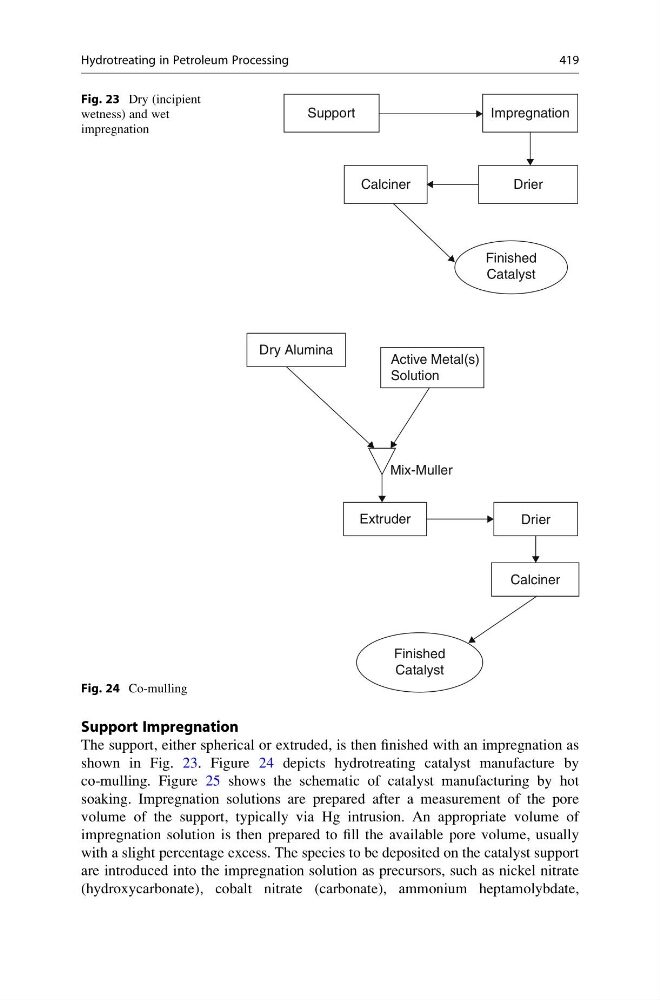
The support, either spherical or extruded, is then finished with an impregnation as
shown in Fig. 23. Figure 24 depicts hydrotreating catalyst manufacture by
co-mulling. Figure 25 shows the schematic of catalyst manufacturing by hot
soaking. Impregnation solutions are prepared after a measurement of the pore
volume of the support, typically via Hg intrusion. An appropriate volume of
impregnation solution is then prepared to fill the available pore volume, usually
with a slight percentage excess. The species to be deposited on the catalyst support
are introduced into the impregnation solution as precursors, such as nickel nitrate
(hydroxycarbonate), cobalt nitrate (carbonate), ammonium heptamolybdate,
Support
Calciner
Drier
Impregnation
Finished
Catalyst
Fig. 23 Dry (incipient
wetness) and wet
impregnation
Calciner
Drier
Finished
Catalyst
Dry Alumina
Active Metal(s)
Solution
Mix-Muller
Extruder
Fig. 24 Co-mulling
Hydrotreating in Petroleum Processing
419
The support, either spherical or extruded, is then finished with an impregnation as
shown in Fig. 23. Figure 24 depicts hydrotreating catalyst manufacture by
co-mulling. Figure 25 shows the schematic of catalyst manufacturing by hot
soaking. Impregnation solutions are prepared after a measurement of the pore
volume of the support, typically via Hg intrusion. An appropriate volume of
impregnation solution is then prepared to fill the available pore volume, usually
with a slight percentage excess. The species to be deposited on the catalyst support
are introduced into the impregnation solution as precursors, such as nickel nitrate
(hydroxycarbonate), cobalt nitrate (carbonate), ammonium heptamolybdate,
Support
Calciner
Drier
Impregnation
Finished
Catalyst
Fig. 23 Dry (incipient
wetness) and wet
impregnation
Calciner
Drier
Finished
Catalyst
Dry Alumina
Active Metal(s)
Solution
Mix-Muller
Extruder
Fig. 24 Co-mulling
Hydrotreating in Petroleum Processing
419