

molybdenum trioxide, and ammonium metatungstate. The volumes of support and
impregnation solution are then mixed, excess water is removed by drying if
necessary, and the catalyst is heat-treated to convert the metal precursors to metal
oxides. In the case of Type II hydrotreating catalysts, it is typical to include at least
one additive to the impregnation solution. EDTA and NTA are common examples
of chelating agent additives. It is also typical that the heat treatment is not carried
out at temperatures which would completely remove the additive. The purpose of
the additive or additives is to facilitate formation of the Type II active phase when
the catalyst’s metal oxides are converted to metal sulfides during activation/
sulfidation. This may occur via multiple pathways: stabilize the impregnation
solution especially in the case of high metal loadings, improve the dispersion of
the active phase during the course of impregnation (buffering effect), bind with
those support species which would otherwise bond with the active phase, act as an
inert support upon which the active phase may deposit, and adjust the sulfidation
rate of one or more of the metal oxides (an effect of chelation) during the activation
to facilitate greater coordination of the promoter to active phase nanosheet edges
(Frizi et al. 2008; Breysse et al. 2008).
Catalyst Loading and Activation
Catalyst Loading
There are two methods of catalyst loading: sock loading and dense loading. Pouring
catalyst into a hopper mounted on top of the reactor and then allowing it to flow
through a canvas sock into the reactor is sock loading. Dense loading or dense bed
packing is done with the aid of a mechanical device. Dense loading techniques were
first introduced in the mid-1970s. Catalysts loaded by sock loading will have a
higher void fraction than catalysts that were dense loaded, typically 10–15 % lower
loaded density. Dense bed loading/packing and the resulting higher pressure drop
Calciner
Drier
Finished
Catalyst
Alumina
Metals–orActive Metal(s)
Solution
Mixer (at Elevated
Temperatures)
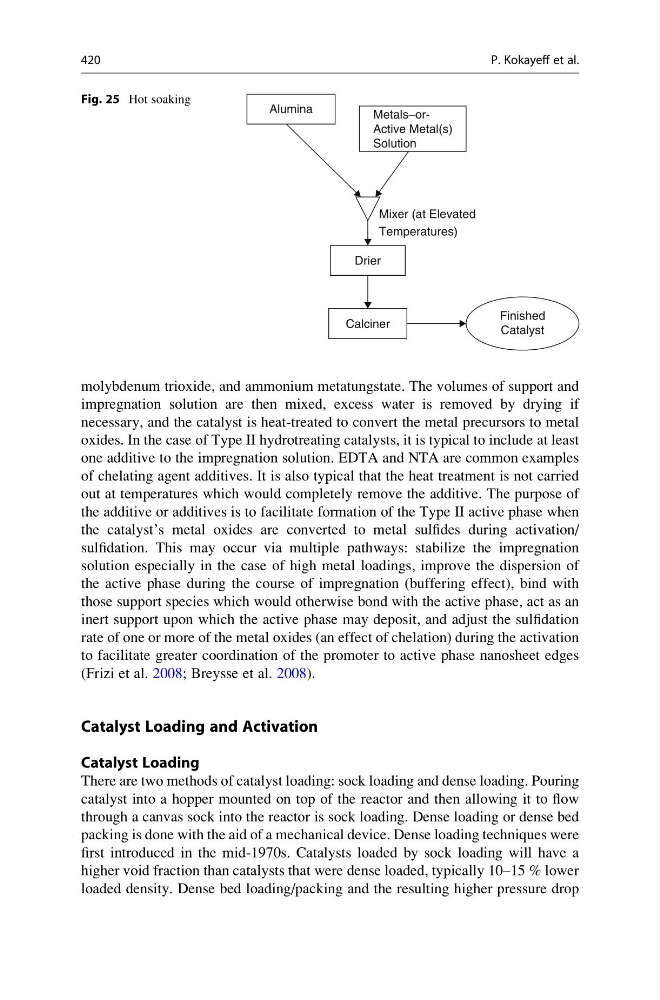
Fig. 25 Hot soaking
420
P. Kokayeff et al.
impregnation solution are then mixed, excess water is removed by drying if
necessary, and the catalyst is heat-treated to convert the metal precursors to metal
oxides. In the case of Type II hydrotreating catalysts, it is typical to include at least
one additive to the impregnation solution. EDTA and NTA are common examples
of chelating agent additives. It is also typical that the heat treatment is not carried
out at temperatures which would completely remove the additive. The purpose of
the additive or additives is to facilitate formation of the Type II active phase when
the catalyst’s metal oxides are converted to metal sulfides during activation/
sulfidation. This may occur via multiple pathways: stabilize the impregnation
solution especially in the case of high metal loadings, improve the dispersion of
the active phase during the course of impregnation (buffering effect), bind with
those support species which would otherwise bond with the active phase, act as an
inert support upon which the active phase may deposit, and adjust the sulfidation
rate of one or more of the metal oxides (an effect of chelation) during the activation
to facilitate greater coordination of the promoter to active phase nanosheet edges
(Frizi et al. 2008; Breysse et al. 2008).
Catalyst Loading and Activation
Catalyst Loading
There are two methods of catalyst loading: sock loading and dense loading. Pouring
catalyst into a hopper mounted on top of the reactor and then allowing it to flow
through a canvas sock into the reactor is sock loading. Dense loading or dense bed
packing is done with the aid of a mechanical device. Dense loading techniques were
first introduced in the mid-1970s. Catalysts loaded by sock loading will have a
higher void fraction than catalysts that were dense loaded, typically 10–15 % lower
loaded density. Dense bed loading/packing and the resulting higher pressure drop
Calciner
Drier
Finished
Catalyst
Alumina
Metals–orActive Metal(s)
Solution
Mixer (at Elevated
Temperatures)
Fig. 25 Hot soaking
420
P. Kokayeff et al.