

a way so as to offer a high surface area upon which to disperse the active metals and
an appropriate pore structure, so that pore plugging with coke and/or metals is
sufficiently mitigated to achieve the desired operating cycle. The active component
is normally molybdenum sulfide, although tungsten-containing catalysts are also
used (though seldom, and that generally for special applications such as lube oil
processing). Regarding molybdenum catalysts, both cobalt (CoMo) and nickel
(NiMo) are used as promoters. The promoter has the effect of substantially increasing (approximately 100-fold) the activity of the active metal sulfide. The acidity of
the support (which itself may be increased with dopants, beyond the nascent
acidity) can be increased to boost the catalyst activity for hydrocracking and
isomerization reactions. The commercially available catalysts have varying amounts
of promoters and active components, depending on the desired applications, but in
general they can contain up to about 25 wt% promoter and up to 25 wt%
active component as oxides. Hydrotreating catalysts come in different sizes and
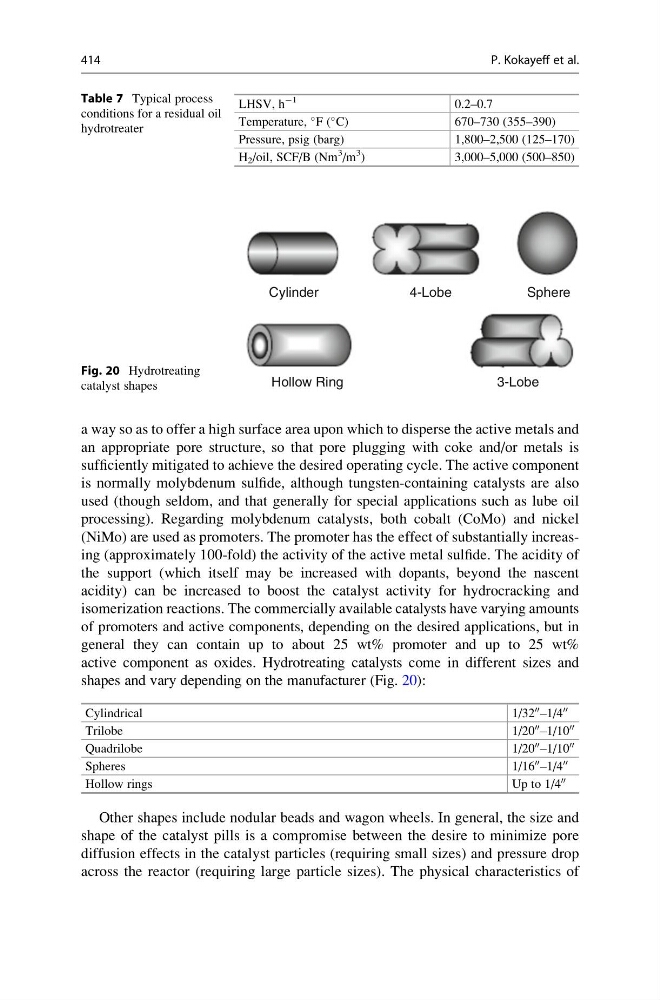
shapes and vary depending on the manufacturer (Fig. 20):
Cylindrical
1/32
00 –1/4
00
Trilobe
1/20
00 –1/10
00
Quadrilobe
1/20
00 –1/10
00
Spheres
1/16
00 –1/4
00
Hollow rings
Up to 1/4
00
Other shapes include nodular beads and wagon wheels. In general, the size and
shape of the catalyst pills is a compromise between the desire to minimize pore
diffusion effects in the catalyst particles (requiring small sizes) and pressure drop
across the reactor (requiring large particle sizes). The physical characteristics of
Table 7 Typical process
conditions for a residual oil
hydrotreater
LHSV, h
À1
0.2–0.7
Temperature,
F (
C)
670–730 (355–390)
Pressure, psig (barg)
1,800–2,500 (125–170)
H 2 /oil, SCF/B (Nm
3
/m
3
)
3,000–5,000 (500–850)
Cylinder
Hollow Ring
4-Lobe
3-Lobe
Sphere
Fig. 20 Hydrotreating
catalyst shapes
414
P. Kokayeff et al.
an appropriate pore structure, so that pore plugging with coke and/or metals is
sufficiently mitigated to achieve the desired operating cycle. The active component
is normally molybdenum sulfide, although tungsten-containing catalysts are also
used (though seldom, and that generally for special applications such as lube oil
processing). Regarding molybdenum catalysts, both cobalt (CoMo) and nickel
(NiMo) are used as promoters. The promoter has the effect of substantially increasing (approximately 100-fold) the activity of the active metal sulfide. The acidity of
the support (which itself may be increased with dopants, beyond the nascent
acidity) can be increased to boost the catalyst activity for hydrocracking and
isomerization reactions. The commercially available catalysts have varying amounts
of promoters and active components, depending on the desired applications, but in
general they can contain up to about 25 wt% promoter and up to 25 wt%
active component as oxides. Hydrotreating catalysts come in different sizes and
shapes and vary depending on the manufacturer (Fig. 20):
Cylindrical
1/32
00 –1/4
00
Trilobe
1/20
00 –1/10
00
Quadrilobe
1/20
00 –1/10
00
Spheres
1/16
00 –1/4
00
Hollow rings
Up to 1/4
00
Other shapes include nodular beads and wagon wheels. In general, the size and
shape of the catalyst pills is a compromise between the desire to minimize pore
diffusion effects in the catalyst particles (requiring small sizes) and pressure drop
across the reactor (requiring large particle sizes). The physical characteristics of
Table 7 Typical process
conditions for a residual oil
hydrotreater
LHSV, h
À1
0.2–0.7
Temperature,
F (
C)
670–730 (355–390)
Pressure, psig (barg)
1,800–2,500 (125–170)
H 2 /oil, SCF/B (Nm
3
/m
3
)
3,000–5,000 (500–850)
Cylinder
Hollow Ring
4-Lobe
3-Lobe
Sphere
Fig. 20 Hydrotreating
catalyst shapes
414
P. Kokayeff et al.