

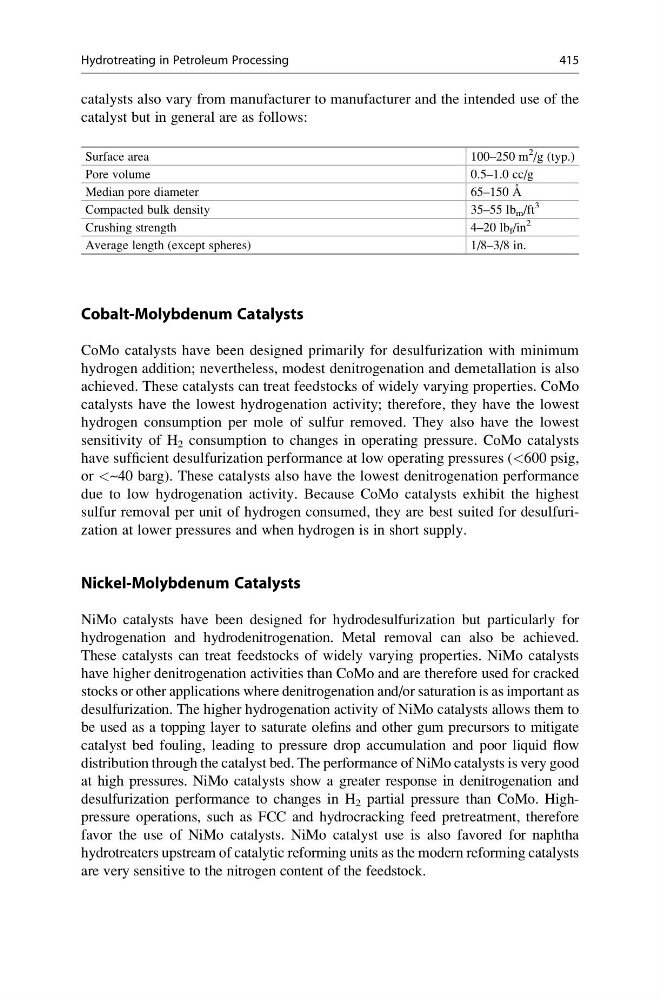
catalysts also vary from manufacturer to manufacturer and the intended use of the
catalyst but in general are as follows:
Surface area
100–250 m
2
/g (typ.)
Pore volume
0.5–1.0 cc/g
Median pore diameter
65–150 A ˚
Compacted bulk density
35–55 lb m /ft
3
Crushing strength
4–20 lb f /in
2
Average length (except spheres)
1/8–3/8 in.
Cobalt-Molybdenum Catalysts
CoMo catalysts have been designed primarily for desulfurization with minimum
hydrogen addition; nevertheless, modest denitrogenation and demetallation is also
achieved. These catalysts can treat feedstocks of widely varying properties. CoMo
catalysts have the lowest hydrogenation activity; therefore, they have the lowest
hydrogen consumption per mole of sulfur removed. They also have the lowest
sensitivity of H 2 consumption to changes in operating pressure. CoMo catalysts
have sufficient desulfurization performance at low operating pressures (<600 psig,
or <~40 barg). These catalysts also have the lowest denitrogenation performance
due to low hydrogenation activity. Because CoMo catalysts exhibit the highest
sulfur removal per unit of hydrogen consumed, they are best suited for desulfurization at lower pressures and when hydrogen is in short supply.
Nickel-Molybdenum Catalysts
NiMo catalysts have been designed for hydrodesulfurization but particularly for
hydrogenation and hydrodenitrogenation. Metal removal can also be achieved.
These catalysts can treat feedstocks of widely varying properties. NiMo catalysts
have higher denitrogenation activities than CoMo and are therefore used for cracked
stocks or other applications where denitrogenation and/or saturation is as important as
desulfurization. The higher hydrogenation activity of NiMo catalysts allows them to
be used as a topping layer to saturate olefins and other gum precursors to mitigate
catalyst bed fouling, leading to pressure drop accumulation and poor liquid flow
distribution through the catalyst bed. The performance of NiMo catalysts is very good
at high pressures. NiMo catalysts show a greater response in denitrogenation and
desulfurization performance to changes in H 2 partial pressure than CoMo. Highpressure operations, such as FCC and hydrocracking feed pretreatment, therefore
favor the use of NiMo catalysts. NiMo catalyst use is also favored for naphtha
hydrotreaters upstream of catalytic reforming units as the modern reforming catalysts
are very sensitive to the nitrogen content of the feedstock.
Hydrotreating in Petroleum Processing
415
catalyst but in general are as follows:
Surface area
100–250 m
2
/g (typ.)
Pore volume
0.5–1.0 cc/g
Median pore diameter
65–150 A ˚
Compacted bulk density
35–55 lb m /ft
3
Crushing strength
4–20 lb f /in
2
Average length (except spheres)
1/8–3/8 in.
Cobalt-Molybdenum Catalysts
CoMo catalysts have been designed primarily for desulfurization with minimum
hydrogen addition; nevertheless, modest denitrogenation and demetallation is also
achieved. These catalysts can treat feedstocks of widely varying properties. CoMo
catalysts have the lowest hydrogenation activity; therefore, they have the lowest
hydrogen consumption per mole of sulfur removed. They also have the lowest
sensitivity of H 2 consumption to changes in operating pressure. CoMo catalysts
have sufficient desulfurization performance at low operating pressures (<600 psig,
or <~40 barg). These catalysts also have the lowest denitrogenation performance
due to low hydrogenation activity. Because CoMo catalysts exhibit the highest
sulfur removal per unit of hydrogen consumed, they are best suited for desulfurization at lower pressures and when hydrogen is in short supply.
Nickel-Molybdenum Catalysts
NiMo catalysts have been designed for hydrodesulfurization but particularly for
hydrogenation and hydrodenitrogenation. Metal removal can also be achieved.
These catalysts can treat feedstocks of widely varying properties. NiMo catalysts
have higher denitrogenation activities than CoMo and are therefore used for cracked
stocks or other applications where denitrogenation and/or saturation is as important as
desulfurization. The higher hydrogenation activity of NiMo catalysts allows them to
be used as a topping layer to saturate olefins and other gum precursors to mitigate
catalyst bed fouling, leading to pressure drop accumulation and poor liquid flow
distribution through the catalyst bed. The performance of NiMo catalysts is very good
at high pressures. NiMo catalysts show a greater response in denitrogenation and
desulfurization performance to changes in H 2 partial pressure than CoMo. Highpressure operations, such as FCC and hydrocracking feed pretreatment, therefore
favor the use of NiMo catalysts. NiMo catalyst use is also favored for naphtha
hydrotreaters upstream of catalytic reforming units as the modern reforming catalysts
are very sensitive to the nitrogen content of the feedstock.
Hydrotreating in Petroleum Processing
415