

Process Configuration
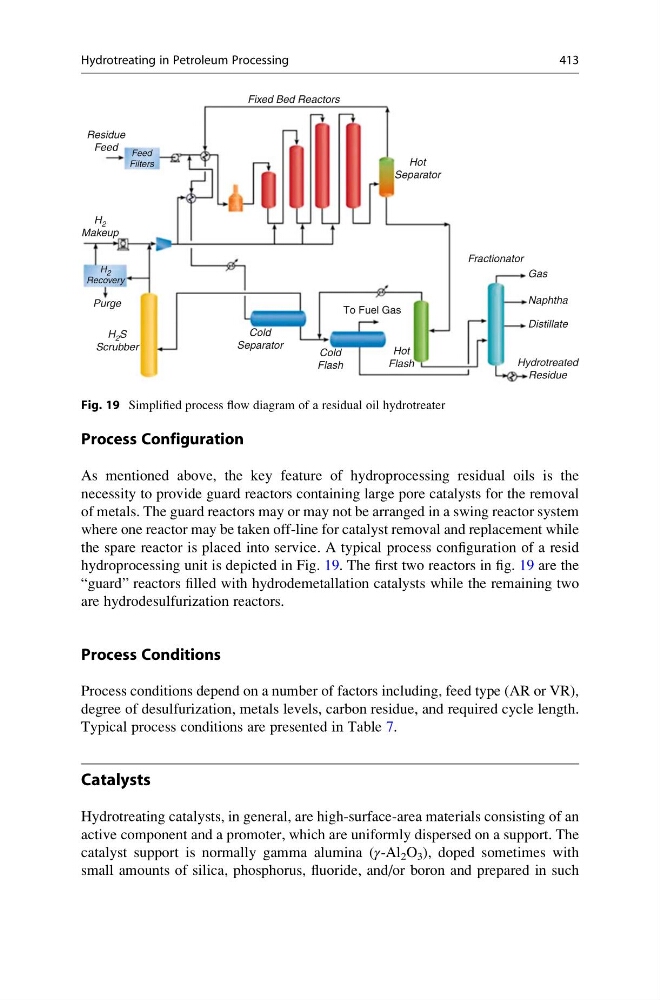
As mentioned above, the key feature of hydroprocessing residual oils is the
necessity to provide guard reactors containing large pore catalysts for the removal
of metals. The guard reactors may or may not be arranged in a swing reactor system
where one reactor may be taken off-line for catalyst removal and replacement while
the spare reactor is placed into service. A typical process configuration of a resid
hydroprocessing unit is depicted in Fig. 19. The first two reactors in fig. 19 are the
“guard” reactors filled with hydrodemetallation catalysts while the remaining two
are hydrodesulfurization reactors.
Process Conditions
Process conditions depend on a number of factors including, feed type (AR or VR),
degree of desulfurization, metals levels, carbon residue, and required cycle length.
Typical process conditions are presented in Table 7.
Catalysts
Hydrotreating catalysts, in general, are high-surface-area materials consisting of an
active component and a promoter, which are uniformly dispersed on a support. The
catalyst support is normally gamma alumina (γ-Al 2 O 3 ), doped sometimes with
small amounts of silica, phosphorus, fluoride, and/or boron and prepared in such
Fixed Bed Reactors
Residue
Feed
H 2
Makeup
H 2
Recovery
Purge
H 2 S
Scrubber
Cold
Separator
Cold
Flash
To Fuel Gas
Hot
Flash
Hydrotreated
Residue
Distillate
Naphtha
Gas
Fractionator
Hot
Separator
Feed
Filters
Fig. 19 Simplified process flow diagram of a residual oil hydrotreater
Hydrotreating in Petroleum Processing
413
As mentioned above, the key feature of hydroprocessing residual oils is the
necessity to provide guard reactors containing large pore catalysts for the removal
of metals. The guard reactors may or may not be arranged in a swing reactor system
where one reactor may be taken off-line for catalyst removal and replacement while
the spare reactor is placed into service. A typical process configuration of a resid
hydroprocessing unit is depicted in Fig. 19. The first two reactors in fig. 19 are the
“guard” reactors filled with hydrodemetallation catalysts while the remaining two
are hydrodesulfurization reactors.
Process Conditions
Process conditions depend on a number of factors including, feed type (AR or VR),
degree of desulfurization, metals levels, carbon residue, and required cycle length.
Typical process conditions are presented in Table 7.
Catalysts
Hydrotreating catalysts, in general, are high-surface-area materials consisting of an
active component and a promoter, which are uniformly dispersed on a support. The
catalyst support is normally gamma alumina (γ-Al 2 O 3 ), doped sometimes with
small amounts of silica, phosphorus, fluoride, and/or boron and prepared in such
Fixed Bed Reactors
Residue
Feed
H 2
Makeup
H 2
Recovery
Purge
H 2 S
Scrubber
Cold
Separator
Cold
Flash
To Fuel Gas
Hot
Flash
Hydrotreated
Residue
Distillate
Naphtha
Gas
Fractionator
Hot
Separator
Feed
Filters
Fig. 19 Simplified process flow diagram of a residual oil hydrotreater
Hydrotreating in Petroleum Processing
413