

One of the defining characteristics of the residual oils is the presence of metals,
primarily Ni and V, although smaller amounts of other metals may also be present.
Ni and V are typically present in concentrations ranging from ~25 to ~1,000 wppm.
Sulfur concentrations are also quite high, sometimes exceeding 3 wt%. A further
defining feature of the residual oils is their high Conradson carbon residue (CCR),
frequently exceeding 20 %. Additionally, the presence of condensed-ring aromatics
and asphaltenes necessitates the application of high pressures and specialized
catalysts to achieve reasonable cycles, typically 12–18 months.
Catalysts and Reactions
The main feature that differentiates residual oil hydrotreaters from hydrotreaters in
other applications, e.g., distillate and FCC feed pretreaters, is the presence of high
concentrations of metals and the necessity of removing these prior to the main
hydrotreating reactors. This is accomplished by the use of specialized catalysts
having larger pore diameters to accommodate the metals containing molecules
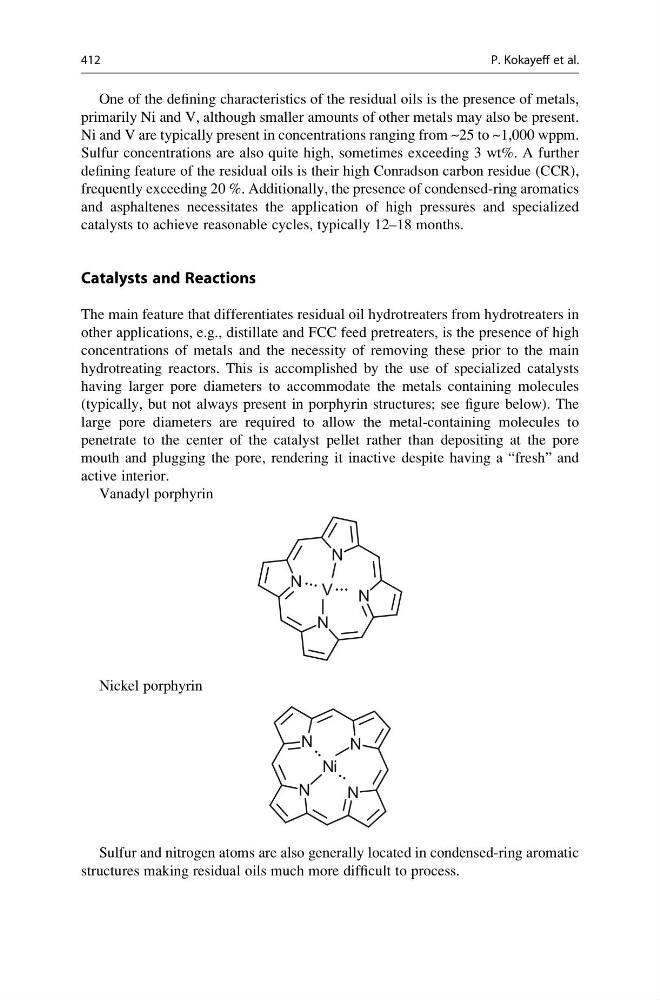
(typically, but not always present in porphyrin structures; see figure below). The
large pore diameters are required to allow the metal-containing molecules to
penetrate to the center of the catalyst pellet rather than depositing at the pore
mouth and plugging the pore, rendering it inactive despite having a “fresh” and
active interior.
Vanadyl porphyrin
Nickel porphyrin
Sulfur and nitrogen atoms are also generally located in condensed-ring aromatic
structures making residual oils much more difficult to process.
412
P. Kokayeff et al.
primarily Ni and V, although smaller amounts of other metals may also be present.
Ni and V are typically present in concentrations ranging from ~25 to ~1,000 wppm.
Sulfur concentrations are also quite high, sometimes exceeding 3 wt%. A further
defining feature of the residual oils is their high Conradson carbon residue (CCR),
frequently exceeding 20 %. Additionally, the presence of condensed-ring aromatics
and asphaltenes necessitates the application of high pressures and specialized
catalysts to achieve reasonable cycles, typically 12–18 months.
Catalysts and Reactions
The main feature that differentiates residual oil hydrotreaters from hydrotreaters in
other applications, e.g., distillate and FCC feed pretreaters, is the presence of high
concentrations of metals and the necessity of removing these prior to the main
hydrotreating reactors. This is accomplished by the use of specialized catalysts
having larger pore diameters to accommodate the metals containing molecules
(typically, but not always present in porphyrin structures; see figure below). The
large pore diameters are required to allow the metal-containing molecules to
penetrate to the center of the catalyst pellet rather than depositing at the pore
mouth and plugging the pore, rendering it inactive despite having a “fresh” and
active interior.
Vanadyl porphyrin
Nickel porphyrin
Sulfur and nitrogen atoms are also generally located in condensed-ring aromatic
structures making residual oils much more difficult to process.
412
P. Kokayeff et al.