

Recombination
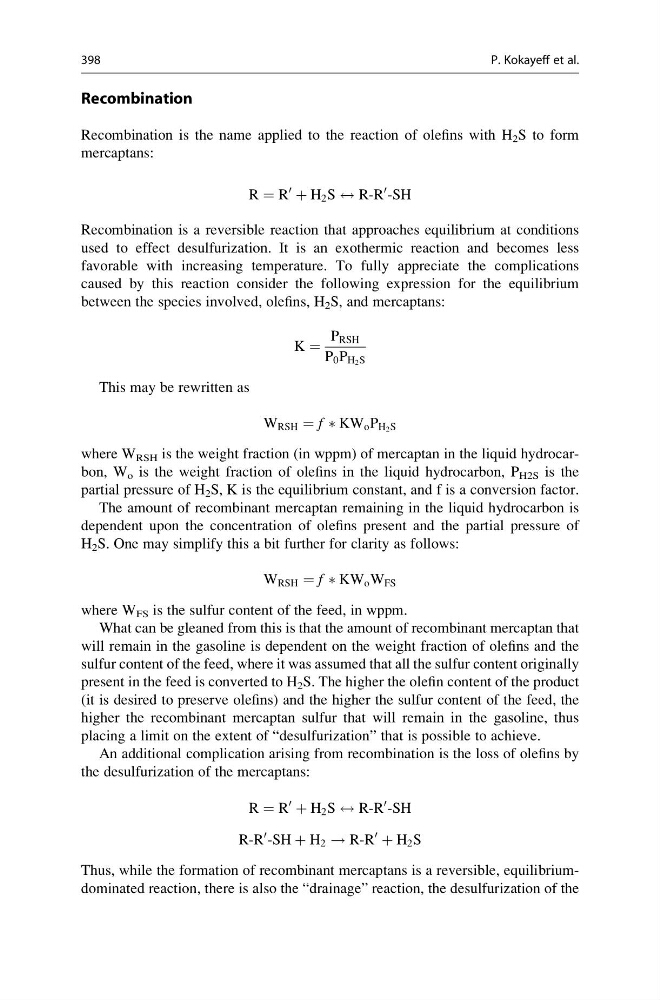
Recombination is the name applied to the reaction of olefins with H 2 S to form
mercaptans:
R ¼ R
0
þ H 2 S $ R-R
0 -SH
Recombination is a reversible reaction that approaches equilibrium at conditions
used to effect desulfurization. It is an exothermic reaction and becomes less
favorable with increasing temperature. To fully appreciate the complications
caused by this reaction consider the following expression for the equilibrium
between the species involved, olefins, H 2 S, and mercaptans:
K ¼
P RSH
P 0 P H 2 S
This may be rewritten as
W RSH ¼ f à KW o P H 2 S
where W RSH is the weight fraction (in wppm) of mercaptan in the liquid hydrocarbon, W o is the weight fraction of olefins in the liquid hydrocarbon, P H2S is the
partial pressure of H 2 S, K is the equilibrium constant, and f is a conversion factor.
The amount of recombinant mercaptan remaining in the liquid hydrocarbon is
dependent upon the concentration of olefins present and the partial pressure of
H 2 S. One may simplify this a bit further for clarity as follows:
W RSH ¼ f à KW o W FS
where W FS is the sulfur content of the feed, in wppm.
What can be gleaned from this is that the amount of recombinant mercaptan that
will remain in the gasoline is dependent on the weight fraction of olefins and the
sulfur content of the feed, where it was assumed that all the sulfur content originally
present in the feed is converted to H 2 S. The higher the olefin content of the product
(it is desired to preserve olefins) and the higher the sulfur content of the feed, the
higher the recombinant mercaptan sulfur that will remain in the gasoline, thus
placing a limit on the extent of “desulfurization” that is possible to achieve.
An additional complication arising from recombination is the loss of olefins by
the desulfurization of the mercaptans:
R ¼ R
0
þ H 2 S $ R-R
0 -SH
R-R
0 -SH þ H 2 ! R-R
0
þ H 2 S
Thus, while the formation of recombinant mercaptans is a reversible, equilibriumdominated reaction, there is also the “drainage” reaction, the desulfurization of the
398
P. Kokayeff et al.
Recombination is the name applied to the reaction of olefins with H 2 S to form
mercaptans:
R ¼ R
0
þ H 2 S $ R-R
0 -SH
Recombination is a reversible reaction that approaches equilibrium at conditions
used to effect desulfurization. It is an exothermic reaction and becomes less
favorable with increasing temperature. To fully appreciate the complications
caused by this reaction consider the following expression for the equilibrium
between the species involved, olefins, H 2 S, and mercaptans:
K ¼
P RSH
P 0 P H 2 S
This may be rewritten as
W RSH ¼ f à KW o P H 2 S
where W RSH is the weight fraction (in wppm) of mercaptan in the liquid hydrocarbon, W o is the weight fraction of olefins in the liquid hydrocarbon, P H2S is the
partial pressure of H 2 S, K is the equilibrium constant, and f is a conversion factor.
The amount of recombinant mercaptan remaining in the liquid hydrocarbon is
dependent upon the concentration of olefins present and the partial pressure of
H 2 S. One may simplify this a bit further for clarity as follows:
W RSH ¼ f à KW o W FS
where W FS is the sulfur content of the feed, in wppm.
What can be gleaned from this is that the amount of recombinant mercaptan that
will remain in the gasoline is dependent on the weight fraction of olefins and the
sulfur content of the feed, where it was assumed that all the sulfur content originally
present in the feed is converted to H 2 S. The higher the olefin content of the product
(it is desired to preserve olefins) and the higher the sulfur content of the feed, the
higher the recombinant mercaptan sulfur that will remain in the gasoline, thus
placing a limit on the extent of “desulfurization” that is possible to achieve.
An additional complication arising from recombination is the loss of olefins by
the desulfurization of the mercaptans:
R ¼ R
0
þ H 2 S $ R-R
0 -SH
R-R
0 -SH þ H 2 ! R-R
0
þ H 2 S
Thus, while the formation of recombinant mercaptans is a reversible, equilibriumdominated reaction, there is also the “drainage” reaction, the desulfurization of the
398
P. Kokayeff et al.