

mercaptan, which, in combination, provides an alternate path for olefin loss in
addition to the conventional olefin saturation reaction. Complications presented by
the recombination reaction in FCC gasoline desulfurization are covered by Leonard
and Kokayeff (Leonard et al. 2006).
Process Considerations
The three main process licensors of hydrotreating technology for processing FCC
gasoline are ExxonMobil (SCANfining™ Process), IFPEN/Axens (Prime-G+™
process), and Honeywell UOP (SelectFining™ Process). While all three process
licensors offer a number of different flow schemes based on feed characteristics,
e.g., sulfur level, and product targets, these technologies have much in common.
Saturation of Diolefins
Besides olefins, FCC gasoline contains diolefins which may cause fouling of heat
exchanger surfaces as well as pressure drop in the hydrotreating reactor and catalyst
deactivation by deposition of coke. The removal of diolefins is accomplished in a
similar manner as is done for coker naphtha hydrotreaters, i.e., by processing the
feed at mild conditions over a hydrotreating catalyst. This simple procedure effects
the saturation of diolefins to monoolefins. In the Axens Prime-G+™ process, this
step contains a catalyst that is also active for the reaction of mercaptans with olefins
to form thioethers:
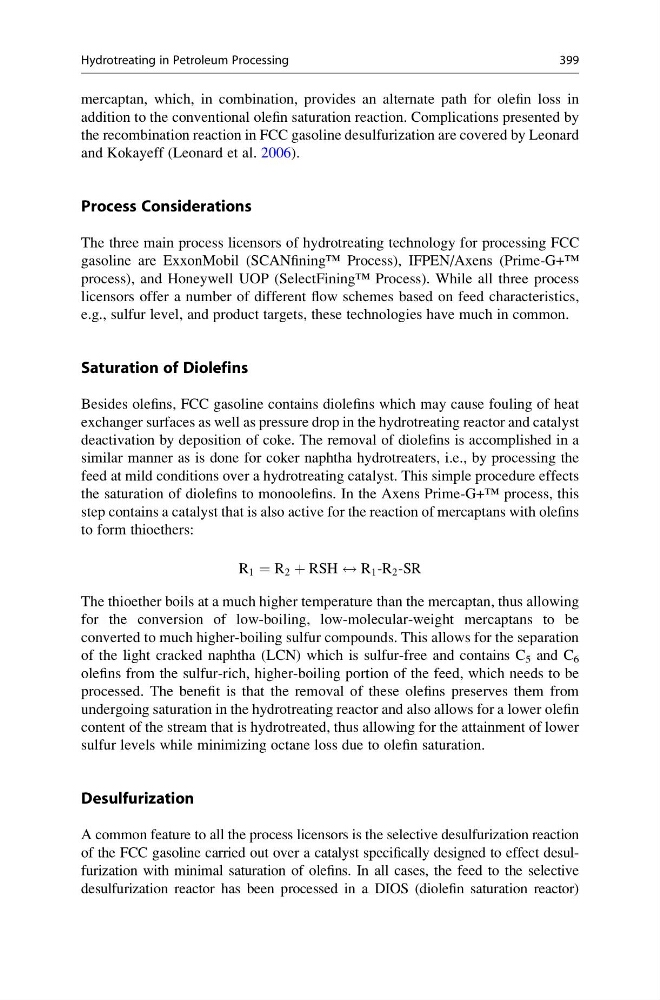
R 1 ¼ R 2 þ RSH $ R 1 -R 2 -SR
The thioether boils at a much higher temperature than the mercaptan, thus allowing
for the conversion of low-boiling, low-molecular-weight mercaptans to be
converted to much higher-boiling sulfur compounds. This allows for the separation
of the light cracked naphtha (LCN) which is sulfur-free and contains C 5 and C 6
olefins from the sulfur-rich, higher-boiling portion of the feed, which needs to be
processed. The benefit is that the removal of these olefins preserves them from
undergoing saturation in the hydrotreating reactor and also allows for a lower olefin
content of the stream that is hydrotreated, thus allowing for the attainment of lower
sulfur levels while minimizing octane loss due to olefin saturation.
Desulfurization
A common feature to all the process licensors is the selective desulfurization reaction
of the FCC gasoline carried out over a catalyst specifically designed to effect desulfurization with minimal saturation of olefins. In all cases, the feed to the selective
desulfurization reactor has been processed in a DIOS (diolefin saturation reactor)
Hydrotreating in Petroleum Processing
399
addition to the conventional olefin saturation reaction. Complications presented by
the recombination reaction in FCC gasoline desulfurization are covered by Leonard
and Kokayeff (Leonard et al. 2006).
Process Considerations
The three main process licensors of hydrotreating technology for processing FCC
gasoline are ExxonMobil (SCANfining™ Process), IFPEN/Axens (Prime-G+™
process), and Honeywell UOP (SelectFining™ Process). While all three process
licensors offer a number of different flow schemes based on feed characteristics,
e.g., sulfur level, and product targets, these technologies have much in common.
Saturation of Diolefins
Besides olefins, FCC gasoline contains diolefins which may cause fouling of heat
exchanger surfaces as well as pressure drop in the hydrotreating reactor and catalyst
deactivation by deposition of coke. The removal of diolefins is accomplished in a
similar manner as is done for coker naphtha hydrotreaters, i.e., by processing the
feed at mild conditions over a hydrotreating catalyst. This simple procedure effects
the saturation of diolefins to monoolefins. In the Axens Prime-G+™ process, this
step contains a catalyst that is also active for the reaction of mercaptans with olefins
to form thioethers:
R 1 ¼ R 2 þ RSH $ R 1 -R 2 -SR
The thioether boils at a much higher temperature than the mercaptan, thus allowing
for the conversion of low-boiling, low-molecular-weight mercaptans to be
converted to much higher-boiling sulfur compounds. This allows for the separation
of the light cracked naphtha (LCN) which is sulfur-free and contains C 5 and C 6
olefins from the sulfur-rich, higher-boiling portion of the feed, which needs to be
processed. The benefit is that the removal of these olefins preserves them from
undergoing saturation in the hydrotreating reactor and also allows for a lower olefin
content of the stream that is hydrotreated, thus allowing for the attainment of lower
sulfur levels while minimizing octane loss due to olefin saturation.
Desulfurization
A common feature to all the process licensors is the selective desulfurization reaction
of the FCC gasoline carried out over a catalyst specifically designed to effect desulfurization with minimal saturation of olefins. In all cases, the feed to the selective
desulfurization reactor has been processed in a DIOS (diolefin saturation reactor)
Hydrotreating in Petroleum Processing
399