

higher octane value and therefore it requires selective desulfurization to meet final
gasoline product sulfur specifications.
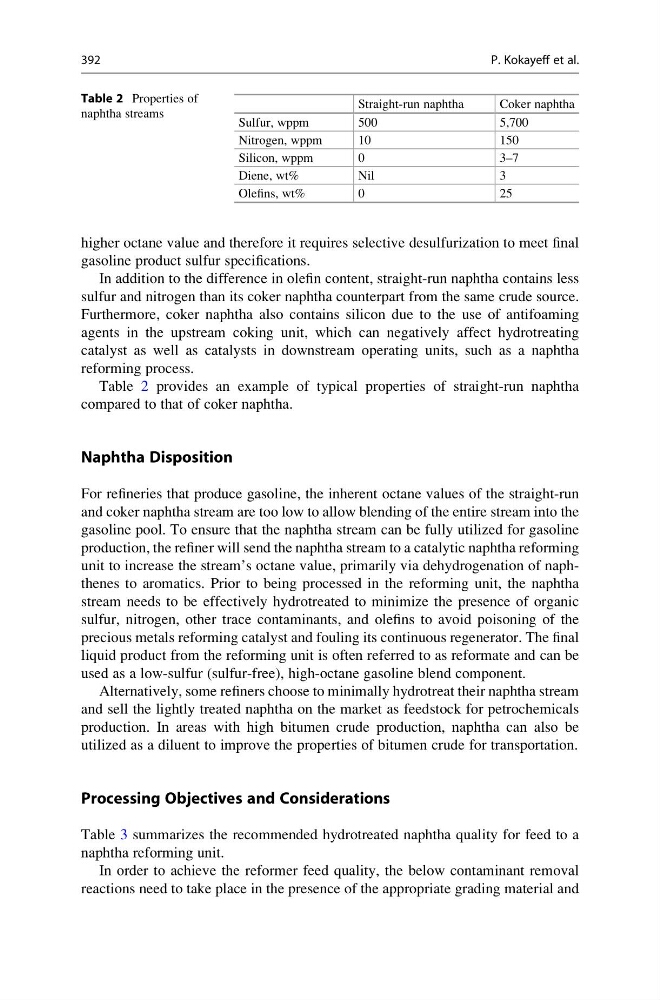
In addition to the difference in olefin content, straight-run naphtha contains less
sulfur and nitrogen than its coker naphtha counterpart from the same crude source.
Furthermore, coker naphtha also contains silicon due to the use of antifoaming
agents in the upstream coking unit, which can negatively affect hydrotreating
catalyst as well as catalysts in downstream operating units, such as a naphtha
reforming process.
Table 2 provides an example of typical properties of straight-run naphtha
compared to that of coker naphtha.
Naphtha Disposition
For refineries that produce gasoline, the inherent octane values of the straight-run
and coker naphtha stream are too low to allow blending of the entire stream into the
gasoline pool. To ensure that the naphtha stream can be fully utilized for gasoline
production, the refiner will send the naphtha stream to a catalytic naphtha reforming
unit to increase the stream’s octane value, primarily via dehydrogenation of naphthenes to aromatics. Prior to being processed in the reforming unit, the naphtha
stream needs to be effectively hydrotreated to minimize the presence of organic
sulfur, nitrogen, other trace contaminants, and olefins to avoid poisoning of the
precious metals reforming catalyst and fouling its continuous regenerator. The final
liquid product from the reforming unit is often referred to as reformate and can be
used as a low-sulfur (sulfur-free), high-octane gasoline blend component.
Alternatively, some refiners choose to minimally hydrotreat their naphtha stream
and sell the lightly treated naphtha on the market as feedstock for petrochemicals
production. In areas with high bitumen crude production, naphtha can also be
utilized as a diluent to improve the properties of bitumen crude for transportation.
Processing Objectives and Considerations
Table 3 summarizes the recommended hydrotreated naphtha quality for feed to a
naphtha reforming unit.
In order to achieve the reformer feed quality, the below contaminant removal
reactions need to take place in the presence of the appropriate grading material and
Table 2 Properties of
naphtha streams
Straight-run naphtha
Coker naphtha
Sulfur, wppm
500
5,700
Nitrogen, wppm
10
150
Silicon, wppm
0
3–7
Diene, wt%
Nil
3
Olefins, wt%
0
25
392
P. Kokayeff et al.
gasoline product sulfur specifications.
In addition to the difference in olefin content, straight-run naphtha contains less
sulfur and nitrogen than its coker naphtha counterpart from the same crude source.
Furthermore, coker naphtha also contains silicon due to the use of antifoaming
agents in the upstream coking unit, which can negatively affect hydrotreating
catalyst as well as catalysts in downstream operating units, such as a naphtha
reforming process.
Table 2 provides an example of typical properties of straight-run naphtha
compared to that of coker naphtha.
Naphtha Disposition
For refineries that produce gasoline, the inherent octane values of the straight-run
and coker naphtha stream are too low to allow blending of the entire stream into the
gasoline pool. To ensure that the naphtha stream can be fully utilized for gasoline
production, the refiner will send the naphtha stream to a catalytic naphtha reforming
unit to increase the stream’s octane value, primarily via dehydrogenation of naphthenes to aromatics. Prior to being processed in the reforming unit, the naphtha
stream needs to be effectively hydrotreated to minimize the presence of organic
sulfur, nitrogen, other trace contaminants, and olefins to avoid poisoning of the
precious metals reforming catalyst and fouling its continuous regenerator. The final
liquid product from the reforming unit is often referred to as reformate and can be
used as a low-sulfur (sulfur-free), high-octane gasoline blend component.
Alternatively, some refiners choose to minimally hydrotreat their naphtha stream
and sell the lightly treated naphtha on the market as feedstock for petrochemicals
production. In areas with high bitumen crude production, naphtha can also be
utilized as a diluent to improve the properties of bitumen crude for transportation.
Processing Objectives and Considerations
Table 3 summarizes the recommended hydrotreated naphtha quality for feed to a
naphtha reforming unit.
In order to achieve the reformer feed quality, the below contaminant removal
reactions need to take place in the presence of the appropriate grading material and
Table 2 Properties of
naphtha streams
Straight-run naphtha
Coker naphtha
Sulfur, wppm
500
5,700
Nitrogen, wppm
10
150
Silicon, wppm
0
3–7
Diene, wt%
Nil
3
Olefins, wt%
0
25
392
P. Kokayeff et al.