

hydrotreating and under the right set of process conditions. In the era of leaded
gasoline, gasoline re-run through the naphtha hydrotreater also required
hydrodemetallation to prevent lead and other metals from poisoning the naphtha
reforming catalyst.
Desulfurization (HDS for hydrodesulfurization) difficulty depends on the type of
sulfur molecule, such as mercaptan, sulfide, thiophenol, thiophene, or
benzothiophene sulfur. Relatively, mercaptan sulfur is the easiest type of sulfur to
remove, whereas benzothiophene is approximately 15 times harder to remove than
mercaptan sulfur. Sulfurs contained in an aromatic structure are removed by
initially opening the ring, removing the sulfur molecule, and saturating the resulting
olefin molecule.
Denitrogenation (HDN for hydrodenitrogenation) is generally more difficult
than desulfurization due to the structure of the nitrogen compound. Nitrogen
contained in an aromatic structure is removed via a different mechanism than sulfur
contained in an aromatic compound. In denitrogenation, the aromatic ring is first
saturated, then the ring is cleaved, and finally the nitrogen molecule is removed.
Since aromatic saturation is required to remove aromatic bound nitrogen, the design
pressure of the hydrotreating unit is more sensitive to the nitrogen content of the
feed rather than the sulfur content of the feed.
Olefin saturation is a relatively rapid reaction that occurs alongside with desulfurization and denitrogenation. There are two main types of olefins to consider
when processing cracked naphtha stock: diolefins or dienes (molecules containing
two double bonds) and monoolefins (molecules containing a single double bond).
Dienes can potentially polymerize and form gums if introduced to hydrotreating
catalyst and hydrogen at the typical temperatures required for hydrodesulfurization
and denitrogenation. Gum formation can either occur in feed heat exchangers or at
the top of the first reactor catalyst bed, leading to fouling and pressure drop issues,
which could ultimately lead to an unplanned unit shutdown and shortened cycle
length.
For combined naphtha streams with a significant amount of diene content, the
stream can first be treated in a separate diolefin saturation reactor to minimize the
risk of gum formation. The diolefin reactor utilizes a relatively low-activity
hydrotreating catalyst and operates within a low enough temperature range to
ensure the diolefin saturation reaction preferentially occurs instead of the polymerization reaction. After the dienes are stabilized, the naphtha stream can then be
heated up and sent to a second reactor loaded with the main hydrotreating catalyst
to complete the removal of sulfur and nitrogen.
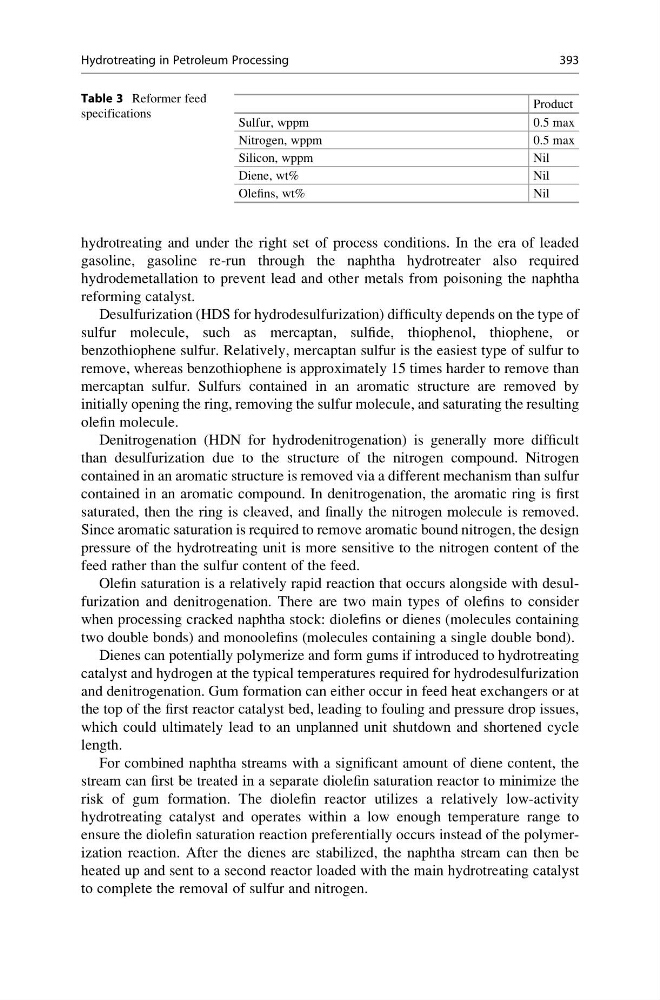
Table 3 Reformer feed
specifications
Product
Sulfur, wppm
0.5 max
Nitrogen, wppm
0.5 max
Silicon, wppm
Nil
Diene, wt%
Nil
Olefins, wt%
Nil
Hydrotreating in Petroleum Processing
393
gasoline, gasoline re-run through the naphtha hydrotreater also required
hydrodemetallation to prevent lead and other metals from poisoning the naphtha
reforming catalyst.
Desulfurization (HDS for hydrodesulfurization) difficulty depends on the type of
sulfur molecule, such as mercaptan, sulfide, thiophenol, thiophene, or
benzothiophene sulfur. Relatively, mercaptan sulfur is the easiest type of sulfur to
remove, whereas benzothiophene is approximately 15 times harder to remove than
mercaptan sulfur. Sulfurs contained in an aromatic structure are removed by
initially opening the ring, removing the sulfur molecule, and saturating the resulting
olefin molecule.
Denitrogenation (HDN for hydrodenitrogenation) is generally more difficult
than desulfurization due to the structure of the nitrogen compound. Nitrogen
contained in an aromatic structure is removed via a different mechanism than sulfur
contained in an aromatic compound. In denitrogenation, the aromatic ring is first
saturated, then the ring is cleaved, and finally the nitrogen molecule is removed.
Since aromatic saturation is required to remove aromatic bound nitrogen, the design
pressure of the hydrotreating unit is more sensitive to the nitrogen content of the
feed rather than the sulfur content of the feed.
Olefin saturation is a relatively rapid reaction that occurs alongside with desulfurization and denitrogenation. There are two main types of olefins to consider
when processing cracked naphtha stock: diolefins or dienes (molecules containing
two double bonds) and monoolefins (molecules containing a single double bond).
Dienes can potentially polymerize and form gums if introduced to hydrotreating
catalyst and hydrogen at the typical temperatures required for hydrodesulfurization
and denitrogenation. Gum formation can either occur in feed heat exchangers or at
the top of the first reactor catalyst bed, leading to fouling and pressure drop issues,
which could ultimately lead to an unplanned unit shutdown and shortened cycle
length.
For combined naphtha streams with a significant amount of diene content, the
stream can first be treated in a separate diolefin saturation reactor to minimize the
risk of gum formation. The diolefin reactor utilizes a relatively low-activity
hydrotreating catalyst and operates within a low enough temperature range to
ensure the diolefin saturation reaction preferentially occurs instead of the polymerization reaction. After the dienes are stabilized, the naphtha stream can then be
heated up and sent to a second reactor loaded with the main hydrotreating catalyst
to complete the removal of sulfur and nitrogen.
Table 3 Reformer feed
specifications
Product
Sulfur, wppm
0.5 max
Nitrogen, wppm
0.5 max
Silicon, wppm
Nil
Diene, wt%
Nil
Olefins, wt%
Nil
Hydrotreating in Petroleum Processing
393