

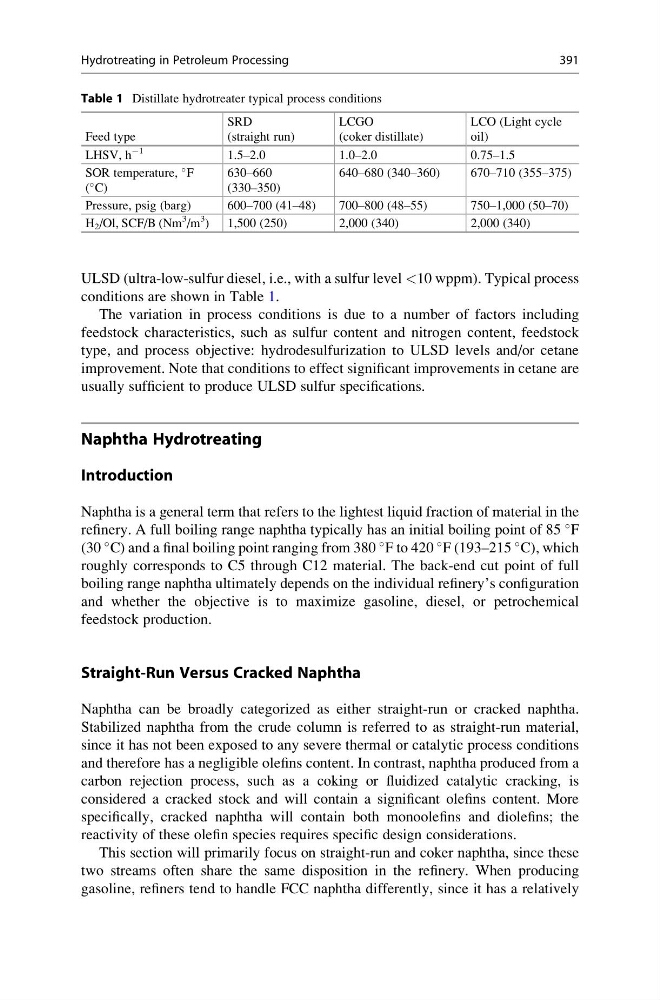
ULSD (ultra-low-sulfur diesel, i.e., with a sulfur level <10 wppm). Typical process
conditions are shown in Table 1.
The variation in process conditions is due to a number of factors including
feedstock characteristics, such as sulfur content and nitrogen content, feedstock
type, and process objective: hydrodesulfurization to ULSD levels and/or cetane
improvement. Note that conditions to effect significant improvements in cetane are
usually sufficient to produce ULSD sulfur specifications.
Naphtha Hydrotreating
Introduction
Naphtha is a general term that refers to the lightest liquid fraction of material in the
refinery. A full boiling range naphtha typically has an initial boiling point of 85
F
(30
C) and a final boiling point ranging from 380
F to 420
F (193–215
C), which
roughly corresponds to C5 through C12 material. The back-end cut point of full
boiling range naphtha ultimately depends on the individual refinery’s configuration
and whether the objective is to maximize gasoline, diesel, or petrochemical
feedstock production.
Straight-Run Versus Cracked Naphtha
Naphtha can be broadly categorized as either straight-run or cracked naphtha.
Stabilized naphtha from the crude column is referred to as straight-run material,
since it has not been exposed to any severe thermal or catalytic process conditions
and therefore has a negligible olefins content. In contrast, naphtha produced from a
carbon rejection process, such as a coking or fluidized catalytic cracking, is
considered a cracked stock and will contain a significant olefins content. More
specifically, cracked naphtha will contain both monoolefins and diolefins; the
reactivity of these olefin species requires specific design considerations.
This section will primarily focus on straight-run and coker naphtha, since these
two streams often share the same disposition in the refinery. When producing
gasoline, refiners tend to handle FCC naphtha differently, since it has a relatively
Table 1 Distillate hydrotreater typical process conditions
Feed type
SRD
(straight run)
LCGO
(coker distillate)
LCO (Light cycle
oil)
LHSV, h
À1
1.5–2.0
1.0–2.0
0.75–1.5
SOR temperature,
F
(
C)
630–660
(330–350)
640–680 (340–360)
670–710 (355–375)
Pressure, psig (barg)
600–700 (41–48)
700–800 (48–55)
750–1,000 (50–70)
H 2 /Ol, SCF/B (Nm
3
/m
3
) 1,500 (250)
2,000 (340)
2,000 (340)
Hydrotreating in Petroleum Processing
391
conditions are shown in Table 1.
The variation in process conditions is due to a number of factors including
feedstock characteristics, such as sulfur content and nitrogen content, feedstock
type, and process objective: hydrodesulfurization to ULSD levels and/or cetane
improvement. Note that conditions to effect significant improvements in cetane are
usually sufficient to produce ULSD sulfur specifications.
Naphtha Hydrotreating
Introduction
Naphtha is a general term that refers to the lightest liquid fraction of material in the
refinery. A full boiling range naphtha typically has an initial boiling point of 85
F
(30
C) and a final boiling point ranging from 380
F to 420
F (193–215
C), which
roughly corresponds to C5 through C12 material. The back-end cut point of full
boiling range naphtha ultimately depends on the individual refinery’s configuration
and whether the objective is to maximize gasoline, diesel, or petrochemical
feedstock production.
Straight-Run Versus Cracked Naphtha
Naphtha can be broadly categorized as either straight-run or cracked naphtha.
Stabilized naphtha from the crude column is referred to as straight-run material,
since it has not been exposed to any severe thermal or catalytic process conditions
and therefore has a negligible olefins content. In contrast, naphtha produced from a
carbon rejection process, such as a coking or fluidized catalytic cracking, is
considered a cracked stock and will contain a significant olefins content. More
specifically, cracked naphtha will contain both monoolefins and diolefins; the
reactivity of these olefin species requires specific design considerations.
This section will primarily focus on straight-run and coker naphtha, since these
two streams often share the same disposition in the refinery. When producing
gasoline, refiners tend to handle FCC naphtha differently, since it has a relatively
Table 1 Distillate hydrotreater typical process conditions
Feed type
SRD
(straight run)
LCGO
(coker distillate)
LCO (Light cycle
oil)
LHSV, h
À1
1.5–2.0
1.0–2.0
0.75–1.5
SOR temperature,
F
(
C)
630–660
(330–350)
640–680 (340–360)
670–710 (355–375)
Pressure, psig (barg)
600–700 (41–48)
700–800 (48–55)
750–1,000 (50–70)
H 2 /Ol, SCF/B (Nm
3
/m
3
) 1,500 (250)
2,000 (340)
2,000 (340)
Hydrotreating in Petroleum Processing
391