

Olefin saturation reactions are very rapid and highly exothermic. While the
hydrodenitrogenation reaction shows a heat of reaction of 1 Btu/lb of feed for
each 100 ft
3 of hydrogen consumed and the hydrodesulfurization reaction generates
1 Btu/lb of feed for each 10 ft
3 hydrogen consumed, the olefin saturation generates
1 Btu/lb of feed for each 2 ft
3 of hydrogen consumed. If proper care is not exercised
during operations, it can result in flow obstructions, such as excessive coking that
can lead to pressure drop buildup and/or poor liquid flow distribution through the
catalyst bed(s). Diolefins are readily hydrogenated to olefins at low temperatures,
e.g., <375
F.
Aromatic Saturation
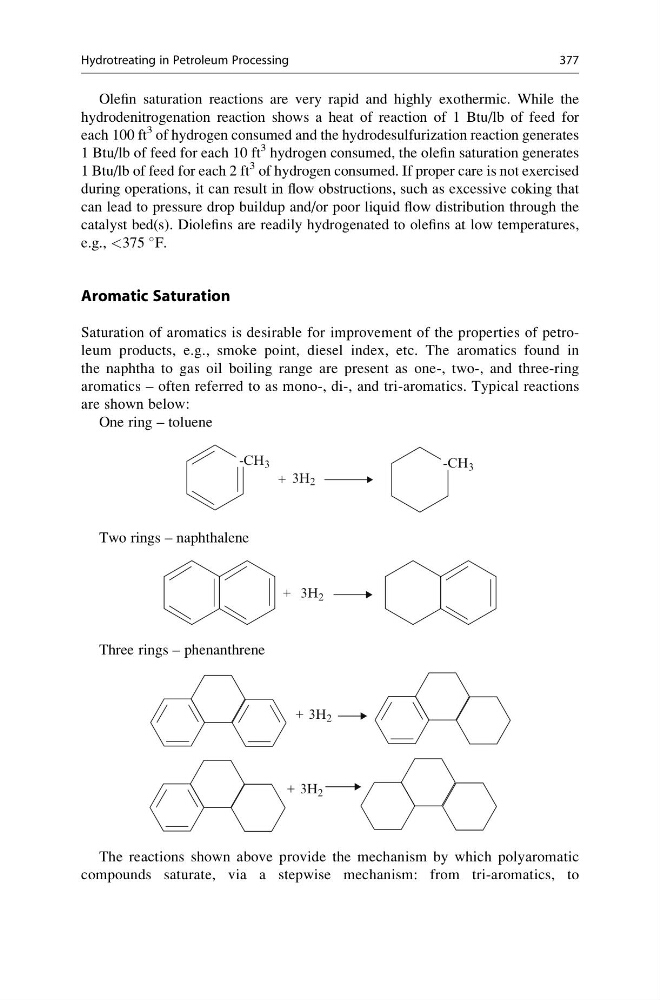
Saturation of aromatics is desirable for improvement of the properties of petroleum products, e.g., smoke point, diesel index, etc. The aromatics found in
the naphtha to gas oil boiling range are present as one-, two-, and three-ring
aromatics – often referred to as mono-, di-, and tri-aromatics. Typical reactions
are shown below:
One ring – toluene
-CH 3
-CH 3
+ 3H 2
Two rings – naphthalene
+ 3H 2
Three rings – phenanthrene
+ 3H 2
+ 3H 2
The reactions shown above provide the mechanism by which polyaromatic
compounds saturate, via a stepwise mechanism: from tri-aromatics, to
Hydrotreating in Petroleum Processing
377
hydrodenitrogenation reaction shows a heat of reaction of 1 Btu/lb of feed for
each 100 ft
3 of hydrogen consumed and the hydrodesulfurization reaction generates
1 Btu/lb of feed for each 10 ft
3 hydrogen consumed, the olefin saturation generates
1 Btu/lb of feed for each 2 ft
3 of hydrogen consumed. If proper care is not exercised
during operations, it can result in flow obstructions, such as excessive coking that
can lead to pressure drop buildup and/or poor liquid flow distribution through the
catalyst bed(s). Diolefins are readily hydrogenated to olefins at low temperatures,
e.g., <375
F.
Aromatic Saturation
Saturation of aromatics is desirable for improvement of the properties of petroleum products, e.g., smoke point, diesel index, etc. The aromatics found in
the naphtha to gas oil boiling range are present as one-, two-, and three-ring
aromatics – often referred to as mono-, di-, and tri-aromatics. Typical reactions
are shown below:
One ring – toluene
-CH 3
-CH 3
+ 3H 2
Two rings – naphthalene
+ 3H 2
Three rings – phenanthrene
+ 3H 2
+ 3H 2
The reactions shown above provide the mechanism by which polyaromatic
compounds saturate, via a stepwise mechanism: from tri-aromatics, to
Hydrotreating in Petroleum Processing
377