

Oxygen Removal
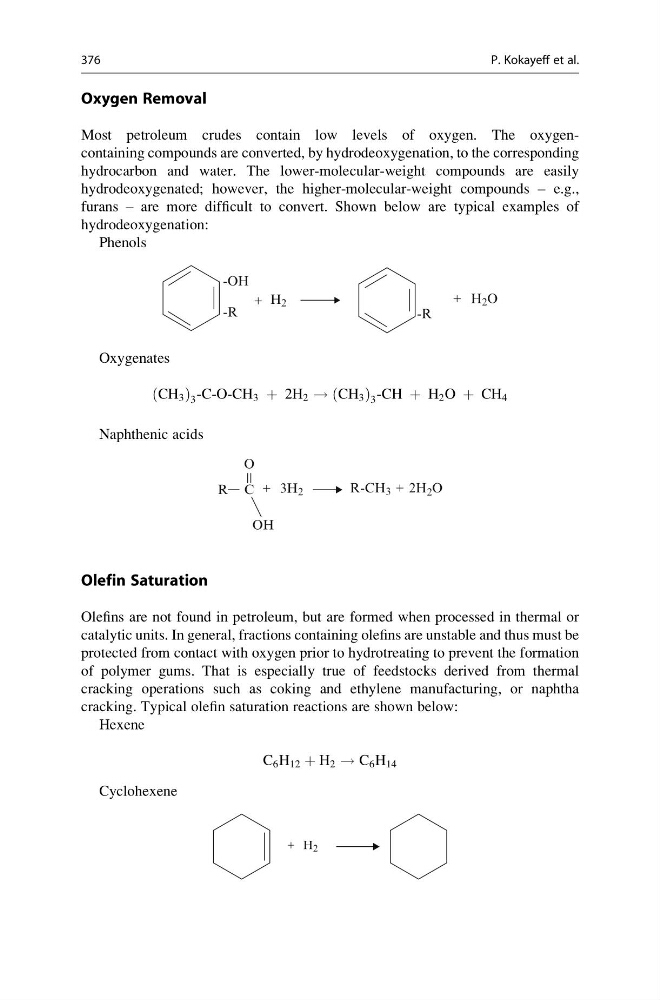
Most petroleum crudes contain low levels of oxygen. The oxygencontaining compounds are converted, by hydrodeoxygenation, to the corresponding
hydrocarbon and water. The lower-molecular-weight compounds are easily
hydrodeoxygenated; however, the higher-molecular-weight compounds – e.g.,
furans – are more difficult to convert. Shown below are typical examples of
hydrodeoxygenation:
Phenols
-OH
+
-R
-R
H 2
+ H 2 O
Oxygenates
CH 3
ð
Þ 3 -C-O-CH 3 þ 2H 2 ! CH 3
ð
Þ 3 -CH þ H 2 O þ CH 4
Naphthenic acids
+ 3H 2
R-CH 3 + 2H 2 O
OH
R C
O
Olefin Saturation
Olefins are not found in petroleum, but are formed when processed in thermal or
catalytic units. In general, fractions containing olefins are unstable and thus must be
protected from contact with oxygen prior to hydrotreating to prevent the formation
of polymer gums. That is especially true of feedstocks derived from thermal
cracking operations such as coking and ethylene manufacturing, or naphtha
cracking. Typical olefin saturation reactions are shown below:
Hexene
C 6 H 12 þ H 2 ! C 6 H 14
Cyclohexene
+ H 2
376
P. Kokayeff et al.
Most petroleum crudes contain low levels of oxygen. The oxygencontaining compounds are converted, by hydrodeoxygenation, to the corresponding
hydrocarbon and water. The lower-molecular-weight compounds are easily
hydrodeoxygenated; however, the higher-molecular-weight compounds – e.g.,
furans – are more difficult to convert. Shown below are typical examples of
hydrodeoxygenation:
Phenols
-OH
+
-R
-R
H 2
+ H 2 O
Oxygenates
CH 3
ð
Þ 3 -C-O-CH 3 þ 2H 2 ! CH 3
ð
Þ 3 -CH þ H 2 O þ CH 4
Naphthenic acids
+ 3H 2
R-CH 3 + 2H 2 O
OH
R C
O
Olefin Saturation
Olefins are not found in petroleum, but are formed when processed in thermal or
catalytic units. In general, fractions containing olefins are unstable and thus must be
protected from contact with oxygen prior to hydrotreating to prevent the formation
of polymer gums. That is especially true of feedstocks derived from thermal
cracking operations such as coking and ethylene manufacturing, or naphtha
cracking. Typical olefin saturation reactions are shown below:
Hexene
C 6 H 12 þ H 2 ! C 6 H 14
Cyclohexene
+ H 2
376
P. Kokayeff et al.