

(b) Hydrogenolysis
N
+ H 2
H 3 C–CH 2 –CH 2 –CH 2 –CH 2 –NH 2
(c) Hydrodenitrogenation
H 3 C-CH 2 -CH 2 -CH 2 -CH 2 -NH 2 þ H 2 ! H 3 C-CH 2 -CH 2 -CH 2 -CH 3 þ NH 3
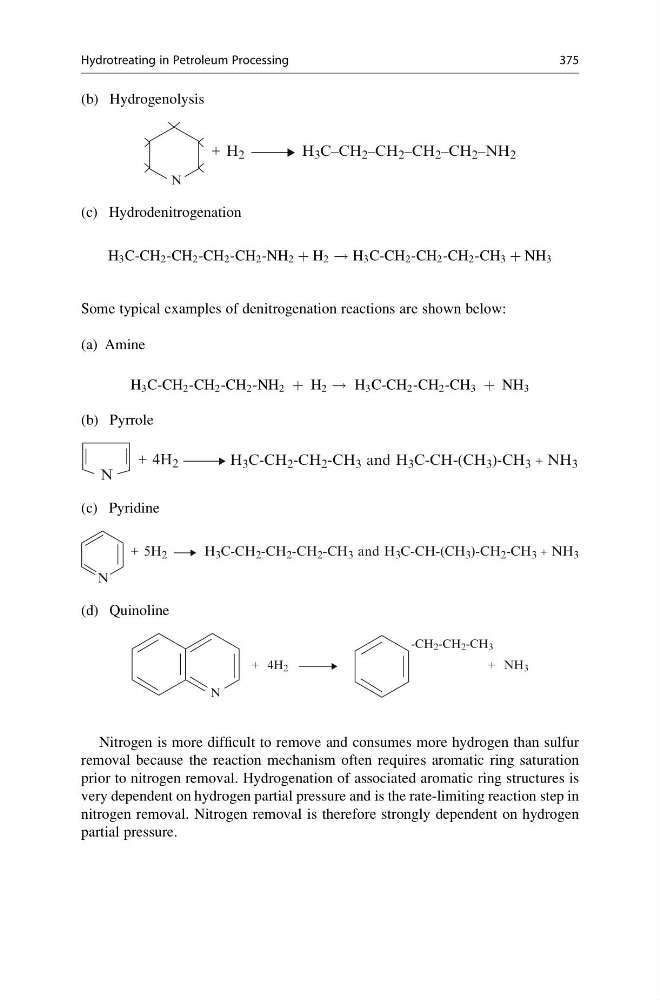
Some typical examples of denitrogenation reactions are shown below:
(a) Amine
H 3 C-CH 2 -CH 2 -CH 2 -NH 2 þ H 2 ! H 3 C-CH 2 -CH 2 -CH 3 þ NH 3
(b) Pyrrole
+ 4H 2
N
H 3 C-CH 2 -CH 2 -CH 3 and H 3 C-CH-(CH 3 )-CH 3 + NH 3
(c) Pyridine
+ 5H 2
N
H 3 C-CH 2 -CH 2 -CH 2 -CH 3 and H 3 C-CH-(CH 3 )-CH 2 -CH 3 + NH 3
(d) Quinoline
N
+ 4H 2
-CH 2 -CH 2 -CH 3
+ NH 3
Nitrogen is more difficult to remove and consumes more hydrogen than sulfur
removal because the reaction mechanism often requires aromatic ring saturation
prior to nitrogen removal. Hydrogenation of associated aromatic ring structures is
very dependent on hydrogen partial pressure and is the rate-limiting reaction step in
nitrogen removal. Nitrogen removal is therefore strongly dependent on hydrogen
partial pressure.
Hydrotreating in Petroleum Processing
375
N
+ H 2
H 3 C–CH 2 –CH 2 –CH 2 –CH 2 –NH 2
(c) Hydrodenitrogenation
H 3 C-CH 2 -CH 2 -CH 2 -CH 2 -NH 2 þ H 2 ! H 3 C-CH 2 -CH 2 -CH 2 -CH 3 þ NH 3
Some typical examples of denitrogenation reactions are shown below:
(a) Amine
H 3 C-CH 2 -CH 2 -CH 2 -NH 2 þ H 2 ! H 3 C-CH 2 -CH 2 -CH 3 þ NH 3
(b) Pyrrole
+ 4H 2
N
H 3 C-CH 2 -CH 2 -CH 3 and H 3 C-CH-(CH 3 )-CH 3 + NH 3
(c) Pyridine
+ 5H 2
N
H 3 C-CH 2 -CH 2 -CH 2 -CH 3 and H 3 C-CH-(CH 3 )-CH 2 -CH 3 + NH 3
(d) Quinoline
N
+ 4H 2
-CH 2 -CH 2 -CH 3
+ NH 3
Nitrogen is more difficult to remove and consumes more hydrogen than sulfur
removal because the reaction mechanism often requires aromatic ring saturation
prior to nitrogen removal. Hydrogenation of associated aromatic ring structures is
very dependent on hydrogen partial pressure and is the rate-limiting reaction step in
nitrogen removal. Nitrogen removal is therefore strongly dependent on hydrogen
partial pressure.
Hydrotreating in Petroleum Processing
375