

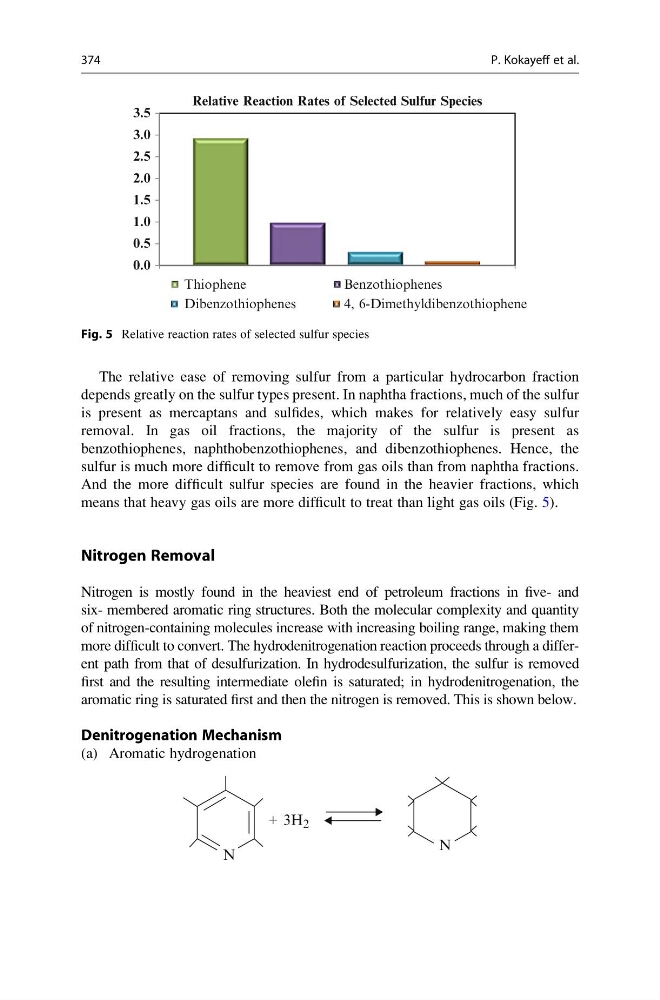
The relative ease of removing sulfur from a particular hydrocarbon fraction
depends greatly on the sulfur types present. In naphtha fractions, much of the sulfur
is present as mercaptans and sulfides, which makes for relatively easy sulfur
removal. In gas oil fractions, the majority of the sulfur is present as
benzothiophenes, naphthobenzothiophenes, and dibenzothiophenes. Hence, the
sulfur is much more difficult to remove from gas oils than from naphtha fractions.
And the more difficult sulfur species are found in the heavier fractions, which
means that heavy gas oils are more difficult to treat than light gas oils (Fig. 5).
Nitrogen Removal
Nitrogen is mostly found in the heaviest end of petroleum fractions in five- and
six- membered aromatic ring structures. Both the molecular complexity and quantity
of nitrogen-containing molecules increase with increasing boiling range, making them
more difficult to convert. The hydrodenitrogenation reaction proceeds through a different path from that of desulfurization. In hydrodesulfurization, the sulfur is removed
first and the resulting intermediate olefin is saturated; in hydrodenitrogenation, the
aromatic ring is saturated first and then the nitrogen is removed. This is shown below.
Denitrogenation Mechanism
(a) Aromatic hydrogenation
N
N
+ 3H 2
0.0
0.5
1.0
1.5
2.0
2.5
3.0
3.5
Relative Reaction Rates of Selected Sulfur Species
Thiophene
Benzothiophenes
Dibenzothiophenes
4, 6-Dimethyldibenzothiophene
Fig. 5 Relative reaction rates of selected sulfur species
374
P. Kokayeff et al.
depends greatly on the sulfur types present. In naphtha fractions, much of the sulfur
is present as mercaptans and sulfides, which makes for relatively easy sulfur
removal. In gas oil fractions, the majority of the sulfur is present as
benzothiophenes, naphthobenzothiophenes, and dibenzothiophenes. Hence, the
sulfur is much more difficult to remove from gas oils than from naphtha fractions.
And the more difficult sulfur species are found in the heavier fractions, which
means that heavy gas oils are more difficult to treat than light gas oils (Fig. 5).
Nitrogen Removal
Nitrogen is mostly found in the heaviest end of petroleum fractions in five- and
six- membered aromatic ring structures. Both the molecular complexity and quantity
of nitrogen-containing molecules increase with increasing boiling range, making them
more difficult to convert. The hydrodenitrogenation reaction proceeds through a different path from that of desulfurization. In hydrodesulfurization, the sulfur is removed
first and the resulting intermediate olefin is saturated; in hydrodenitrogenation, the
aromatic ring is saturated first and then the nitrogen is removed. This is shown below.
Denitrogenation Mechanism
(a) Aromatic hydrogenation
N
N
+ 3H 2
0.0
0.5
1.0
1.5
2.0
2.5
3.0
3.5
Relative Reaction Rates of Selected Sulfur Species
Thiophene
Benzothiophenes
Dibenzothiophenes
4, 6-Dimethyldibenzothiophene
Fig. 5 Relative reaction rates of selected sulfur species
374
P. Kokayeff et al.