

Thiophene
Step (1)
+ 2H 2
S
H 2 C = CH – CH = CH 2 + H 2 S
Step (2)
H 2 C ¼ CH-CH ¼ CH 2 þ 2H 2 ! H 3 C-CH 2 -CH 2 -CH 3
Benzothiophenes
S
R
+ 3H 2
CH 2 -CH 3
+ H 2 S
Dibenzothiophenes
S
+ H 2
+ 3H 2 (1)
(2) + H 2
+ H 2 S
S
+ H 2 S
S
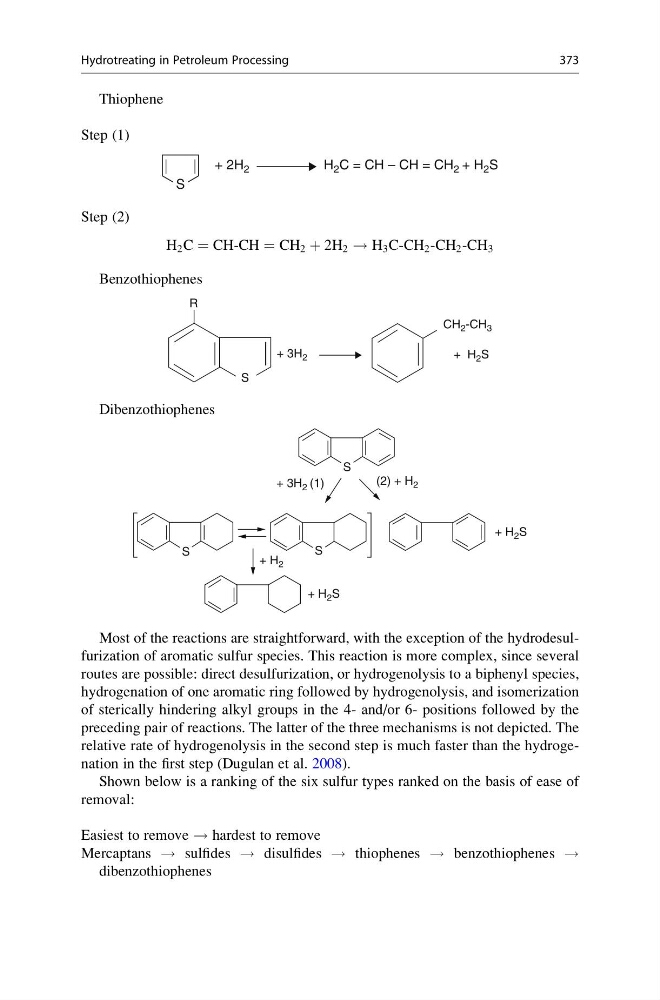
Most of the reactions are straightforward, with the exception of the hydrodesulfurization of aromatic sulfur species. This reaction is more complex, since several
routes are possible: direct desulfurization, or hydrogenolysis to a biphenyl species,
hydrogenation of one aromatic ring followed by hydrogenolysis, and isomerization
of sterically hindering alkyl groups in the 4- and/or 6- positions followed by the
preceding pair of reactions. The latter of the three mechanisms is not depicted. The
relative rate of hydrogenolysis in the second step is much faster than the hydrogenation in the first step (Dugulan et al. 2008).
Shown below is a ranking of the six sulfur types ranked on the basis of ease of
removal:
Easiest to remove ! hardest to remove
Mercaptans ! sulfides ! disulfides ! thiophenes ! benzothiophenes !
dibenzothiophenes
Hydrotreating in Petroleum Processing
373
Step (1)
+ 2H 2
S
H 2 C = CH – CH = CH 2 + H 2 S
Step (2)
H 2 C ¼ CH-CH ¼ CH 2 þ 2H 2 ! H 3 C-CH 2 -CH 2 -CH 3
Benzothiophenes
S
R
+ 3H 2
CH 2 -CH 3
+ H 2 S
Dibenzothiophenes
S
+ H 2
+ 3H 2 (1)
(2) + H 2
+ H 2 S
S
+ H 2 S
S
Most of the reactions are straightforward, with the exception of the hydrodesulfurization of aromatic sulfur species. This reaction is more complex, since several
routes are possible: direct desulfurization, or hydrogenolysis to a biphenyl species,
hydrogenation of one aromatic ring followed by hydrogenolysis, and isomerization
of sterically hindering alkyl groups in the 4- and/or 6- positions followed by the
preceding pair of reactions. The latter of the three mechanisms is not depicted. The
relative rate of hydrogenolysis in the second step is much faster than the hydrogenation in the first step (Dugulan et al. 2008).
Shown below is a ranking of the six sulfur types ranked on the basis of ease of
removal:
Easiest to remove ! hardest to remove
Mercaptans ! sulfides ! disulfides ! thiophenes ! benzothiophenes !
dibenzothiophenes
Hydrotreating in Petroleum Processing
373