

di-aromatics, to mono-aromatics. The end products are naphthenic. Ring opening
does not occur in hydrotreating (it does in hydrocracking) because a hydrotreating
catalyst’s support is not designed with significant acidity, unlike a hydrocracking
catalyst. The aromatic saturation reaction is strongly favored by high hydrogen
partial pressure. Unlike all the other hydrotreating reactions, the amount of
conversion of aromatics becomes equilibrium limited at higher operating temperatures within the commercial operating range, since the naphthene dehydrogenation reverse reaction becomes favored when temperature is increased. The
optimum temperature for maximum aromatic saturation depends on LHSV,
hydrogen partial pressure, and catalyst type but typically lies in the range of
670–730
F.
Mono-aromatic rings are much more difficult to saturate than the di- and
tri-aromatic rings because the saturation of the last aromatic ring requires the
most energy. This means that as aromatic saturation proceeds, there is little progress
in total aromatics reduction until most, if not all, of the di- and tri-aromatics have
been saturated. The complete saturation of aromatics requires the application of
noble metal catalysts in a sulfur- and H 2 S-free environment and is generally not
possible in conventional hydrotreating with base metal sulfide catalysts.
Metals and Nonmetal Removal
Most metallic contaminants are present as organometallic compounds. Once
deposited, these metals contribute to catalyst deactivation; unlike coke,
they cannot be removed by regeneration. In naphtha hydrotreating, the most
commonly occurring contaminants are arsenic from certain crude sources, alkali
metals (e.g., Ca, Na), mercury from certain condensates, and silica from
polydimethylsiloxane-based antifoam agents used in visbreakers, delayed cokers,
and deepwater drilling for crude oil. Gas oil streams may contain traces of nickel
and vanadium in the heavier fractions. These too are deposited on the catalyst and
contribute to deactivation. Atmospheric residua can contain metals, almost exclusively Ni and V, in the 20–500 ppm range. Hydrodemetallation of that type of
feedstock is an important goal of processing and special hydrodemetallation
catalysts are applied for that purpose. Hydrodemetallation of nickel and vanadium
occurs before any substantial hydrodesulfurization and conversion of the
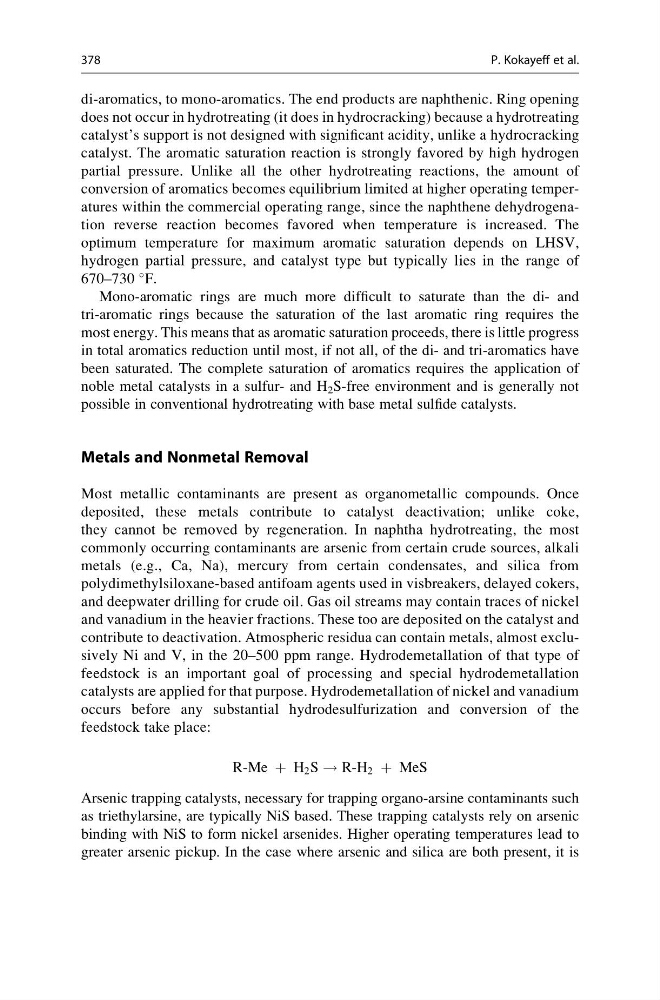
feedstock take place:
R-Me þ H 2 S ! R-H 2 þ MeS
Arsenic trapping catalysts, necessary for trapping organo-arsine contaminants such
as triethylarsine, are typically NiS based. These trapping catalysts rely on arsenic
binding with NiS to form nickel arsenides. Higher operating temperatures lead to
greater arsenic pickup. In the case where arsenic and silica are both present, it is
378
P. Kokayeff et al.
does not occur in hydrotreating (it does in hydrocracking) because a hydrotreating
catalyst’s support is not designed with significant acidity, unlike a hydrocracking
catalyst. The aromatic saturation reaction is strongly favored by high hydrogen
partial pressure. Unlike all the other hydrotreating reactions, the amount of
conversion of aromatics becomes equilibrium limited at higher operating temperatures within the commercial operating range, since the naphthene dehydrogenation reverse reaction becomes favored when temperature is increased. The
optimum temperature for maximum aromatic saturation depends on LHSV,
hydrogen partial pressure, and catalyst type but typically lies in the range of
670–730
F.
Mono-aromatic rings are much more difficult to saturate than the di- and
tri-aromatic rings because the saturation of the last aromatic ring requires the
most energy. This means that as aromatic saturation proceeds, there is little progress
in total aromatics reduction until most, if not all, of the di- and tri-aromatics have
been saturated. The complete saturation of aromatics requires the application of
noble metal catalysts in a sulfur- and H 2 S-free environment and is generally not
possible in conventional hydrotreating with base metal sulfide catalysts.
Metals and Nonmetal Removal
Most metallic contaminants are present as organometallic compounds. Once
deposited, these metals contribute to catalyst deactivation; unlike coke,
they cannot be removed by regeneration. In naphtha hydrotreating, the most
commonly occurring contaminants are arsenic from certain crude sources, alkali
metals (e.g., Ca, Na), mercury from certain condensates, and silica from
polydimethylsiloxane-based antifoam agents used in visbreakers, delayed cokers,
and deepwater drilling for crude oil. Gas oil streams may contain traces of nickel
and vanadium in the heavier fractions. These too are deposited on the catalyst and
contribute to deactivation. Atmospheric residua can contain metals, almost exclusively Ni and V, in the 20–500 ppm range. Hydrodemetallation of that type of
feedstock is an important goal of processing and special hydrodemetallation
catalysts are applied for that purpose. Hydrodemetallation of nickel and vanadium
occurs before any substantial hydrodesulfurization and conversion of the
feedstock take place:
R-Me þ H 2 S ! R-H 2 þ MeS
Arsenic trapping catalysts, necessary for trapping organo-arsine contaminants such
as triethylarsine, are typically NiS based. These trapping catalysts rely on arsenic
binding with NiS to form nickel arsenides. Higher operating temperatures lead to
greater arsenic pickup. In the case where arsenic and silica are both present, it is
378
P. Kokayeff et al.