

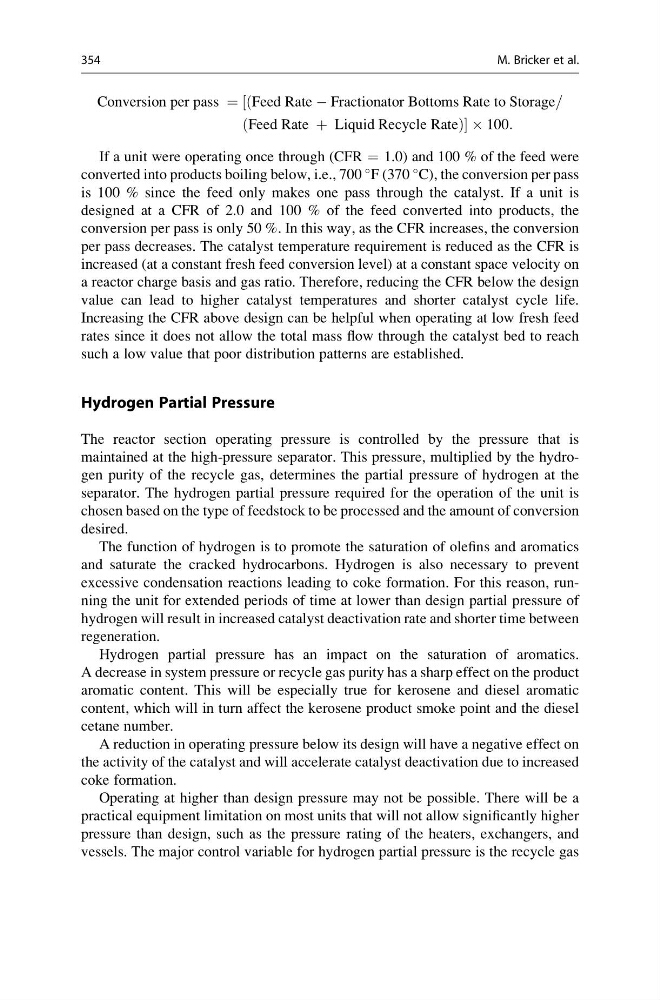
Conversion per pass ¼ Feed Rate À Fractionator Bottoms Rate to Storage=
ð
½
Feed Rate þ Liquid Recycle Rate
ð
Þ Â 100:
If a unit were operating once through (CFR = 1.0) and 100 % of the feed were
converted into products boiling below, i.e., 700
F (370
C), the conversion per pass
is 100 % since the feed only makes one pass through the catalyst. If a unit is
designed at a CFR of 2.0 and 100 % of the feed converted into products, the
conversion per pass is only 50 %. In this way, as the CFR increases, the conversion
per pass decreases. The catalyst temperature requirement is reduced as the CFR is
increased (at a constant fresh feed conversion level) at a constant space velocity on
a reactor charge basis and gas ratio. Therefore, reducing the CFR below the design
value can lead to higher catalyst temperatures and shorter catalyst cycle life.
Increasing the CFR above design can be helpful when operating at low fresh feed
rates since it does not allow the total mass flow through the catalyst bed to reach
such a low value that poor distribution patterns are established.
Hydrogen Partial Pressure
The reactor section operating pressure is controlled by the pressure that is
maintained at the high-pressure separator. This pressure, multiplied by the hydrogen purity of the recycle gas, determines the partial pressure of hydrogen at the
separator. The hydrogen partial pressure required for the operation of the unit is
chosen based on the type of feedstock to be processed and the amount of conversion
desired.
The function of hydrogen is to promote the saturation of olefins and aromatics
and saturate the cracked hydrocarbons. Hydrogen is also necessary to prevent
excessive condensation reactions leading to coke formation. For this reason, running the unit for extended periods of time at lower than design partial pressure of
hydrogen will result in increased catalyst deactivation rate and shorter time between
regeneration.
Hydrogen partial pressure has an impact on the saturation of aromatics.
A decrease in system pressure or recycle gas purity has a sharp effect on the product
aromatic content. This will be especially true for kerosene and diesel aromatic
content, which will in turn affect the kerosene product smoke point and the diesel
cetane number.
A reduction in operating pressure below its design will have a negative effect on
the activity of the catalyst and will accelerate catalyst deactivation due to increased
coke formation.
Operating at higher than design pressure may not be possible. There will be a
practical equipment limitation on most units that will not allow significantly higher
pressure than design, such as the pressure rating of the heaters, exchangers, and
vessels. The major control variable for hydrogen partial pressure is the recycle gas
354
M. Bricker et al.
ð
½
Feed Rate þ Liquid Recycle Rate
ð
Þ Â 100:
If a unit were operating once through (CFR = 1.0) and 100 % of the feed were
converted into products boiling below, i.e., 700
F (370
C), the conversion per pass
is 100 % since the feed only makes one pass through the catalyst. If a unit is
designed at a CFR of 2.0 and 100 % of the feed converted into products, the
conversion per pass is only 50 %. In this way, as the CFR increases, the conversion
per pass decreases. The catalyst temperature requirement is reduced as the CFR is
increased (at a constant fresh feed conversion level) at a constant space velocity on
a reactor charge basis and gas ratio. Therefore, reducing the CFR below the design
value can lead to higher catalyst temperatures and shorter catalyst cycle life.
Increasing the CFR above design can be helpful when operating at low fresh feed
rates since it does not allow the total mass flow through the catalyst bed to reach
such a low value that poor distribution patterns are established.
Hydrogen Partial Pressure
The reactor section operating pressure is controlled by the pressure that is
maintained at the high-pressure separator. This pressure, multiplied by the hydrogen purity of the recycle gas, determines the partial pressure of hydrogen at the
separator. The hydrogen partial pressure required for the operation of the unit is
chosen based on the type of feedstock to be processed and the amount of conversion
desired.
The function of hydrogen is to promote the saturation of olefins and aromatics
and saturate the cracked hydrocarbons. Hydrogen is also necessary to prevent
excessive condensation reactions leading to coke formation. For this reason, running the unit for extended periods of time at lower than design partial pressure of
hydrogen will result in increased catalyst deactivation rate and shorter time between
regeneration.
Hydrogen partial pressure has an impact on the saturation of aromatics.
A decrease in system pressure or recycle gas purity has a sharp effect on the product
aromatic content. This will be especially true for kerosene and diesel aromatic
content, which will in turn affect the kerosene product smoke point and the diesel
cetane number.
A reduction in operating pressure below its design will have a negative effect on
the activity of the catalyst and will accelerate catalyst deactivation due to increased
coke formation.
Operating at higher than design pressure may not be possible. There will be a
practical equipment limitation on most units that will not allow significantly higher
pressure than design, such as the pressure rating of the heaters, exchangers, and
vessels. The major control variable for hydrogen partial pressure is the recycle gas
354
M. Bricker et al.