

purity that should be monitored closely to assure it is always maintained above the
minimum value. The hydrogen purity can be improved by increasing the hydrogen
purity of the makeup hydrogen, venting gas off the high-pressure separator, or
reducing the temperature at the high-pressure separator.
Recycle Gas Rate
In addition to maintaining a prescribed partial pressure of hydrogen in the reactor
section, it is equally important to maintain the physical contact of the hydrogen with
the catalyst and hydrocarbon so that the hydrogen is available at the sites where the
reaction is taking place. The physical contact of hydrogen with the catalyst is
accomplished by circulating the recycle gas throughout the reactor circuit continuously with the recycle gas compressor. The amount of gas that must be recycled is
a design variable again set by the design severity of the operation. The standard
measure of the amount of gas required is the ratio of the gas being recycled to the
rate fresh feed being charged to the catalyst.
As with hydrogen partial pressure, the recycle gas-to-feed ratio should be
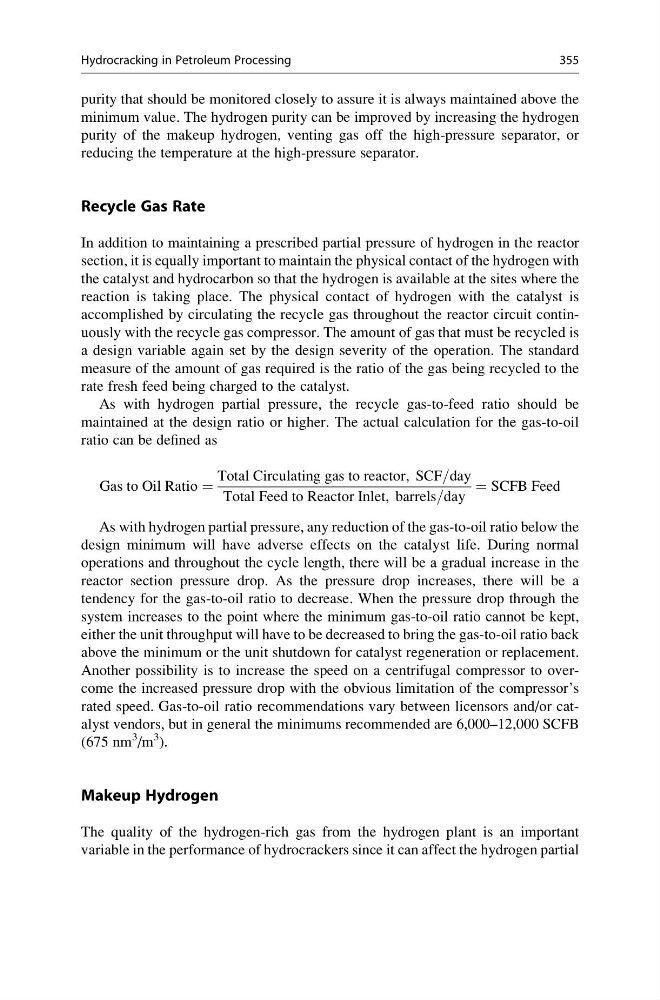
maintained at the design ratio or higher. The actual calculation for the gas-to-oil
ratio can be defined as
Gas to Oil Ratio ¼
Total Circulating gas to reactor, SCF=day
Total Feed to Reactor Inlet, barrels=day
¼ SCFB Feed
As with hydrogen partial pressure, any reduction of the gas-to-oil ratio below the
design minimum will have adverse effects on the catalyst life. During normal
operations and throughout the cycle length, there will be a gradual increase in the
reactor section pressure drop. As the pressure drop increases, there will be a
tendency for the gas-to-oil ratio to decrease. When the pressure drop through the
system increases to the point where the minimum gas-to-oil ratio cannot be kept,
either the unit throughput will have to be decreased to bring the gas-to-oil ratio back
above the minimum or the unit shutdown for catalyst regeneration or replacement.
Another possibility is to increase the speed on a centrifugal compressor to overcome the increased pressure drop with the obvious limitation of the compressor’s
rated speed. Gas-to-oil ratio recommendations vary between licensors and/or catalyst vendors, but in general the minimums recommended are 6,000–12,000 SCFB
(675 nm
3 /m
3 ).
Makeup Hydrogen
The quality of the hydrogen-rich gas from the hydrogen plant is an important
variable in the performance of hydrocrackers since it can affect the hydrogen partial
Hydrocracking in Petroleum Processing
355
minimum value. The hydrogen purity can be improved by increasing the hydrogen
purity of the makeup hydrogen, venting gas off the high-pressure separator, or
reducing the temperature at the high-pressure separator.
Recycle Gas Rate
In addition to maintaining a prescribed partial pressure of hydrogen in the reactor
section, it is equally important to maintain the physical contact of the hydrogen with
the catalyst and hydrocarbon so that the hydrogen is available at the sites where the
reaction is taking place. The physical contact of hydrogen with the catalyst is
accomplished by circulating the recycle gas throughout the reactor circuit continuously with the recycle gas compressor. The amount of gas that must be recycled is
a design variable again set by the design severity of the operation. The standard
measure of the amount of gas required is the ratio of the gas being recycled to the
rate fresh feed being charged to the catalyst.
As with hydrogen partial pressure, the recycle gas-to-feed ratio should be
maintained at the design ratio or higher. The actual calculation for the gas-to-oil
ratio can be defined as
Gas to Oil Ratio ¼
Total Circulating gas to reactor, SCF=day
Total Feed to Reactor Inlet, barrels=day
¼ SCFB Feed
As with hydrogen partial pressure, any reduction of the gas-to-oil ratio below the
design minimum will have adverse effects on the catalyst life. During normal
operations and throughout the cycle length, there will be a gradual increase in the
reactor section pressure drop. As the pressure drop increases, there will be a
tendency for the gas-to-oil ratio to decrease. When the pressure drop through the
system increases to the point where the minimum gas-to-oil ratio cannot be kept,
either the unit throughput will have to be decreased to bring the gas-to-oil ratio back
above the minimum or the unit shutdown for catalyst regeneration or replacement.
Another possibility is to increase the speed on a centrifugal compressor to overcome the increased pressure drop with the obvious limitation of the compressor’s
rated speed. Gas-to-oil ratio recommendations vary between licensors and/or catalyst vendors, but in general the minimums recommended are 6,000–12,000 SCFB
(675 nm
3 /m
3 ).
Makeup Hydrogen
The quality of the hydrogen-rich gas from the hydrogen plant is an important
variable in the performance of hydrocrackers since it can affect the hydrogen partial
Hydrocracking in Petroleum Processing
355