

conversion. It is recommended to keep the total metals in the feedstock as low as
possible and protect active catalyst by the use of catalysts designed to remove
metals and graded bed strategies.
Fresh Feed Rate (LHSV)
The amount of catalyst loaded into the reactors is based upon the quantity and quality
of the design feedstock and the desired conversion level. The variable that is normally
used to relate the amount of catalyst to the amount of feed is termed liquid
hourly space velocity (LHSV). LHSV is the ratio of volumetric feed rate per hour
to the catalyst volume. Space velocity is the inverse of space time or the residence
time the feed resides over the catalyst. Hydrocrackers are normally designed for an
LHSV that depends on the severity of the operation. Increasing the fresh feed rate with
a constant catalyst volume increases the LHSV, and a corresponding increase in
catalyst temperature will be required to maintain a constant conversion. The increased
catalyst temperature will lead to a faster rate of coke formation and, therefore,
reduce the catalyst life. If the LHSV is run significantly higher than the design of
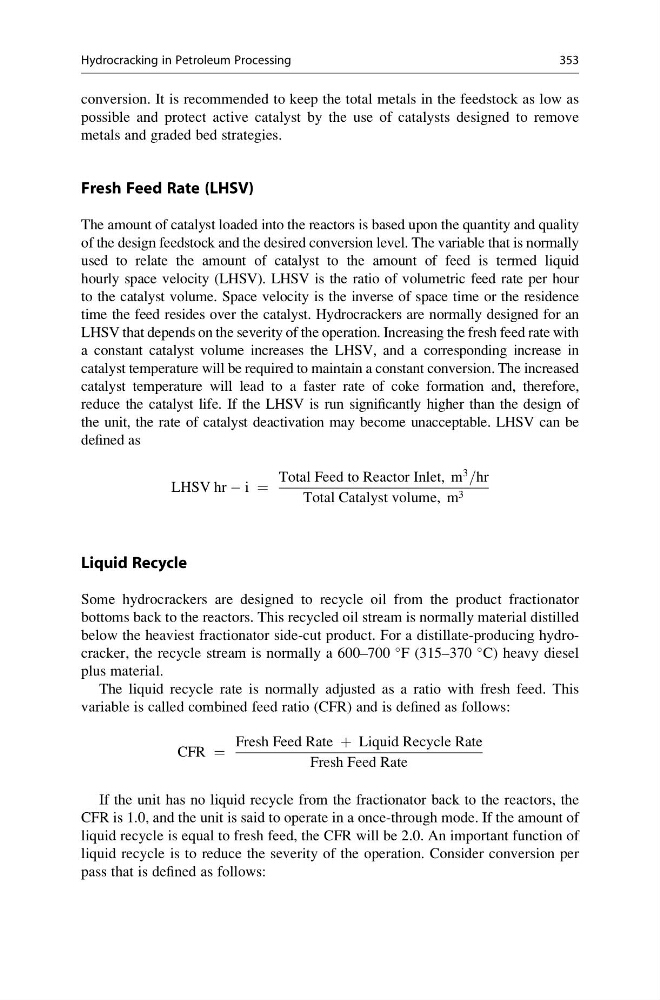
the unit, the rate of catalyst deactivation may become unacceptable. LHSV can be
defined as
LHSV hr À i ¼
Total Feed to Reactor Inlet, m
3
=hr
Total Catalyst volume, m 3
Liquid Recycle
Some hydrocrackers are designed to recycle oil from the product fractionator
bottoms back to the reactors. This recycled oil stream is normally material distilled
below the heaviest fractionator side-cut product. For a distillate-producing hydrocracker, the recycle stream is normally a 600–700
F (315–370
C) heavy diesel
plus material.
The liquid recycle rate is normally adjusted as a ratio with fresh feed. This
variable is called combined feed ratio (CFR) and is defined as follows:
CFR ¼
Fresh Feed Rate þ Liquid Recycle Rate
Fresh Feed Rate
If the unit has no liquid recycle from the fractionator back to the reactors, the
CFR is 1.0, and the unit is said to operate in a once-through mode. If the amount of
liquid recycle is equal to fresh feed, the CFR will be 2.0. An important function of
liquid recycle is to reduce the severity of the operation. Consider conversion per
pass that is defined as follows:
Hydrocracking in Petroleum Processing
353
possible and protect active catalyst by the use of catalysts designed to remove
metals and graded bed strategies.
Fresh Feed Rate (LHSV)
The amount of catalyst loaded into the reactors is based upon the quantity and quality
of the design feedstock and the desired conversion level. The variable that is normally
used to relate the amount of catalyst to the amount of feed is termed liquid
hourly space velocity (LHSV). LHSV is the ratio of volumetric feed rate per hour
to the catalyst volume. Space velocity is the inverse of space time or the residence
time the feed resides over the catalyst. Hydrocrackers are normally designed for an
LHSV that depends on the severity of the operation. Increasing the fresh feed rate with
a constant catalyst volume increases the LHSV, and a corresponding increase in
catalyst temperature will be required to maintain a constant conversion. The increased
catalyst temperature will lead to a faster rate of coke formation and, therefore,
reduce the catalyst life. If the LHSV is run significantly higher than the design of
the unit, the rate of catalyst deactivation may become unacceptable. LHSV can be
defined as
LHSV hr À i ¼
Total Feed to Reactor Inlet, m
3
=hr
Total Catalyst volume, m 3
Liquid Recycle
Some hydrocrackers are designed to recycle oil from the product fractionator
bottoms back to the reactors. This recycled oil stream is normally material distilled
below the heaviest fractionator side-cut product. For a distillate-producing hydrocracker, the recycle stream is normally a 600–700
F (315–370
C) heavy diesel
plus material.
The liquid recycle rate is normally adjusted as a ratio with fresh feed. This
variable is called combined feed ratio (CFR) and is defined as follows:
CFR ¼
Fresh Feed Rate þ Liquid Recycle Rate
Fresh Feed Rate
If the unit has no liquid recycle from the fractionator back to the reactors, the
CFR is 1.0, and the unit is said to operate in a once-through mode. If the amount of
liquid recycle is equal to fresh feed, the CFR will be 2.0. An important function of
liquid recycle is to reduce the severity of the operation. Consider conversion per
pass that is defined as follows:
Hydrocracking in Petroleum Processing
353