

The active phase is similar for the CoMo or NiMo supported on Al 2 O 3 or SiO 2
and by analogy Ni/W on the more complex hydrocracking catalyst (Topsoe
et al. 1996). These consist of Co or Ni atoms on the edges of MoS2 slabs and are
referred to as CoMoS and NiMoS phases, and by analogy NiWS phase. W and Mo
exhibit different behavior with respect to sulfidation. Ni/W is more difficult to
sulfide than Ni/Mo, i.e., requires higher temperature. The presence of the Ni
enhances the sulfidation of either Ni or Mo. The slabs of Mo or S have a specific
length and appear as strands with different levels of stacking. An image (Bricker
et al. 2012) of Ni/W in a hydrocracking catalyst is shown in Fig. 23. In this figure
the individual atoms of W can be seen.
The non-noble (base metal) catalysts are activated by transforming the catalytically inactive metal oxides into active metal sulfides. This is accomplished mainly
in situ though some refiners have started to do the activation outside the unit
(ex situ). More and more refiners will opt to receive the catalyst at the refinery
site in pre-sulfided state to accelerate the start-up of the unit. In situ sulfiding can be
accomplished either in vapor or liquid phase. In vapor phase sulfiding, the activation of the catalyst is accomplished by injecting a chemical which easily decomposes to H 2 S, such as dimethyl disulfide (DMDS) or dimethyl sulfide (DMS). The
use of H 2 S was fairly common until a few years ago, but now it is only rarely used
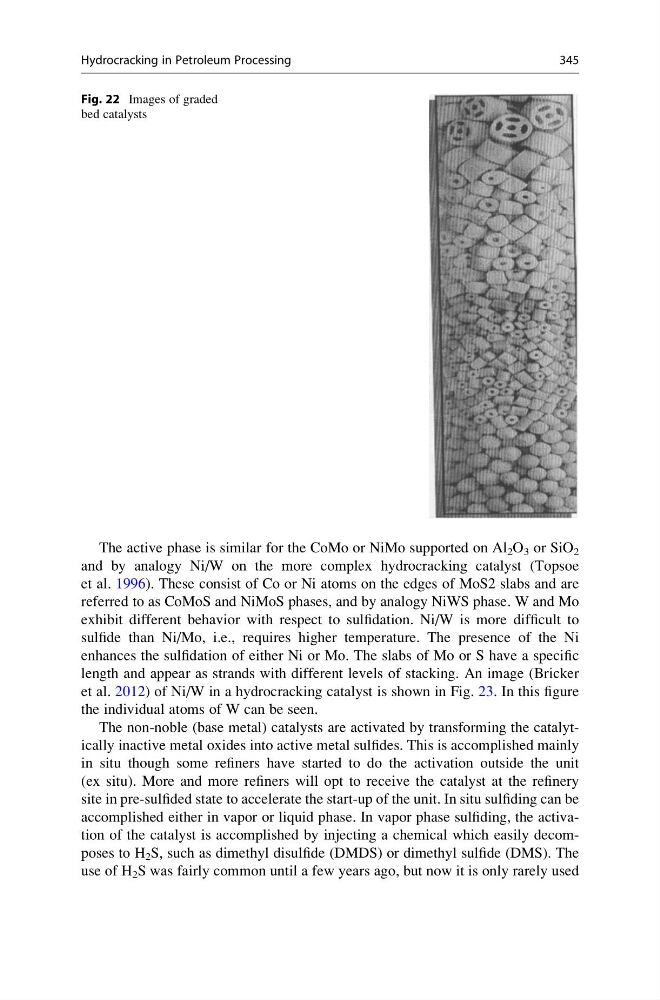
Fig. 22 Images of graded
bed catalysts
Hydrocracking in Petroleum Processing
345
and by analogy Ni/W on the more complex hydrocracking catalyst (Topsoe
et al. 1996). These consist of Co or Ni atoms on the edges of MoS2 slabs and are
referred to as CoMoS and NiMoS phases, and by analogy NiWS phase. W and Mo
exhibit different behavior with respect to sulfidation. Ni/W is more difficult to
sulfide than Ni/Mo, i.e., requires higher temperature. The presence of the Ni
enhances the sulfidation of either Ni or Mo. The slabs of Mo or S have a specific
length and appear as strands with different levels of stacking. An image (Bricker
et al. 2012) of Ni/W in a hydrocracking catalyst is shown in Fig. 23. In this figure
the individual atoms of W can be seen.
The non-noble (base metal) catalysts are activated by transforming the catalytically inactive metal oxides into active metal sulfides. This is accomplished mainly
in situ though some refiners have started to do the activation outside the unit
(ex situ). More and more refiners will opt to receive the catalyst at the refinery
site in pre-sulfided state to accelerate the start-up of the unit. In situ sulfiding can be
accomplished either in vapor or liquid phase. In vapor phase sulfiding, the activation of the catalyst is accomplished by injecting a chemical which easily decomposes to H 2 S, such as dimethyl disulfide (DMDS) or dimethyl sulfide (DMS). The
use of H 2 S was fairly common until a few years ago, but now it is only rarely used
Fig. 22 Images of graded
bed catalysts
Hydrocracking in Petroleum Processing
345