

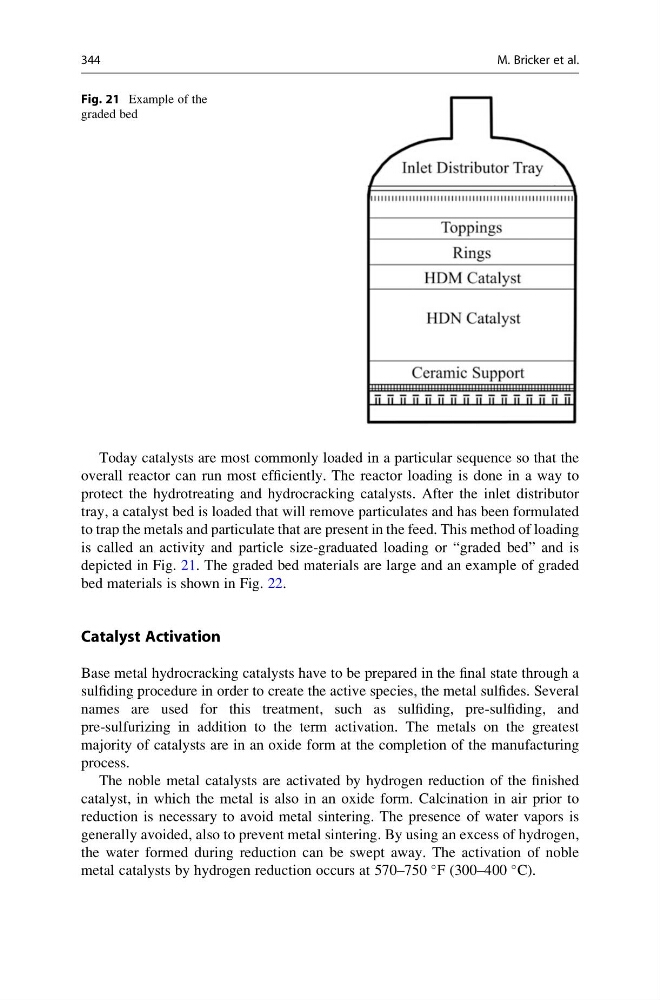
Today catalysts are most commonly loaded in a particular sequence so that the
overall reactor can run most efficiently. The reactor loading is done in a way to
protect the hydrotreating and hydrocracking catalysts. After the inlet distributor
tray, a catalyst bed is loaded that will remove particulates and has been formulated
to trap the metals and particulate that are present in the feed. This method of loading
is called an activity and particle size-graduated loading or “graded bed” and is
depicted in Fig. 21. The graded bed materials are large and an example of graded
bed materials is shown in Fig. 22.
Catalyst Activation
Base metal hydrocracking catalysts have to be prepared in the final state through a
sulfiding procedure in order to create the active species, the metal sulfides. Several
names are used for this treatment, such as sulfiding, pre-sulfiding, and
pre-sulfurizing in addition to the term activation. The metals on the greatest
majority of catalysts are in an oxide form at the completion of the manufacturing
process.
The noble metal catalysts are activated by hydrogen reduction of the finished
catalyst, in which the metal is also in an oxide form. Calcination in air prior to
reduction is necessary to avoid metal sintering. The presence of water vapors is
generally avoided, also to prevent metal sintering. By using an excess of hydrogen,
the water formed during reduction can be swept away. The activation of noble
metal catalysts by hydrogen reduction occurs at 570–750
F (300–400
C).
Fig. 21 Example of the
graded bed
344
M. Bricker et al.
overall reactor can run most efficiently. The reactor loading is done in a way to
protect the hydrotreating and hydrocracking catalysts. After the inlet distributor
tray, a catalyst bed is loaded that will remove particulates and has been formulated
to trap the metals and particulate that are present in the feed. This method of loading
is called an activity and particle size-graduated loading or “graded bed” and is
depicted in Fig. 21. The graded bed materials are large and an example of graded
bed materials is shown in Fig. 22.
Catalyst Activation
Base metal hydrocracking catalysts have to be prepared in the final state through a
sulfiding procedure in order to create the active species, the metal sulfides. Several
names are used for this treatment, such as sulfiding, pre-sulfiding, and
pre-sulfurizing in addition to the term activation. The metals on the greatest
majority of catalysts are in an oxide form at the completion of the manufacturing
process.
The noble metal catalysts are activated by hydrogen reduction of the finished
catalyst, in which the metal is also in an oxide form. Calcination in air prior to
reduction is necessary to avoid metal sintering. The presence of water vapors is
generally avoided, also to prevent metal sintering. By using an excess of hydrogen,
the water formed during reduction can be swept away. The activation of noble
metal catalysts by hydrogen reduction occurs at 570–750
F (300–400
C).
Fig. 21 Example of the
graded bed
344
M. Bricker et al.