

Catalyst Loading (Reactor) and Activation of the Catalyst
Catalyst Loading into Reactor
There are two methods of catalyst loading, sock loading and dense loading. Sock
loading is done by pouring the catalyst into a hopper mounted on top of the reactor and
then allowing it to flow through a canvas sock into the reactor. Dense loading or dense
bed packing is done with the help of a mechanical device. The dense loading method
was introduced in the mid-1970s. Catalyst loaded by sock loading will have a higher
void fraction than catalyst that was dense loaded. Dense bed packing and the resulting
higher-pressure drop provide a more even distribution of liquid in a trickle-flow
reactor. Most distillate hydrocrackers are in the trickle-flow regime. If diffusion
limitations are negligible, dense loading is desirable in order to maximize the catalyst
mass per volume of the reactor and, thus, the reaction rate per unit reactor volume.
Another advantage of dense loading is that it orients the catalyst particles in a
horizontal and uniform manner. This improves the vapor/liquid distribution through
the catalyst beds. Catalyst particle orientation is important especially for cylindrically
shaped extruded catalyst in vapor/liquid reactant systems. When the catalyst particles
are oriented in a horizontal position in the catalyst bed, liquid channeling is almost
completely eliminated. Poor liquid distribution tends to occur when the catalyst
loading is done by the sock loading method, which generally causes the extrudates
to be oriented in a downward slant toward the reactor walls, increasing bed voids and
creating poor liquid distribution. Of all the factors influencing catalyst utilization,
catalyst loading has generally proven to be a very important factor. Except for the
hydrocrackers that have reactor pressure drop limitations mainly due to operation at
higher than design throughputs, the great majority of units worldwide are dense loaded.
Catalyst
Support
Evaporator
Metal Salts
Dip Tank
Calciner
Screen
Oversize
Finished
Catalyst
Fines
Calcinated Catalyst
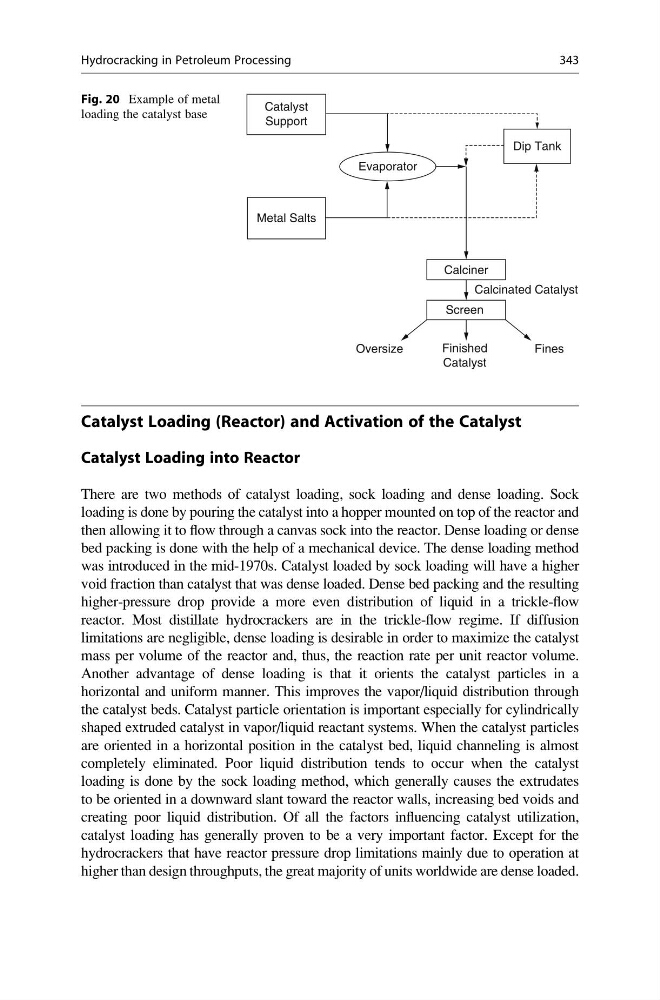
Fig. 20 Example of metal
loading the catalyst base
Hydrocracking in Petroleum Processing
343
Catalyst Loading into Reactor
There are two methods of catalyst loading, sock loading and dense loading. Sock
loading is done by pouring the catalyst into a hopper mounted on top of the reactor and
then allowing it to flow through a canvas sock into the reactor. Dense loading or dense
bed packing is done with the help of a mechanical device. The dense loading method
was introduced in the mid-1970s. Catalyst loaded by sock loading will have a higher
void fraction than catalyst that was dense loaded. Dense bed packing and the resulting
higher-pressure drop provide a more even distribution of liquid in a trickle-flow
reactor. Most distillate hydrocrackers are in the trickle-flow regime. If diffusion
limitations are negligible, dense loading is desirable in order to maximize the catalyst
mass per volume of the reactor and, thus, the reaction rate per unit reactor volume.
Another advantage of dense loading is that it orients the catalyst particles in a
horizontal and uniform manner. This improves the vapor/liquid distribution through
the catalyst beds. Catalyst particle orientation is important especially for cylindrically
shaped extruded catalyst in vapor/liquid reactant systems. When the catalyst particles
are oriented in a horizontal position in the catalyst bed, liquid channeling is almost
completely eliminated. Poor liquid distribution tends to occur when the catalyst
loading is done by the sock loading method, which generally causes the extrudates
to be oriented in a downward slant toward the reactor walls, increasing bed voids and
creating poor liquid distribution. Of all the factors influencing catalyst utilization,
catalyst loading has generally proven to be a very important factor. Except for the
hydrocrackers that have reactor pressure drop limitations mainly due to operation at
higher than design throughputs, the great majority of units worldwide are dense loaded.
Catalyst
Support
Evaporator
Metal Salts
Dip Tank
Calciner
Screen
Oversize
Finished
Catalyst
Fines
Calcinated Catalyst
Fig. 20 Example of metal
loading the catalyst base
Hydrocracking in Petroleum Processing
343