

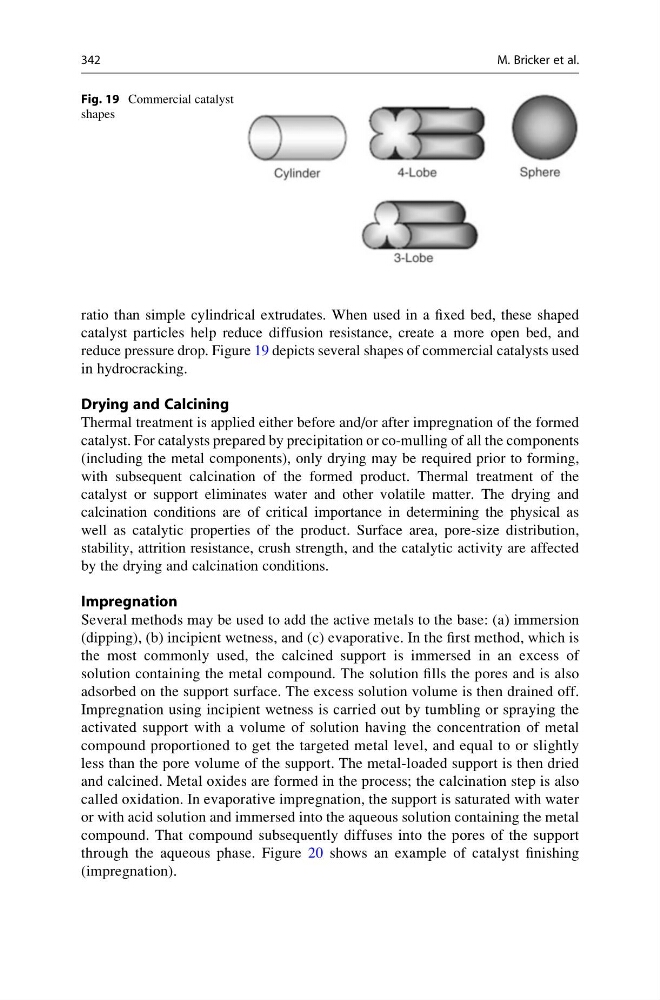
ratio than simple cylindrical extrudates. When used in a fixed bed, these shaped
catalyst particles help reduce diffusion resistance, create a more open bed, and
reduce pressure drop. Figure 19 depicts several shapes of commercial catalysts used
in hydrocracking.
Drying and Calcining
Thermal treatment is applied either before and/or after impregnation of the formed
catalyst. For catalysts prepared by precipitation or co-mulling of all the components
(including the metal components), only drying may be required prior to forming,
with subsequent calcination of the formed product. Thermal treatment of the
catalyst or support eliminates water and other volatile matter. The drying and
calcination conditions are of critical importance in determining the physical as
well as catalytic properties of the product. Surface area, pore-size distribution,
stability, attrition resistance, crush strength, and the catalytic activity are affected
by the drying and calcination conditions.
Impregnation
Several methods may be used to add the active metals to the base: (a) immersion
(dipping), (b) incipient wetness, and (c) evaporative. In the first method, which is
the most commonly used, the calcined support is immersed in an excess of
solution containing the metal compound. The solution fills the pores and is also
adsorbed on the support surface. The excess solution volume is then drained off.
Impregnation using incipient wetness is carried out by tumbling or spraying the
activated support with a volume of solution having the concentration of metal
compound proportioned to get the targeted metal level, and equal to or slightly
less than the pore volume of the support. The metal-loaded support is then dried
and calcined. Metal oxides are formed in the process; the calcination step is also
called oxidation. In evaporative impregnation, the support is saturated with water
or with acid solution and immersed into the aqueous solution containing the metal
compound. That compound subsequently diffuses into the pores of the support
through the aqueous phase. Figure 20 shows an example of catalyst finishing
(impregnation).
Fig. 19 Commercial catalyst
shapes
342
M. Bricker et al.
catalyst particles help reduce diffusion resistance, create a more open bed, and
reduce pressure drop. Figure 19 depicts several shapes of commercial catalysts used
in hydrocracking.
Drying and Calcining
Thermal treatment is applied either before and/or after impregnation of the formed
catalyst. For catalysts prepared by precipitation or co-mulling of all the components
(including the metal components), only drying may be required prior to forming,
with subsequent calcination of the formed product. Thermal treatment of the
catalyst or support eliminates water and other volatile matter. The drying and
calcination conditions are of critical importance in determining the physical as
well as catalytic properties of the product. Surface area, pore-size distribution,
stability, attrition resistance, crush strength, and the catalytic activity are affected
by the drying and calcination conditions.
Impregnation
Several methods may be used to add the active metals to the base: (a) immersion
(dipping), (b) incipient wetness, and (c) evaporative. In the first method, which is
the most commonly used, the calcined support is immersed in an excess of
solution containing the metal compound. The solution fills the pores and is also
adsorbed on the support surface. The excess solution volume is then drained off.
Impregnation using incipient wetness is carried out by tumbling or spraying the
activated support with a volume of solution having the concentration of metal
compound proportioned to get the targeted metal level, and equal to or slightly
less than the pore volume of the support. The metal-loaded support is then dried
and calcined. Metal oxides are formed in the process; the calcination step is also
called oxidation. In evaporative impregnation, the support is saturated with water
or with acid solution and immersed into the aqueous solution containing the metal
compound. That compound subsequently diffuses into the pores of the support
through the aqueous phase. Figure 20 shows an example of catalyst finishing
(impregnation).
Fig. 19 Commercial catalyst
shapes
342
M. Bricker et al.