

proper pore-size distribution are generally required. The pore-size distribution and
other physical properties of a catalyst support prepared by precipitation are also
affected by the precipitation and the aging conditions of the precipitate as well as by
subsequent drying, forming, and calcining.
Forming
The final shape and size of catalyst particles are determined in the manufacturing
step. Catalysts and catalyst supports are formed into several possible shapes such as
spheres, cylindrical extrudates, or shaped forms such as a trilobe or a quadrilobe.
Spherical catalyst support catalyst can be obtained by “oil dropping,” whereby
precipitation occurs upon the pouring of a liquid into a second immiscible liquid.
Other spherical processes include marmurizing. Generally, because of cost and
process considerations such as pressure drop, the majority of catalysts are currently
formed in shapes other than spheres. Fewer spherical catalysts are used in modern
hydrocracking. Non spherical shapes are obtained by mixing raw materials to form
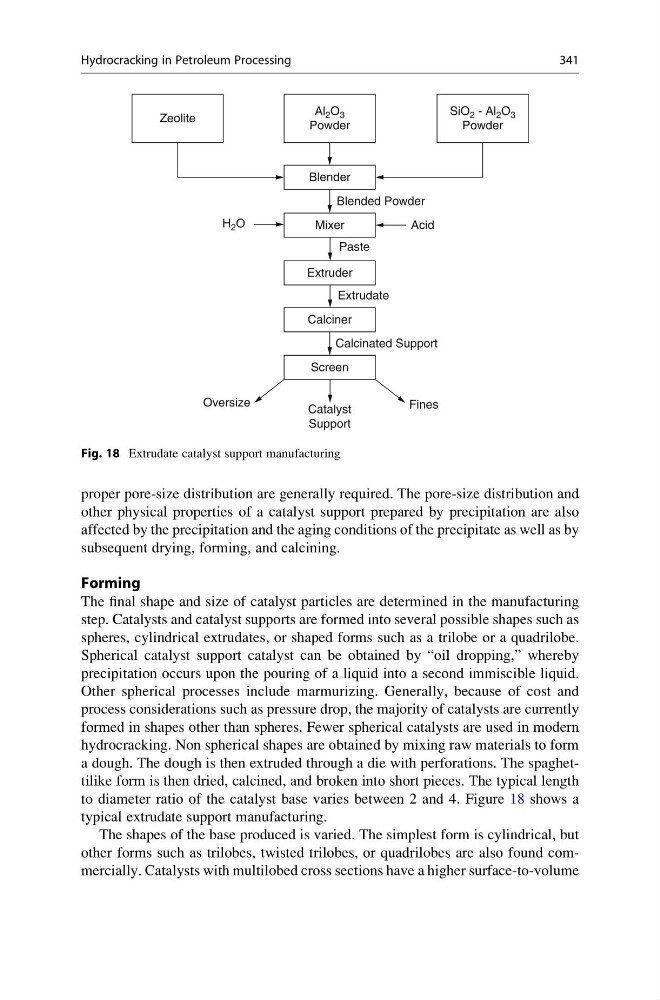
a dough. The dough is then extruded through a die with perforations. The spaghettilike form is then dried, calcined, and broken into short pieces. The typical length
to diameter ratio of the catalyst base varies between 2 and 4. Figure 18 shows a
typical extrudate support manufacturing.
The shapes of the base produced is varied. The simplest form is cylindrical, but
other forms such as trilobes, twisted trilobes, or quadrilobes are also found commercially. Catalysts with multilobed cross sections have a higher surface-to-volume
Zeolite
Al 2 O 3
Powder
Blender
Mixer
Extruder
Extrudate
Calciner
Screen
Catalyst
Support
Fines
Oversize
Calcinated Support
Acid
Blended Powder
SiO 2 - Al 2 O 3
Powder
H 2 O
Paste
Fig. 18 Extrudate catalyst support manufacturing
Hydrocracking in Petroleum Processing
341
other physical properties of a catalyst support prepared by precipitation are also
affected by the precipitation and the aging conditions of the precipitate as well as by
subsequent drying, forming, and calcining.
Forming
The final shape and size of catalyst particles are determined in the manufacturing
step. Catalysts and catalyst supports are formed into several possible shapes such as
spheres, cylindrical extrudates, or shaped forms such as a trilobe or a quadrilobe.
Spherical catalyst support catalyst can be obtained by “oil dropping,” whereby
precipitation occurs upon the pouring of a liquid into a second immiscible liquid.
Other spherical processes include marmurizing. Generally, because of cost and
process considerations such as pressure drop, the majority of catalysts are currently
formed in shapes other than spheres. Fewer spherical catalysts are used in modern
hydrocracking. Non spherical shapes are obtained by mixing raw materials to form
a dough. The dough is then extruded through a die with perforations. The spaghettilike form is then dried, calcined, and broken into short pieces. The typical length
to diameter ratio of the catalyst base varies between 2 and 4. Figure 18 shows a
typical extrudate support manufacturing.
The shapes of the base produced is varied. The simplest form is cylindrical, but
other forms such as trilobes, twisted trilobes, or quadrilobes are also found commercially. Catalysts with multilobed cross sections have a higher surface-to-volume
Zeolite
Al 2 O 3
Powder
Blender
Mixer
Extruder
Extrudate
Calciner
Screen
Catalyst
Support
Fines
Oversize
Calcinated Support
Acid
Blended Powder
SiO 2 - Al 2 O 3
Powder
H 2 O
Paste
Fig. 18 Extrudate catalyst support manufacturing
Hydrocracking in Petroleum Processing
341