

properties, the details of that relationship are not always well understood due to the
complex nature of the catalyst systems. The chemical composition of the catalyst
plays a critical role in its performance; the physical and mechanical properties also
play a major role. The preparation of hydrocracking catalysts involves several
steps: precipitation, filtration (decantation, centrifugation), washing, drying,
forming, calcination, and impregnation. Other steps, such as kneading or mulling,
grinding, and sieving, may also be required. Depending on the preparation method
used, some of these steps may be eliminated, whereas other steps may be added. For
example, kneading or co-mulling of the wet solid precursors is used in some
processes instead of precipitation. When the metal precursors are precipitated or
co-mulled together with the support precursors, the impregnation step can be
eliminated. Described below are the steps that are an integral part of any hydrocracking catalyst manufacturing process.
Precipitation
Precipitation involves the mixing of solutions or suspension of materials, resulting
in the formation of a precipitate, which may be crystalline or amorphous. Mulling
or kneading of wet solid materials usually leads to the formation of dough that is
subsequently formed and dried. The mulled or kneaded product is subjected to
thermal treatment in order to obtain a more intimate contact between components
and better homogeneity by thermal diffusion and solid-state reactions. Precipitation
or mulling is often used to prepare the support for the catalyst, and the metal
component is subsequently added by impregnation or incipient wetting methods.
The support characteristics determine the mechanical properties of the catalyst,
such as attrition resistance, hardness, and crushing strength. High surface area and
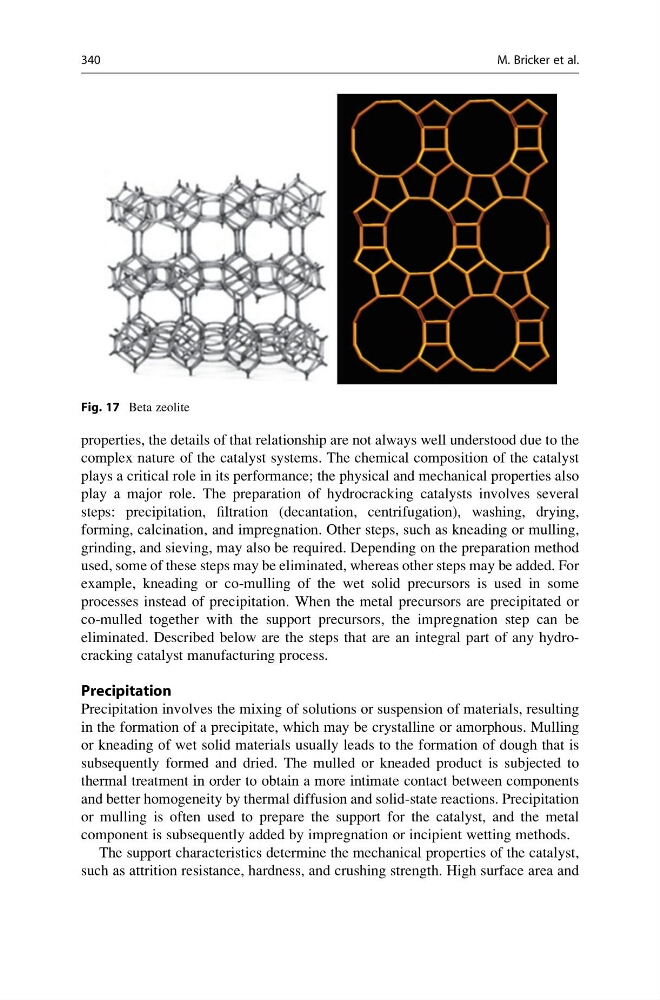
Fig. 17 Beta zeolite
340
M. Bricker et al.
complex nature of the catalyst systems. The chemical composition of the catalyst
plays a critical role in its performance; the physical and mechanical properties also
play a major role. The preparation of hydrocracking catalysts involves several
steps: precipitation, filtration (decantation, centrifugation), washing, drying,
forming, calcination, and impregnation. Other steps, such as kneading or mulling,
grinding, and sieving, may also be required. Depending on the preparation method
used, some of these steps may be eliminated, whereas other steps may be added. For
example, kneading or co-mulling of the wet solid precursors is used in some
processes instead of precipitation. When the metal precursors are precipitated or
co-mulled together with the support precursors, the impregnation step can be
eliminated. Described below are the steps that are an integral part of any hydrocracking catalyst manufacturing process.
Precipitation
Precipitation involves the mixing of solutions or suspension of materials, resulting
in the formation of a precipitate, which may be crystalline or amorphous. Mulling
or kneading of wet solid materials usually leads to the formation of dough that is
subsequently formed and dried. The mulled or kneaded product is subjected to
thermal treatment in order to obtain a more intimate contact between components
and better homogeneity by thermal diffusion and solid-state reactions. Precipitation
or mulling is often used to prepare the support for the catalyst, and the metal
component is subsequently added by impregnation or incipient wetting methods.
The support characteristics determine the mechanical properties of the catalyst,
such as attrition resistance, hardness, and crushing strength. High surface area and
Fig. 17 Beta zeolite
340
M. Bricker et al.