

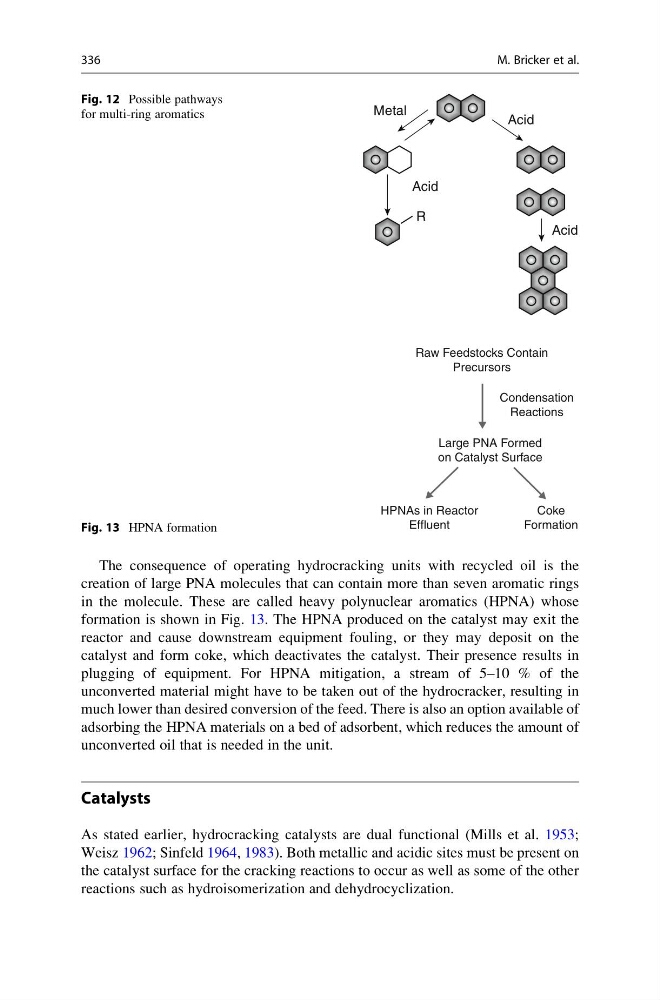
The consequence of operating hydrocracking units with recycled oil is the
creation of large PNA molecules that can contain more than seven aromatic rings
in the molecule. These are called heavy polynuclear aromatics (HPNA) whose
formation is shown in Fig. 13. The HPNA produced on the catalyst may exit the
reactor and cause downstream equipment fouling, or they may deposit on the
catalyst and form coke, which deactivates the catalyst. Their presence results in
plugging of equipment. For HPNA mitigation, a stream of 5–10 % of the
unconverted material might have to be taken out of the hydrocracker, resulting in
much lower than desired conversion of the feed. There is also an option available of
adsorbing the HPNA materials on a bed of adsorbent, which reduces the amount of
unconverted oil that is needed in the unit.
Catalysts
As stated earlier, hydrocracking catalysts are dual functional (Mills et al. 1953;
Weisz 1962; Sinfeld 1964, 1983). Both metallic and acidic sites must be present on
the catalyst surface for the cracking reactions to occur as well as some of the other
reactions such as hydroisomerization and dehydrocyclization.
Metal
Acid
R
Acid
Acid
Fig. 12 Possible pathways
for multi-ring aromatics
Raw Feedstocks Contain
Precursors
Condensation
Reactions
Large PNA Formed
on Catalyst Surface
HPNAs in Reactor
Effluent
Coke
Formation
Fig. 13 HPNA formation
336
M. Bricker et al.
creation of large PNA molecules that can contain more than seven aromatic rings
in the molecule. These are called heavy polynuclear aromatics (HPNA) whose
formation is shown in Fig. 13. The HPNA produced on the catalyst may exit the
reactor and cause downstream equipment fouling, or they may deposit on the
catalyst and form coke, which deactivates the catalyst. Their presence results in
plugging of equipment. For HPNA mitigation, a stream of 5–10 % of the
unconverted material might have to be taken out of the hydrocracker, resulting in
much lower than desired conversion of the feed. There is also an option available of
adsorbing the HPNA materials on a bed of adsorbent, which reduces the amount of
unconverted oil that is needed in the unit.
Catalysts
As stated earlier, hydrocracking catalysts are dual functional (Mills et al. 1953;
Weisz 1962; Sinfeld 1964, 1983). Both metallic and acidic sites must be present on
the catalyst surface for the cracking reactions to occur as well as some of the other
reactions such as hydroisomerization and dehydrocyclization.
Metal
Acid
R
Acid
Acid
Fig. 12 Possible pathways
for multi-ring aromatics
Raw Feedstocks Contain
Precursors
Condensation
Reactions
Large PNA Formed
on Catalyst Surface
HPNAs in Reactor
Effluent
Coke
Formation
Fig. 13 HPNA formation
336
M. Bricker et al.