

The metals providing the hydrogenation function can be noble metals (palladium, platinum) or non-noble (also called “base”) metal sulfides from group VIA
(molybdenum, tungsten) and group VIllA (cobalt, nickel). As previously discussed,
these metals catalyze the hydrogenation of the feedstock, making it more reactive
for cracking and heteroatom removal, as well as reducing the coking rate. They also
initiate the cracking by forming a reactive olefin intermediate via dehydrogenation.
The ratio between the catalyst’s cracking function and hydrogenation function can
be adjusted in order to optimize activity and selectivity. For a hydrocracking
catalyst to be effective, it is important that there be a rapid molecular transfer
between the acid sites and hydrogenation sites in order to avoid undesirable
secondary reactions. Rapid molecular transfer can be achieved by having the
hydrogenation sites located in the proximity of the cracking (acid) sites.
Acid Function of the Catalyst
Cracking and isomerization reactions take place on the acidic support. Amorphous
silica-alumina (ASA) provides the cracking function of amorphous catalysts and
serves as support for the hydrogenation metals. Sometimes, ASA catalysts or a
combination of ASA and zeolite can be used to produce high-yield distillate
hydrocracking catalysts. Amorphous silica-alumina also plays a catalytic role in
low-zeolite catalysts. Zeolites particularly Y and beta are commonly used in highactivity distillate-selective catalysts and in hydrocracking catalysts for the production of naphtha. Other acidic support components such as acid-treated clays,
pillared clays, layered silicates, acid metal phosphates, and other solid acids have
been tried in the past; however, present-day hydrocracking catalysts do not contain
any of these materials.
Amorphous mixed-metal oxide supports are acidic because of the difference in
charge between adjacent cations in the oxide structure. The advantages of ASA for
hydrocracking are their large pores, which permit access of bulky feedstock molecules to the acidic sites, and moderate activity, which makes the metal-acid
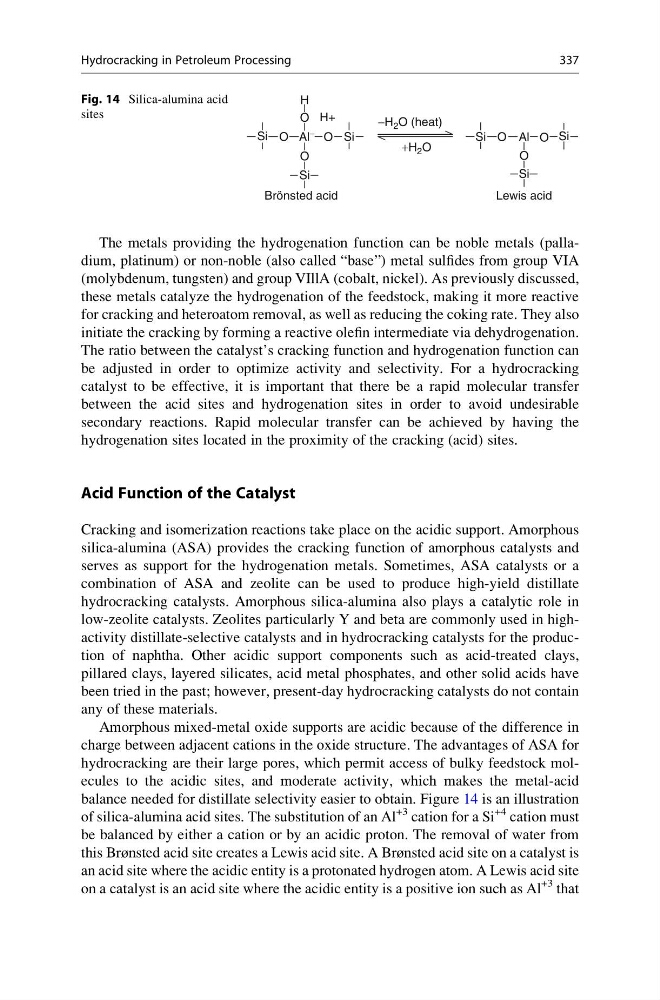
balance needed for distillate selectivity easier to obtain. Figure 14 is an illustration
of silica-alumina acid sites. The substitution of an Al
+3 cation for a Si
+4 cation must
be balanced by either a cation or by an acidic proton. The removal of water from
this Brønsted acid site creates a Lewis acid site. A Brønsted acid site on a catalyst is
an acid site where the acidic entity is a protonated hydrogen atom. A Lewis acid site
on a catalyst is an acid site where the acidic entity is a positive ion such as Al
+3 that
H
−H 2 O (heat)
+H 2 O
O
O
Brönsted acid
Lewis acid
O
O
S i
Si
Si
Al
−
H+
O
O
O
Si
Si
Si
Al
Fig. 14 Silica-alumina acid
sites
Hydrocracking in Petroleum Processing
337
(molybdenum, tungsten) and group VIllA (cobalt, nickel). As previously discussed,
these metals catalyze the hydrogenation of the feedstock, making it more reactive
for cracking and heteroatom removal, as well as reducing the coking rate. They also
initiate the cracking by forming a reactive olefin intermediate via dehydrogenation.
The ratio between the catalyst’s cracking function and hydrogenation function can
be adjusted in order to optimize activity and selectivity. For a hydrocracking
catalyst to be effective, it is important that there be a rapid molecular transfer
between the acid sites and hydrogenation sites in order to avoid undesirable
secondary reactions. Rapid molecular transfer can be achieved by having the
hydrogenation sites located in the proximity of the cracking (acid) sites.
Acid Function of the Catalyst
Cracking and isomerization reactions take place on the acidic support. Amorphous
silica-alumina (ASA) provides the cracking function of amorphous catalysts and
serves as support for the hydrogenation metals. Sometimes, ASA catalysts or a
combination of ASA and zeolite can be used to produce high-yield distillate
hydrocracking catalysts. Amorphous silica-alumina also plays a catalytic role in
low-zeolite catalysts. Zeolites particularly Y and beta are commonly used in highactivity distillate-selective catalysts and in hydrocracking catalysts for the production of naphtha. Other acidic support components such as acid-treated clays,
pillared clays, layered silicates, acid metal phosphates, and other solid acids have
been tried in the past; however, present-day hydrocracking catalysts do not contain
any of these materials.
Amorphous mixed-metal oxide supports are acidic because of the difference in
charge between adjacent cations in the oxide structure. The advantages of ASA for
hydrocracking are their large pores, which permit access of bulky feedstock molecules to the acidic sites, and moderate activity, which makes the metal-acid
balance needed for distillate selectivity easier to obtain. Figure 14 is an illustration
of silica-alumina acid sites. The substitution of an Al
+3 cation for a Si
+4 cation must
be balanced by either a cation or by an acidic proton. The removal of water from
this Brønsted acid site creates a Lewis acid site. A Brønsted acid site on a catalyst is
an acid site where the acidic entity is a protonated hydrogen atom. A Lewis acid site
on a catalyst is an acid site where the acidic entity is a positive ion such as Al
+3 that
H
−H 2 O (heat)
+H 2 O
O
O
Brönsted acid
Lewis acid
O
O
S i
Si
Si
Al
−
H+
O
O
O
Si
Si
Si
Al
Fig. 14 Silica-alumina acid
sites
Hydrocracking in Petroleum Processing
337