

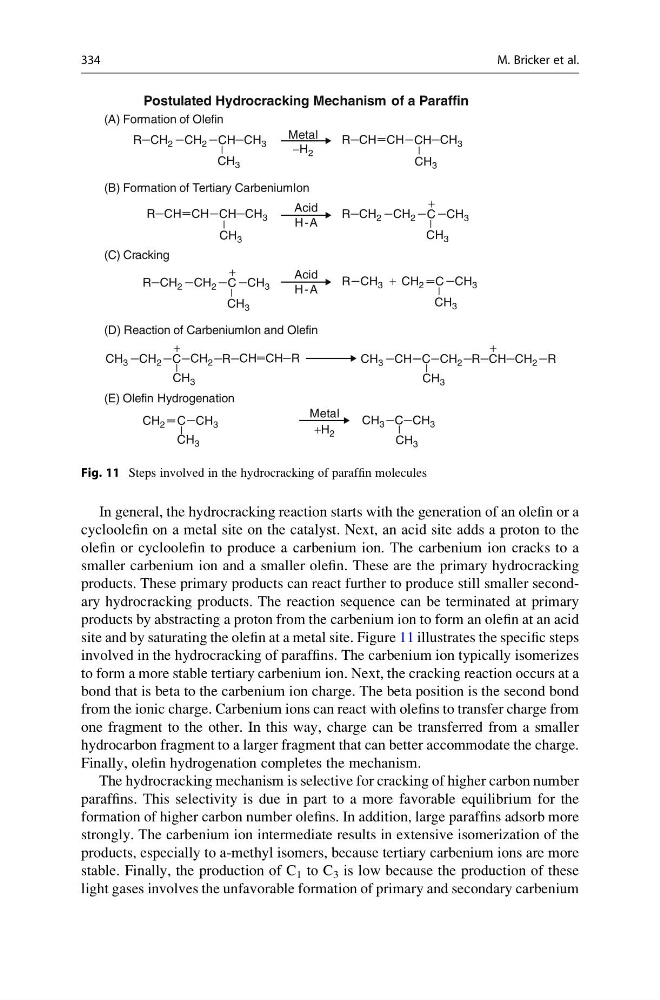
In general, the hydrocracking reaction starts with the generation of an olefin or a
cycloolefin on a metal site on the catalyst. Next, an acid site adds a proton to the
olefin or cycloolefin to produce a carbenium ion. The carbenium ion cracks to a
smaller carbenium ion and a smaller olefin. These are the primary hydrocracking
products. These primary products can react further to produce still smaller secondary hydrocracking products. The reaction sequence can be terminated at primary
products by abstracting a proton from the carbenium ion to form an olefin at an acid
site and by saturating the olefin at a metal site. Figure 11 illustrates the specific steps
involved in the hydrocracking of paraffins. The carbenium ion typically isomerizes
to form a more stable tertiary carbenium ion. Next, the cracking reaction occurs at a
bond that is beta to the carbenium ion charge. The beta position is the second bond
from the ionic charge. Carbenium ions can react with olefins to transfer charge from
one fragment to the other. In this way, charge can be transferred from a smaller
hydrocarbon fragment to a larger fragment that can better accommodate the charge.
Finally, olefin hydrogenation completes the mechanism.
The hydrocracking mechanism is selective for cracking of higher carbon number
paraffins. This selectivity is due in part to a more favorable equilibrium for the
formation of higher carbon number olefins. In addition, large paraffins adsorb more
strongly. The carbenium ion intermediate results in extensive isomerization of the
products, especially to a-methyl isomers, because tertiary carbenium ions are more
stable. Finally, the production of C 1 to C 3 is low because the production of these
light gases involves the unfavorable formation of primary and secondary carbenium
Postulated Hydrocracking Mechanism of a Paraffin
(A) Formation of Olefin
(B) Formation of Tertiary CarbeniumIon
(C) Cracking
(D) Reaction of CarbeniumIon and Olefin
(E) Olefin Hydrogenation
+
R
C H 2
CH 2
CH
CH 3
CH 3
R
C H 2
CH 2
C
CH 3
CH 3
+
R
C H 2
CH 3
C
CH 3
CH 3
+
R
C H 2
CH 2
C
CH 3
CH 3
R
C H
CH
CH
CH 3
CH 3
R
C H
CH
CH
CH 3
CH 3
CH 3 CH 2 C
CH 3
CH 2 R
CH
CH
R
+
CH 3 CH C
CH 3
CH 2 R
CH 2
CH
R
+
CH 2 C
CH 3
CH 3
C
CH 3
CH 3
CH 3
Metal
Acid
H-A
−H 2
Acid
H-A
Metal
+H 2
Fig. 11 Steps involved in the hydrocracking of paraffin molecules
334
M. Bricker et al.
cycloolefin on a metal site on the catalyst. Next, an acid site adds a proton to the
olefin or cycloolefin to produce a carbenium ion. The carbenium ion cracks to a
smaller carbenium ion and a smaller olefin. These are the primary hydrocracking
products. These primary products can react further to produce still smaller secondary hydrocracking products. The reaction sequence can be terminated at primary
products by abstracting a proton from the carbenium ion to form an olefin at an acid
site and by saturating the olefin at a metal site. Figure 11 illustrates the specific steps
involved in the hydrocracking of paraffins. The carbenium ion typically isomerizes
to form a more stable tertiary carbenium ion. Next, the cracking reaction occurs at a
bond that is beta to the carbenium ion charge. The beta position is the second bond
from the ionic charge. Carbenium ions can react with olefins to transfer charge from
one fragment to the other. In this way, charge can be transferred from a smaller
hydrocarbon fragment to a larger fragment that can better accommodate the charge.
Finally, olefin hydrogenation completes the mechanism.
The hydrocracking mechanism is selective for cracking of higher carbon number
paraffins. This selectivity is due in part to a more favorable equilibrium for the
formation of higher carbon number olefins. In addition, large paraffins adsorb more
strongly. The carbenium ion intermediate results in extensive isomerization of the
products, especially to a-methyl isomers, because tertiary carbenium ions are more
stable. Finally, the production of C 1 to C 3 is low because the production of these
light gases involves the unfavorable formation of primary and secondary carbenium
Postulated Hydrocracking Mechanism of a Paraffin
(A) Formation of Olefin
(B) Formation of Tertiary CarbeniumIon
(C) Cracking
(D) Reaction of CarbeniumIon and Olefin
(E) Olefin Hydrogenation
+
R
C H 2
CH 2
CH
CH 3
CH 3
R
C H 2
CH 2
C
CH 3
CH 3
+
R
C H 2
CH 3
C
CH 3
CH 3
+
R
C H 2
CH 2
C
CH 3
CH 3
R
C H
CH
CH
CH 3
CH 3
R
C H
CH
CH
CH 3
CH 3
CH 3 CH 2 C
CH 3
CH 2 R
CH
CH
R
+
CH 3 CH C
CH 3
CH 2 R
CH 2
CH
R
+
CH 2 C
CH 3
CH 3
C
CH 3
CH 3
CH 3
Metal
Acid
H-A
−H 2
Acid
H-A
Metal
+H 2
Fig. 11 Steps involved in the hydrocracking of paraffin molecules
334
M. Bricker et al.