

and aromatic saturation. Figure 9 shows the evolution of the reactions in the
hydrotreating reactor. Hydrogen is consumed in all of the treating reactions. As a
guideline, the desulfurization reactions consume 100–150 SCFB/wt% S change
(17–25 Nm
3 /m
3 /wt% change), and denitrogenation reactions consume 200–350
SCFB/wt% N change (34–59 Nm
3 /m
3 /wt% change). Typically the heat release in
the hydrotreating section is about 0.1–0.2
F/SCFB H 2 .
Hydrocracking Reactions
Hydrocracking reactions proceed through a bifunctional mechanism (Mills
et al. 1953; Weisz 1962; Sinfeld 1964, 1983). Two distinct types of catalytic sites
are required to catalyze the separate steps in the reaction sequence. The acid
function provides for cracking and isomerization, and the metal function provides
for olefin formation and hydrogenation. The cracking reaction requires heat, while
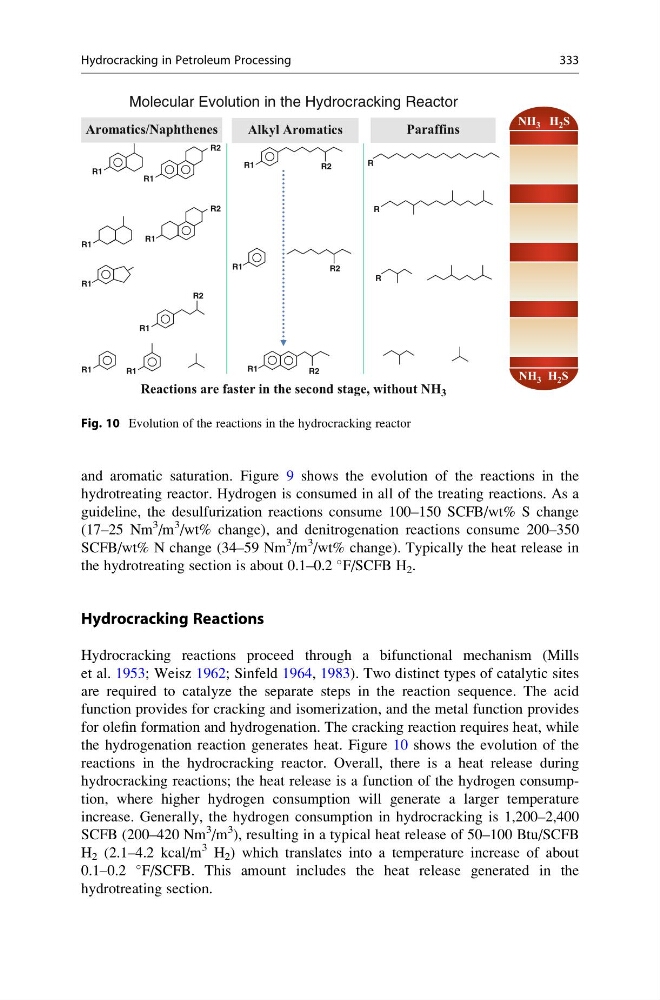
the hydrogenation reaction generates heat. Figure 10 shows the evolution of the
reactions in the hydrocracking reactor. Overall, there is a heat release during
hydrocracking reactions; the heat release is a function of the hydrogen consumption, where higher hydrogen consumption will generate a larger temperature
increase. Generally, the hydrogen consumption in hydrocracking is 1,200–2,400
SCFB (200–420 Nm
3 /m
3 ), resulting in a typical heat release of 50–100 Btu/SCFB
H 2 (2.1–4.2 kcal/m
3 H 2 ) which translates into a temperature increase of about
0.1–0.2
F/SCFB. This amount includes the heat release generated in the
hydrotreating section.
NH 3 H 2 S
NH 3 H 2 S
Molecular Evolution in the Hydrocracking Reactor
Alkyl Aromatics
Paraffins
Aromatics/Naphthenes
R1
R2
R1
R1
R1
R2
R1
R1
R2
R1
R1
R2
R1
R1
R2
R1
R2
R
R
R
Reactions are faster in the second stage, without NH 3
Fig. 10 Evolution of the reactions in the hydrocracking reactor
Hydrocracking in Petroleum Processing
333
hydrotreating reactor. Hydrogen is consumed in all of the treating reactions. As a
guideline, the desulfurization reactions consume 100–150 SCFB/wt% S change
(17–25 Nm
3 /m
3 /wt% change), and denitrogenation reactions consume 200–350
SCFB/wt% N change (34–59 Nm
3 /m
3 /wt% change). Typically the heat release in
the hydrotreating section is about 0.1–0.2
F/SCFB H 2 .
Hydrocracking Reactions
Hydrocracking reactions proceed through a bifunctional mechanism (Mills
et al. 1953; Weisz 1962; Sinfeld 1964, 1983). Two distinct types of catalytic sites
are required to catalyze the separate steps in the reaction sequence. The acid
function provides for cracking and isomerization, and the metal function provides
for olefin formation and hydrogenation. The cracking reaction requires heat, while
the hydrogenation reaction generates heat. Figure 10 shows the evolution of the
reactions in the hydrocracking reactor. Overall, there is a heat release during
hydrocracking reactions; the heat release is a function of the hydrogen consumption, where higher hydrogen consumption will generate a larger temperature
increase. Generally, the hydrogen consumption in hydrocracking is 1,200–2,400
SCFB (200–420 Nm
3 /m
3 ), resulting in a typical heat release of 50–100 Btu/SCFB
H 2 (2.1–4.2 kcal/m
3 H 2 ) which translates into a temperature increase of about
0.1–0.2
F/SCFB. This amount includes the heat release generated in the
hydrotreating section.
NH 3 H 2 S
NH 3 H 2 S
Molecular Evolution in the Hydrocracking Reactor
Alkyl Aromatics
Paraffins
Aromatics/Naphthenes
R1
R2
R1
R1
R1
R2
R1
R1
R2
R1
R1
R2
R1
R1
R2
R1
R2
R
R
R
Reactions are faster in the second stage, without NH 3
Fig. 10 Evolution of the reactions in the hydrocracking reactor
Hydrocracking in Petroleum Processing
333