

Catalyst selectivity is a measure of the rate of formation of a desired product
relative to the rate of conversion of the feed (or formation of other products).
Hydrocracking selectivity is expressed as the yield of desired product at a specific
conversion. Yield is determined by the rate of formation of the desired product
relative to the feed rate. At 100 % conversion, catalyst yield equals catalyst
selectivity. Hydrocracking selectivity is affected by operating conditions. In general, more severe operating conditions cause higher selectivity to secondary
products.
Catalyst stability is a measure of change of reaction rate over time. Hydrocrackers are typically operated in the constant conversion mode, with temperature
adjustments made to maintain the desired conversion. Hydrocracking activity
stability is defined as the temperature change per time required for maintaining
constant conversion. Changes in product yield over time also occur. Hydrocracking
yield stability is defined as the yield change with time at constant conversion and is
usually expressed as a function of temperature.
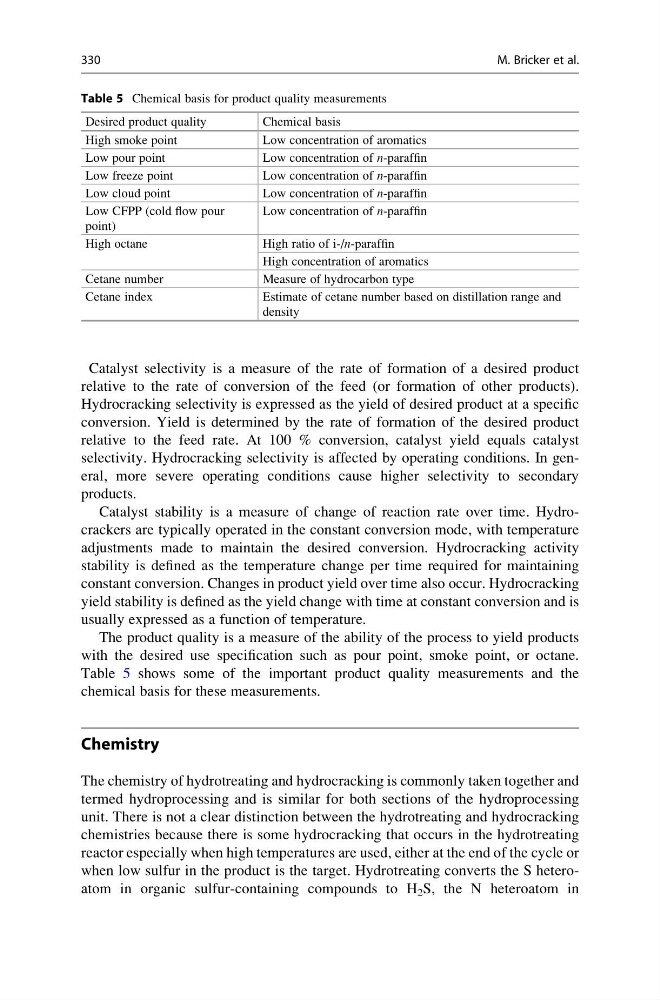
The product quality is a measure of the ability of the process to yield products
with the desired use specification such as pour point, smoke point, or octane.
Table 5 shows some of the important product quality measurements and the
chemical basis for these measurements.
Chemistry
The chemistry of hydrotreating and hydrocracking is commonly taken together and
termed hydroprocessing and is similar for both sections of the hydroprocessing
unit. There is not a clear distinction between the hydrotreating and hydrocracking
chemistries because there is some hydrocracking that occurs in the hydrotreating
reactor especially when high temperatures are used, either at the end of the cycle or
when low sulfur in the product is the target. Hydrotreating converts the S heteroatom in organic sulfur-containing compounds to H 2 S, the N heteroatom in
Table 5 Chemical basis for product quality measurements
Desired product quality
Chemical basis
High smoke point
Low concentration of aromatics
Low pour point
Low concentration of n-paraffin
Low freeze point
Low concentration of n-paraffin
Low cloud point
Low concentration of n-paraffin
Low CFPP (cold flow pour
point)
Low concentration of n-paraffin
High octane
High ratio of i-/n-paraffin
High concentration of aromatics
Cetane number
Measure of hydrocarbon type
Cetane index
Estimate of cetane number based on distillation range and
density
330
M. Bricker et al.
relative to the rate of conversion of the feed (or formation of other products).
Hydrocracking selectivity is expressed as the yield of desired product at a specific
conversion. Yield is determined by the rate of formation of the desired product
relative to the feed rate. At 100 % conversion, catalyst yield equals catalyst
selectivity. Hydrocracking selectivity is affected by operating conditions. In general, more severe operating conditions cause higher selectivity to secondary
products.
Catalyst stability is a measure of change of reaction rate over time. Hydrocrackers are typically operated in the constant conversion mode, with temperature
adjustments made to maintain the desired conversion. Hydrocracking activity
stability is defined as the temperature change per time required for maintaining
constant conversion. Changes in product yield over time also occur. Hydrocracking
yield stability is defined as the yield change with time at constant conversion and is
usually expressed as a function of temperature.
The product quality is a measure of the ability of the process to yield products
with the desired use specification such as pour point, smoke point, or octane.
Table 5 shows some of the important product quality measurements and the
chemical basis for these measurements.
Chemistry
The chemistry of hydrotreating and hydrocracking is commonly taken together and
termed hydroprocessing and is similar for both sections of the hydroprocessing
unit. There is not a clear distinction between the hydrotreating and hydrocracking
chemistries because there is some hydrocracking that occurs in the hydrotreating
reactor especially when high temperatures are used, either at the end of the cycle or
when low sulfur in the product is the target. Hydrotreating converts the S heteroatom in organic sulfur-containing compounds to H 2 S, the N heteroatom in
Table 5 Chemical basis for product quality measurements
Desired product quality
Chemical basis
High smoke point
Low concentration of aromatics
Low pour point
Low concentration of n-paraffin
Low freeze point
Low concentration of n-paraffin
Low cloud point
Low concentration of n-paraffin
Low CFPP (cold flow pour
point)
Low concentration of n-paraffin
High octane
High ratio of i-/n-paraffin
High concentration of aromatics
Cetane number
Measure of hydrocarbon type
Cetane index
Estimate of cetane number based on distillation range and
density
330
M. Bricker et al.