

• To cool the partially reacted fluids with hydrogen quench gas
• To assure a uniform temperature distribution of the fluids entering the next
catalyst bed
• To mix efficiently and disperse evenly the fluids over the top of the next catalyst bed
Furthermore, the temperature distribution in the cooled fluids entering the next
catalyst bed has to be uniform in order to minimize the radial temperature gradients
in successive catalyst beds. Unbalanced temperatures in a catalyst bed could result
in different reaction rates in the same bed. This can lead to different deactivation
rates of the catalyst and, in worse cases, to temperature excursions.
It is also important to achieve a good mass flow distribution. The effective vapor/
liquid mixing and uniform distribution of fluids over the top of the catalyst bed,
accomplished in the quench zone, reestablishes an even mass flow distribution
through the catalyst bed. Another important parameter is liquid flux (lb/h/ft
2 of
cross-sectional area). While gas mass flux has practically no influence on liquid
distribution, liquid mass flux is determinant in avoiding poor distribution in the
catalyst bed. Operation at a liquid mass flux of more than 2,000 lb/h/ft
2 is
recommended; operation at liquid fluxes lower than 1,500 lb/h/ft
2 is discouraged.
Furthermore, if the liquid mass flux is below the recommended limit, increasing the
gas mass flux may not improve the liquid distribution.
Hydrocracking Reactor Operation
During operation, the hydrocracking catalyst gradually loses its activity. In order to
maintain constant conversion of feedstock to products, the average bed temperature is
gradually increased. The temperature increase in many cases is very small, less than
2
F/month (1
C/month). When the average bed temperature reaches a value close to
the design maximum, the catalyst has to be replaced or reactivated. Because the
required temperature increase per unit time is relatively small, the reactor can be
operated with the same catalyst for several years before replacement of the deactivated
catalyst becomes necessary. Similar changes take place in the pretreating reactor.
The rates of reaction determine the key properties of a hydrocracking catalyst:
initial activity, selectivity, stability, and product quality. The temperature required to
obtain the desired product at the start of the run measures the initial activity. In
general, the catalyst activity is a measure of the relative rate of feedstock conversion.
In hydrocracking, activity is defined as the required temperature obtaining a fixed
conversion under certain process conditions. Hydrocracking conversion is usually
defined in terms of shifting molecules above a specified true boiling point (TBP) to
products boiling below the same TBP, commonly referred to as a cut point:
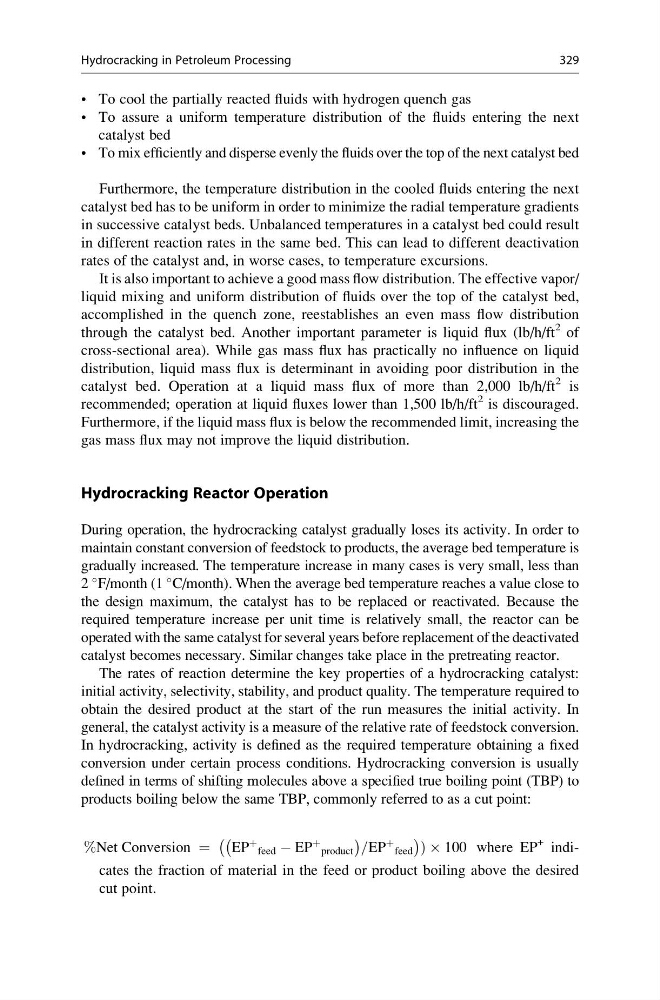
%Net Conversion ¼ EP
þ
feed À EP
þ
product
À
Á =EP
þ
feed
À
Á Þ Â 100 where EP
+ indicates the fraction of material in the feed or product boiling above the desired
cut point.
Hydrocracking in Petroleum Processing
329
• To assure a uniform temperature distribution of the fluids entering the next
catalyst bed
• To mix efficiently and disperse evenly the fluids over the top of the next catalyst bed
Furthermore, the temperature distribution in the cooled fluids entering the next
catalyst bed has to be uniform in order to minimize the radial temperature gradients
in successive catalyst beds. Unbalanced temperatures in a catalyst bed could result
in different reaction rates in the same bed. This can lead to different deactivation
rates of the catalyst and, in worse cases, to temperature excursions.
It is also important to achieve a good mass flow distribution. The effective vapor/
liquid mixing and uniform distribution of fluids over the top of the catalyst bed,
accomplished in the quench zone, reestablishes an even mass flow distribution
through the catalyst bed. Another important parameter is liquid flux (lb/h/ft
2 of
cross-sectional area). While gas mass flux has practically no influence on liquid
distribution, liquid mass flux is determinant in avoiding poor distribution in the
catalyst bed. Operation at a liquid mass flux of more than 2,000 lb/h/ft
2 is
recommended; operation at liquid fluxes lower than 1,500 lb/h/ft
2 is discouraged.
Furthermore, if the liquid mass flux is below the recommended limit, increasing the
gas mass flux may not improve the liquid distribution.
Hydrocracking Reactor Operation
During operation, the hydrocracking catalyst gradually loses its activity. In order to
maintain constant conversion of feedstock to products, the average bed temperature is
gradually increased. The temperature increase in many cases is very small, less than
2
F/month (1
C/month). When the average bed temperature reaches a value close to
the design maximum, the catalyst has to be replaced or reactivated. Because the
required temperature increase per unit time is relatively small, the reactor can be
operated with the same catalyst for several years before replacement of the deactivated
catalyst becomes necessary. Similar changes take place in the pretreating reactor.
The rates of reaction determine the key properties of a hydrocracking catalyst:
initial activity, selectivity, stability, and product quality. The temperature required to
obtain the desired product at the start of the run measures the initial activity. In
general, the catalyst activity is a measure of the relative rate of feedstock conversion.
In hydrocracking, activity is defined as the required temperature obtaining a fixed
conversion under certain process conditions. Hydrocracking conversion is usually
defined in terms of shifting molecules above a specified true boiling point (TBP) to
products boiling below the same TBP, commonly referred to as a cut point:
%Net Conversion ¼ EP
þ
feed À EP
þ
product
À
Á =EP
þ
feed
À
Á Þ Â 100 where EP
+ indicates the fraction of material in the feed or product boiling above the desired
cut point.
Hydrocracking in Petroleum Processing
329