

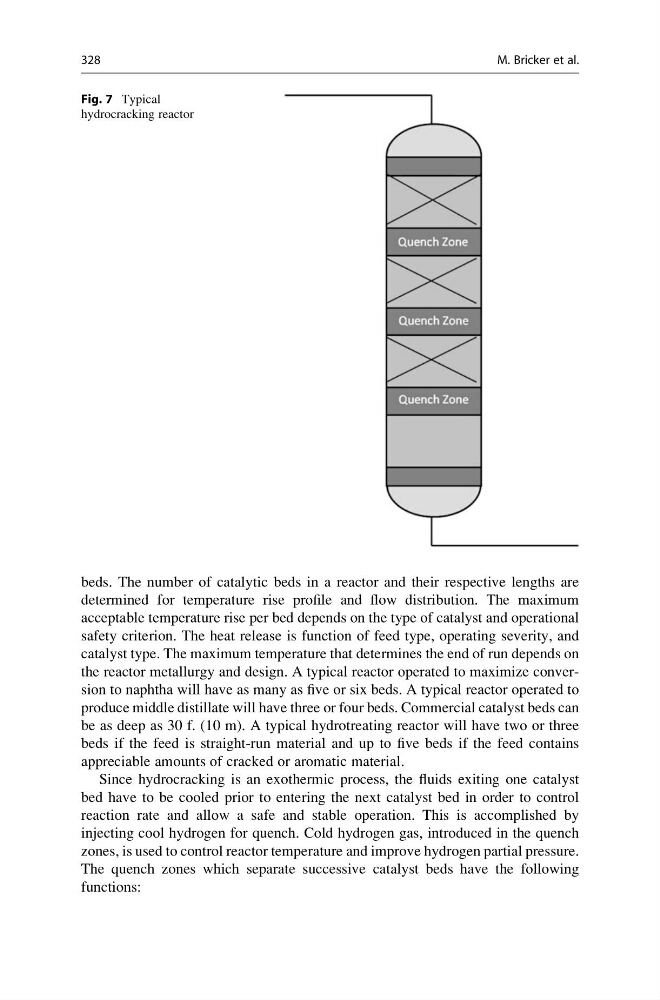
beds. The number of catalytic beds in a reactor and their respective lengths are
determined for temperature rise profile and flow distribution. The maximum
acceptable temperature rise per bed depends on the type of catalyst and operational
safety criterion. The heat release is function of feed type, operating severity, and
catalyst type. The maximum temperature that determines the end of run depends on
the reactor metallurgy and design. A typical reactor operated to maximize conversion to naphtha will have as many as five or six beds. A typical reactor operated to
produce middle distillate will have three or four beds. Commercial catalyst beds can
be as deep as 30 f. (10 m). A typical hydrotreating reactor will have two or three
beds if the feed is straight-run material and up to five beds if the feed contains
appreciable amounts of cracked or aromatic material.
Since hydrocracking is an exothermic process, the fluids exiting one catalyst
bed have to be cooled prior to entering the next catalyst bed in order to control
reaction rate and allow a safe and stable operation. This is accomplished by
injecting cool hydrogen for quench. Cold hydrogen gas, introduced in the quench
zones, is used to control reactor temperature and improve hydrogen partial pressure.
The quench zones which separate successive catalyst beds have the following
functions:
Fig. 7 Typical
hydrocracking reactor
328
M. Bricker et al.
determined for temperature rise profile and flow distribution. The maximum
acceptable temperature rise per bed depends on the type of catalyst and operational
safety criterion. The heat release is function of feed type, operating severity, and
catalyst type. The maximum temperature that determines the end of run depends on
the reactor metallurgy and design. A typical reactor operated to maximize conversion to naphtha will have as many as five or six beds. A typical reactor operated to
produce middle distillate will have three or four beds. Commercial catalyst beds can
be as deep as 30 f. (10 m). A typical hydrotreating reactor will have two or three
beds if the feed is straight-run material and up to five beds if the feed contains
appreciable amounts of cracked or aromatic material.
Since hydrocracking is an exothermic process, the fluids exiting one catalyst
bed have to be cooled prior to entering the next catalyst bed in order to control
reaction rate and allow a safe and stable operation. This is accomplished by
injecting cool hydrogen for quench. Cold hydrogen gas, introduced in the quench
zones, is used to control reactor temperature and improve hydrogen partial pressure.
The quench zones which separate successive catalyst beds have the following
functions:
Fig. 7 Typical
hydrocracking reactor
328
M. Bricker et al.