

Separate Hydrotreating with Two-Stage Hydrocracking
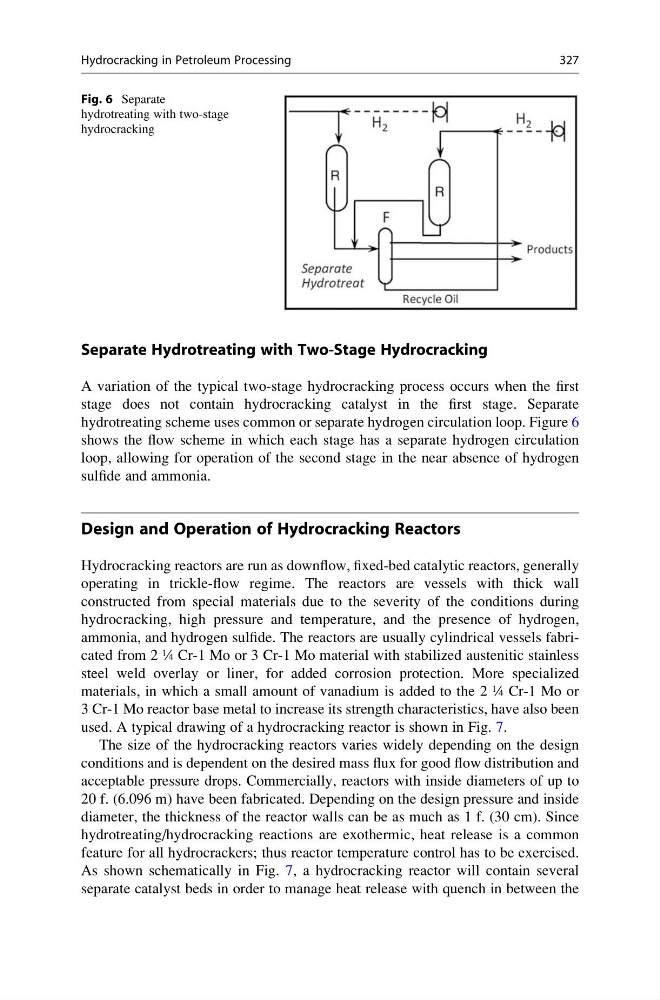
A variation of the typical two-stage hydrocracking process occurs when the first
stage does not contain hydrocracking catalyst in the first stage. Separate
hydrotreating scheme uses common or separate hydrogen circulation loop. Figure 6
shows the flow scheme in which each stage has a separate hydrogen circulation
loop, allowing for operation of the second stage in the near absence of hydrogen
sulfide and ammonia.
Design and Operation of Hydrocracking Reactors
Hydrocracking reactors are run as downflow, fixed-bed catalytic reactors, generally
operating in trickle-flow regime. The reactors are vessels with thick wall
constructed from special materials due to the severity of the conditions during
hydrocracking, high pressure and temperature, and the presence of hydrogen,
ammonia, and hydrogen sulfide. The reactors are usually cylindrical vessels fabricated from 2 ¼ Cr-1 Mo or 3 Cr-1 Mo material with stabilized austenitic stainless
steel weld overlay or liner, for added corrosion protection. More specialized
materials, in which a small amount of vanadium is added to the 2 ¼ Cr-1 Mo or
3 Cr-1 Mo reactor base metal to increase its strength characteristics, have also been
used. A typical drawing of a hydrocracking reactor is shown in Fig. 7.
The size of the hydrocracking reactors varies widely depending on the design
conditions and is dependent on the desired mass flux for good flow distribution and
acceptable pressure drops. Commercially, reactors with inside diameters of up to
20 f. (6.096 m) have been fabricated. Depending on the design pressure and inside
diameter, the thickness of the reactor walls can be as much as 1 f. (30 cm). Since
hydrotreating/hydrocracking reactions are exothermic, heat release is a common
feature for all hydrocrackers; thus reactor temperature control has to be exercised.
As shown schematically in Fig. 7, a hydrocracking reactor will contain several
separate catalyst beds in order to manage heat release with quench in between the
Fig. 6 Separate
hydrotreating with two-stage
hydrocracking
Hydrocracking in Petroleum Processing
327
A variation of the typical two-stage hydrocracking process occurs when the first
stage does not contain hydrocracking catalyst in the first stage. Separate
hydrotreating scheme uses common or separate hydrogen circulation loop. Figure 6
shows the flow scheme in which each stage has a separate hydrogen circulation
loop, allowing for operation of the second stage in the near absence of hydrogen
sulfide and ammonia.
Design and Operation of Hydrocracking Reactors
Hydrocracking reactors are run as downflow, fixed-bed catalytic reactors, generally
operating in trickle-flow regime. The reactors are vessels with thick wall
constructed from special materials due to the severity of the conditions during
hydrocracking, high pressure and temperature, and the presence of hydrogen,
ammonia, and hydrogen sulfide. The reactors are usually cylindrical vessels fabricated from 2 ¼ Cr-1 Mo or 3 Cr-1 Mo material with stabilized austenitic stainless
steel weld overlay or liner, for added corrosion protection. More specialized
materials, in which a small amount of vanadium is added to the 2 ¼ Cr-1 Mo or
3 Cr-1 Mo reactor base metal to increase its strength characteristics, have also been
used. A typical drawing of a hydrocracking reactor is shown in Fig. 7.
The size of the hydrocracking reactors varies widely depending on the design
conditions and is dependent on the desired mass flux for good flow distribution and
acceptable pressure drops. Commercially, reactors with inside diameters of up to
20 f. (6.096 m) have been fabricated. Depending on the design pressure and inside
diameter, the thickness of the reactor walls can be as much as 1 f. (30 cm). Since
hydrotreating/hydrocracking reactions are exothermic, heat release is a common
feature for all hydrocrackers; thus reactor temperature control has to be exercised.
As shown schematically in Fig. 7, a hydrocracking reactor will contain several
separate catalyst beds in order to manage heat release with quench in between the
Fig. 6 Separate
hydrotreating with two-stage
hydrocracking
Hydrocracking in Petroleum Processing
327