

unconverted materials which become feedstock for FCC units, ethylene plant,
or lube oil units. In general, the conversion of the feedstock to products is
30–80 vol.%, but a range as high as 90 vol.% is possible with some feeds.
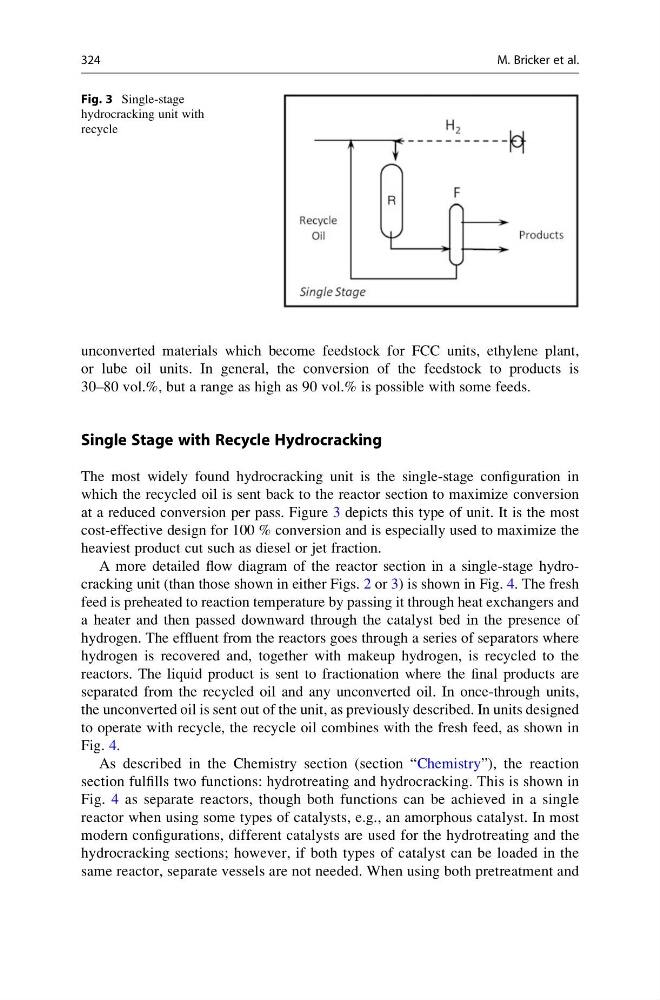
Single Stage with Recycle Hydrocracking
The most widely found hydrocracking unit is the single-stage configuration in
which the recycled oil is sent back to the reactor section to maximize conversion
at a reduced conversion per pass. Figure 3 depicts this type of unit. It is the most
cost-effective design for 100 % conversion and is especially used to maximize the
heaviest product cut such as diesel or jet fraction.
A more detailed flow diagram of the reactor section in a single-stage hydrocracking unit (than those shown in either Figs. 2 or 3) is shown in Fig. 4. The fresh
feed is preheated to reaction temperature by passing it through heat exchangers and
a heater and then passed downward through the catalyst bed in the presence of
hydrogen. The effluent from the reactors goes through a series of separators where
hydrogen is recovered and, together with makeup hydrogen, is recycled to the
reactors. The liquid product is sent to fractionation where the final products are
separated from the recycled oil and any unconverted oil. In once-through units,
the unconverted oil is sent out of the unit, as previously described. In units designed
to operate with recycle, the recycle oil combines with the fresh feed, as shown in
Fig. 4.
As described in the Chemistry section (section “Chemistry”), the reaction
section fulfills two functions: hydrotreating and hydrocracking. This is shown in
Fig. 4 as separate reactors, though both functions can be achieved in a single
reactor when using some types of catalysts, e.g., an amorphous catalyst. In most
modern configurations, different catalysts are used for the hydrotreating and the
hydrocracking sections; however, if both types of catalyst can be loaded in the
same reactor, separate vessels are not needed. When using both pretreatment and
Fig. 3 Single-stage
hydrocracking unit with
recycle
324
M. Bricker et al.
or lube oil units. In general, the conversion of the feedstock to products is
30–80 vol.%, but a range as high as 90 vol.% is possible with some feeds.
Single Stage with Recycle Hydrocracking
The most widely found hydrocracking unit is the single-stage configuration in
which the recycled oil is sent back to the reactor section to maximize conversion
at a reduced conversion per pass. Figure 3 depicts this type of unit. It is the most
cost-effective design for 100 % conversion and is especially used to maximize the
heaviest product cut such as diesel or jet fraction.
A more detailed flow diagram of the reactor section in a single-stage hydrocracking unit (than those shown in either Figs. 2 or 3) is shown in Fig. 4. The fresh
feed is preheated to reaction temperature by passing it through heat exchangers and
a heater and then passed downward through the catalyst bed in the presence of
hydrogen. The effluent from the reactors goes through a series of separators where
hydrogen is recovered and, together with makeup hydrogen, is recycled to the
reactors. The liquid product is sent to fractionation where the final products are
separated from the recycled oil and any unconverted oil. In once-through units,
the unconverted oil is sent out of the unit, as previously described. In units designed
to operate with recycle, the recycle oil combines with the fresh feed, as shown in
Fig. 4.
As described in the Chemistry section (section “Chemistry”), the reaction
section fulfills two functions: hydrotreating and hydrocracking. This is shown in
Fig. 4 as separate reactors, though both functions can be achieved in a single
reactor when using some types of catalysts, e.g., an amorphous catalyst. In most
modern configurations, different catalysts are used for the hydrotreating and the
hydrocracking sections; however, if both types of catalyst can be loaded in the
same reactor, separate vessels are not needed. When using both pretreatment and
Fig. 3 Single-stage
hydrocracking unit with
recycle
324
M. Bricker et al.