

introduced to the catalysts during the rapid growth of hydrocracking technology
during the 1960s. Zeolite-containing catalysts were significantly different than
amorphous catalysts; zeolites had higher activity and gasoline selectivity and better
ammonia tolerance (Baral and Huffman 1971; Bolton 1976). In the United States,
hydrocracking was primarily used in the production of high-octane gasoline, but in
the other parts of the world, it was used primarily for the production of middle
distillates. Different catalyst formulations are selected depending on the product
slate desired by the refiner.
Flow Schemes
Hydrocracking units can be configured in a number of ways. The unit can consist of
one or two reactors with either one or multiple catalysts. The process can use one or
two stages and be operated in once-through or recycle mode. The choice of the
configuration depends on the feed properties and the specific product slate desired
by the refiner. The five main types of operating units are mild, moderate/medium
pressure, conventional, partial conversion, and resid hydrocracking. These are
shown in Table 3.
Once-Through Configuration
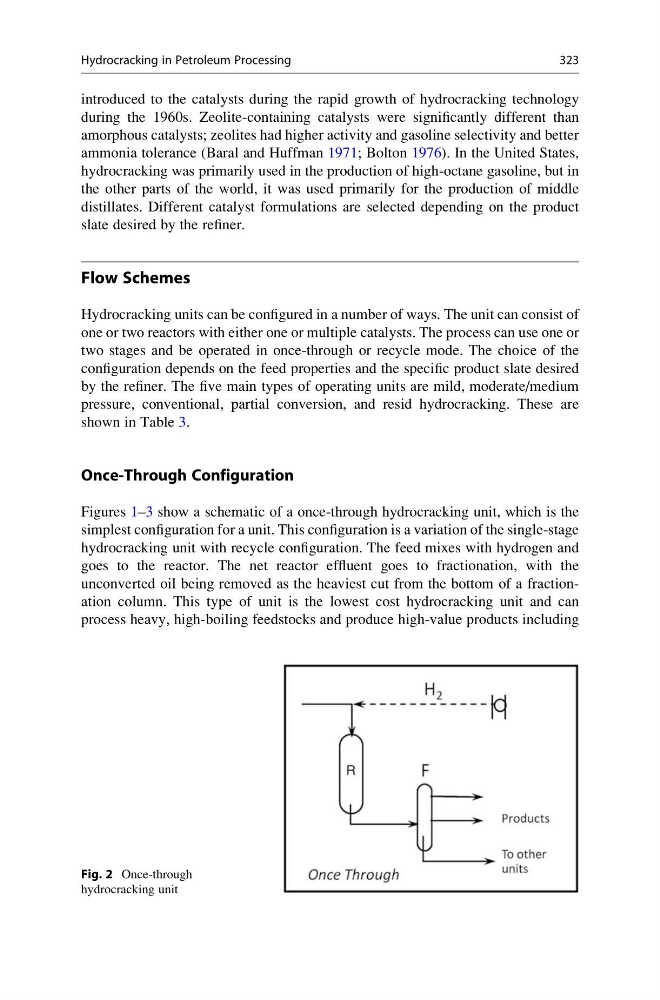
Figures 1–3 show a schematic of a once-through hydrocracking unit, which is the
simplest configuration for a unit. This configuration is a variation of the single-stage
hydrocracking unit with recycle configuration. The feed mixes with hydrogen and
goes to the reactor. The net reactor effluent goes to fractionation, with the
unconverted oil being removed as the heaviest cut from the bottom of a fractionation column. This type of unit is the lowest cost hydrocracking unit and can
process heavy, high-boiling feedstocks and produce high-value products including
Fig. 2 Once-through
hydrocracking unit
Hydrocracking in Petroleum Processing
323
during the 1960s. Zeolite-containing catalysts were significantly different than
amorphous catalysts; zeolites had higher activity and gasoline selectivity and better
ammonia tolerance (Baral and Huffman 1971; Bolton 1976). In the United States,
hydrocracking was primarily used in the production of high-octane gasoline, but in
the other parts of the world, it was used primarily for the production of middle
distillates. Different catalyst formulations are selected depending on the product
slate desired by the refiner.
Flow Schemes
Hydrocracking units can be configured in a number of ways. The unit can consist of
one or two reactors with either one or multiple catalysts. The process can use one or
two stages and be operated in once-through or recycle mode. The choice of the
configuration depends on the feed properties and the specific product slate desired
by the refiner. The five main types of operating units are mild, moderate/medium
pressure, conventional, partial conversion, and resid hydrocracking. These are
shown in Table 3.
Once-Through Configuration
Figures 1–3 show a schematic of a once-through hydrocracking unit, which is the
simplest configuration for a unit. This configuration is a variation of the single-stage
hydrocracking unit with recycle configuration. The feed mixes with hydrogen and
goes to the reactor. The net reactor effluent goes to fractionation, with the
unconverted oil being removed as the heaviest cut from the bottom of a fractionation column. This type of unit is the lowest cost hydrocracking unit and can
process heavy, high-boiling feedstocks and produce high-value products including
Fig. 2 Once-through
hydrocracking unit
Hydrocracking in Petroleum Processing
323