

hydrocracking capacity grew in the world and is expected to continue to grow over
the next decade (http://www.hydrocarbonpublishing.com). Even when a refiner in a
certain area of the world does not need the stringent specification for their region,
the process is designed for the stiffer requirement so that the refiners are able to
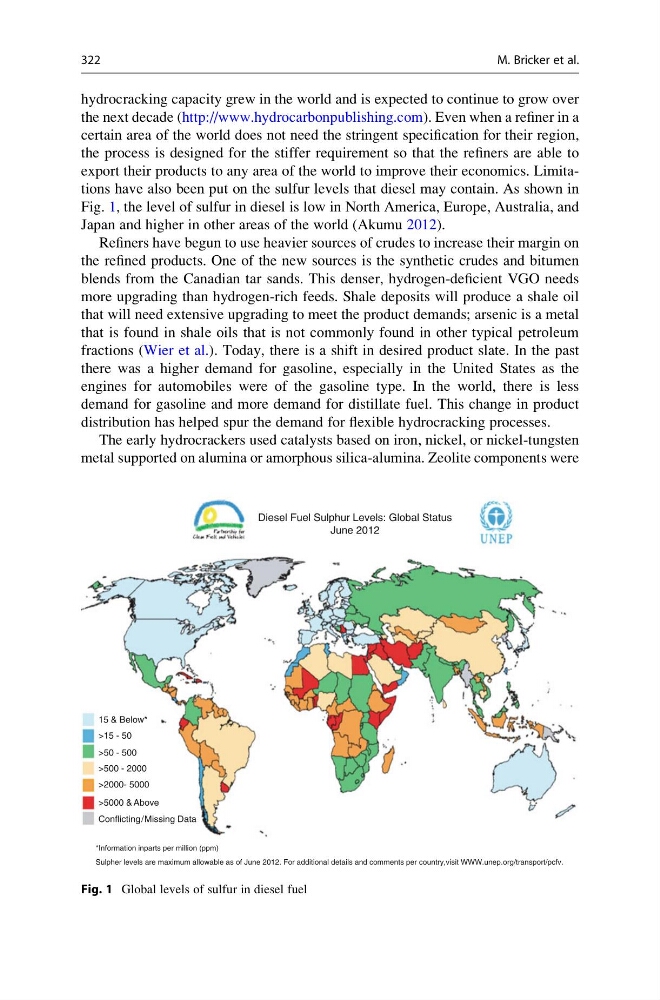
export their products to any area of the world to improve their economics. Limitations have also been put on the sulfur levels that diesel may contain. As shown in
Fig. 1, the level of sulfur in diesel is low in North America, Europe, Australia, and
Japan and higher in other areas of the world (Akumu 2012).
Refiners have begun to use heavier sources of crudes to increase their margin on
the refined products. One of the new sources is the synthetic crudes and bitumen
blends from the Canadian tar sands. This denser, hydrogen-deficient VGO needs
more upgrading than hydrogen-rich feeds. Shale deposits will produce a shale oil
that will need extensive upgrading to meet the product demands; arsenic is a metal
that is found in shale oils that is not commonly found in other typical petroleum
fractions (Wier et al.). Today, there is a shift in desired product slate. In the past
there was a higher demand for gasoline, especially in the United States as the
engines for automobiles were of the gasoline type. In the world, there is less
demand for gasoline and more demand for distillate fuel. This change in product
distribution has helped spur the demand for flexible hydrocracking processes.
The early hydrocrackers used catalysts based on iron, nickel, or nickel-tungsten
metal supported on alumina or amorphous silica-alumina. Zeolite components were
Diesel Fuel Sulphur Levels: Global Status
June 2012
15 & Below*
>15 - 50
>50 - 500
>500 - 2000
>2000- 5000
>5000 & Above
Conflicting/Missing Data
*Information inparts per million (ppm)
Sulpher levels are maximum allowable as of June 2012. For additional details and comments per country,visit WWW.unep.org/transport/pcfv.
Fig. 1 Global levels of sulfur in diesel fuel
322
M. Bricker et al.
the next decade (http://www.hydrocarbonpublishing.com). Even when a refiner in a
certain area of the world does not need the stringent specification for their region,
the process is designed for the stiffer requirement so that the refiners are able to
export their products to any area of the world to improve their economics. Limitations have also been put on the sulfur levels that diesel may contain. As shown in
Fig. 1, the level of sulfur in diesel is low in North America, Europe, Australia, and
Japan and higher in other areas of the world (Akumu 2012).
Refiners have begun to use heavier sources of crudes to increase their margin on
the refined products. One of the new sources is the synthetic crudes and bitumen
blends from the Canadian tar sands. This denser, hydrogen-deficient VGO needs
more upgrading than hydrogen-rich feeds. Shale deposits will produce a shale oil
that will need extensive upgrading to meet the product demands; arsenic is a metal
that is found in shale oils that is not commonly found in other typical petroleum
fractions (Wier et al.). Today, there is a shift in desired product slate. In the past
there was a higher demand for gasoline, especially in the United States as the
engines for automobiles were of the gasoline type. In the world, there is less
demand for gasoline and more demand for distillate fuel. This change in product
distribution has helped spur the demand for flexible hydrocracking processes.
The early hydrocrackers used catalysts based on iron, nickel, or nickel-tungsten
metal supported on alumina or amorphous silica-alumina. Zeolite components were
Diesel Fuel Sulphur Levels: Global Status
June 2012
15 & Below*
>15 - 50
>50 - 500
>500 - 2000
>2000- 5000
>5000 & Above
Conflicting/Missing Data
*Information inparts per million (ppm)
Sulpher levels are maximum allowable as of June 2012. For additional details and comments per country,visit WWW.unep.org/transport/pcfv.
Fig. 1 Global levels of sulfur in diesel fuel
322
M. Bricker et al.