

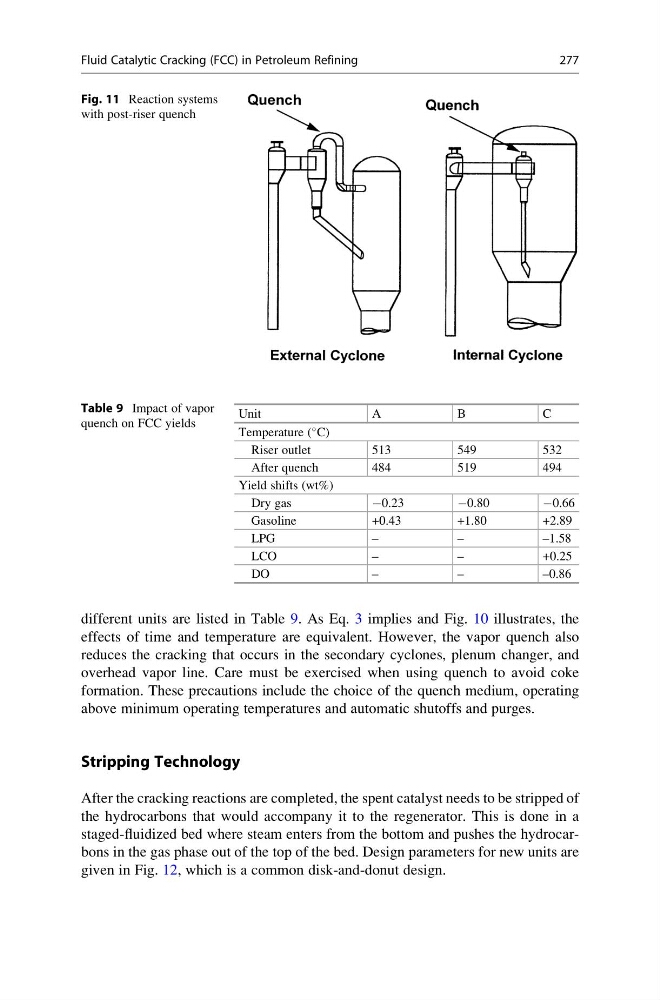
different units are listed in Table 9. As Eq. 3 implies and Fig. 10 illustrates, the
effects of time and temperature are equivalent. However, the vapor quench also
reduces the cracking that occurs in the secondary cyclones, plenum changer, and
overhead vapor line. Care must be exercised when using quench to avoid coke
formation. These precautions include the choice of the quench medium, operating
above minimum operating temperatures and automatic shutoffs and purges.
Stripping Technology
After the cracking reactions are completed, the spent catalyst needs to be stripped of
the hydrocarbons that would accompany it to the regenerator. This is done in a
staged-fluidized bed where steam enters from the bottom and pushes the hydrocarbons in the gas phase out of the top of the bed. Design parameters for new units are
given in Fig. 12, which is a common disk-and-donut design.
Fig. 11 Reaction systems
with post-riser quench
Table 9 Impact of vapor
quench on FCC yields
Unit
A
B
C
Temperature (
C)
Riser outlet
513
549
532
After quench
484
519
494
Yield shifts (wt%)
Dry gas
À0.23
À0.80
À0.66
Gasoline
+0.43
+1.80
+2.89
LPG
–
–
–1.58
LCO
–
–
+0.25
DO
–
–
–0.86
Fluid Catalytic Cracking (FCC) in Petroleum Refining
277
effects of time and temperature are equivalent. However, the vapor quench also
reduces the cracking that occurs in the secondary cyclones, plenum changer, and
overhead vapor line. Care must be exercised when using quench to avoid coke
formation. These precautions include the choice of the quench medium, operating
above minimum operating temperatures and automatic shutoffs and purges.
Stripping Technology
After the cracking reactions are completed, the spent catalyst needs to be stripped of
the hydrocarbons that would accompany it to the regenerator. This is done in a
staged-fluidized bed where steam enters from the bottom and pushes the hydrocarbons in the gas phase out of the top of the bed. Design parameters for new units are
given in Fig. 12, which is a common disk-and-donut design.
Fig. 11 Reaction systems
with post-riser quench
Table 9 Impact of vapor
quench on FCC yields
Unit
A
B
C
Temperature (
C)
Riser outlet
513
549
532
After quench
484
519
494
Yield shifts (wt%)
Dry gas
À0.23
À0.80
À0.66
Gasoline
+0.43
+1.80
+2.89
LPG
–
–
–1.58
LCO
–
–
+0.25
DO
–
–
–0.86
Fluid Catalytic Cracking (FCC) in Petroleum Refining
277