

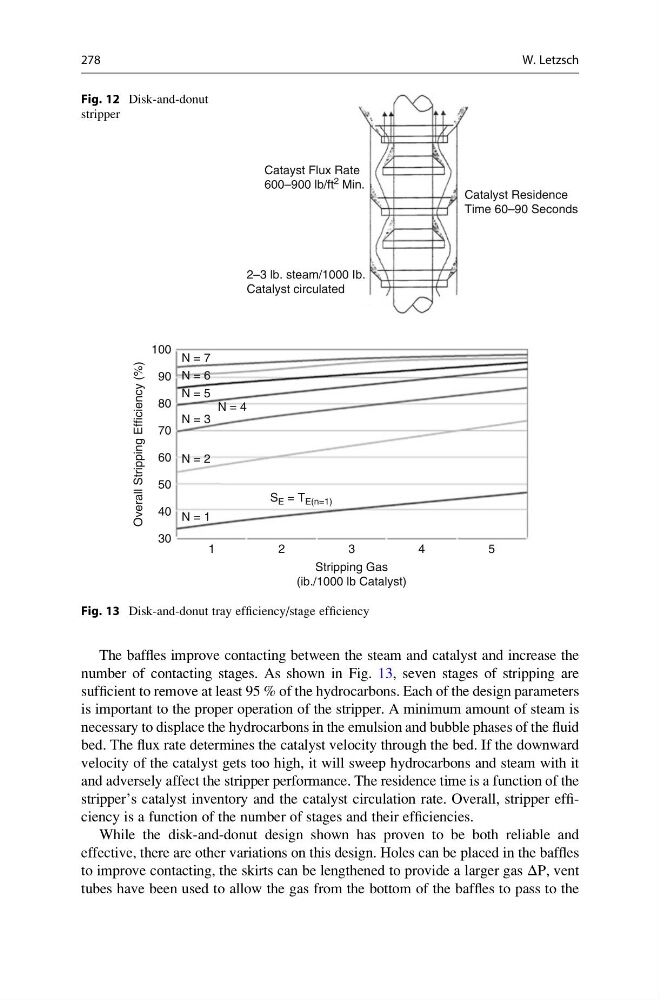
The baffles improve contacting between the steam and catalyst and increase the
number of contacting stages. As shown in Fig. 13, seven stages of stripping are
sufficient to remove at least 95 % of the hydrocarbons. Each of the design parameters
is important to the proper operation of the stripper. A minimum amount of steam is
necessary to displace the hydrocarbons in the emulsion and bubble phases of the fluid
bed. The flux rate determines the catalyst velocity through the bed. If the downward
velocity of the catalyst gets too high, it will sweep hydrocarbons and steam with it
and adversely affect the stripper performance. The residence time is a function of the
stripper’s catalyst inventory and the catalyst circulation rate. Overall, stripper efficiency is a function of the number of stages and their efficiencies.
While the disk-and-donut design shown has proven to be both reliable and
effective, there are other variations on this design. Holes can be placed in the baffles
to improve contacting, the skirts can be lengthened to provide a larger gas ΔP, vent
tubes have been used to allow the gas from the bottom of the baffles to pass to the
Catalyst Residence
Time 60–90 Seconds
Catayst Flux Rate
600–900 lb/ft
2 Min.
2–3 lb. steam/1000 Ib.
Catalyst circulated
Fig. 12 Disk-and-donut
stripper
1
2
3
Stripping Gas
(ib./1000 lb Catalyst)
Overall Stripping Efficiency (%)
N = 1
N = 2
N = 3
N = 4
N = 5
N = 6
N = 7
S E = T E(n=1)
30
40
50
60
70
80
90
100
4
5
Fig. 13 Disk-and-donut tray efficiency/stage efficiency
278
W. Letzsch
number of contacting stages. As shown in Fig. 13, seven stages of stripping are
sufficient to remove at least 95 % of the hydrocarbons. Each of the design parameters
is important to the proper operation of the stripper. A minimum amount of steam is
necessary to displace the hydrocarbons in the emulsion and bubble phases of the fluid
bed. The flux rate determines the catalyst velocity through the bed. If the downward
velocity of the catalyst gets too high, it will sweep hydrocarbons and steam with it
and adversely affect the stripper performance. The residence time is a function of the
stripper’s catalyst inventory and the catalyst circulation rate. Overall, stripper efficiency is a function of the number of stages and their efficiencies.
While the disk-and-donut design shown has proven to be both reliable and
effective, there are other variations on this design. Holes can be placed in the baffles
to improve contacting, the skirts can be lengthened to provide a larger gas ΔP, vent
tubes have been used to allow the gas from the bottom of the baffles to pass to the
Catalyst Residence
Time 60–90 Seconds
Catayst Flux Rate
600–900 lb/ft
2 Min.
2–3 lb. steam/1000 Ib.
Catalyst circulated
Fig. 12 Disk-and-donut
stripper
1
2
3
Stripping Gas
(ib./1000 lb Catalyst)
Overall Stripping Efficiency (%)
N = 1
N = 2
N = 3
N = 4
N = 5
N = 6
N = 7
S E = T E(n=1)
30
40
50
60
70
80
90
100
4
5
Fig. 13 Disk-and-donut tray efficiency/stage efficiency
278
W. Letzsch