

The dilute phase of the reactor-stripper is a place where secondary thermal
reactions can occur, and the extent of these reactions can be estimated from Eq. 3:
Delta dry gas ¼ Ke
E=RT t ¼ 8:3 Â 10
12
À
Á
e
À93, 000= 1:987ÃT R
ð Þ
ð
Þ
t:
(3)
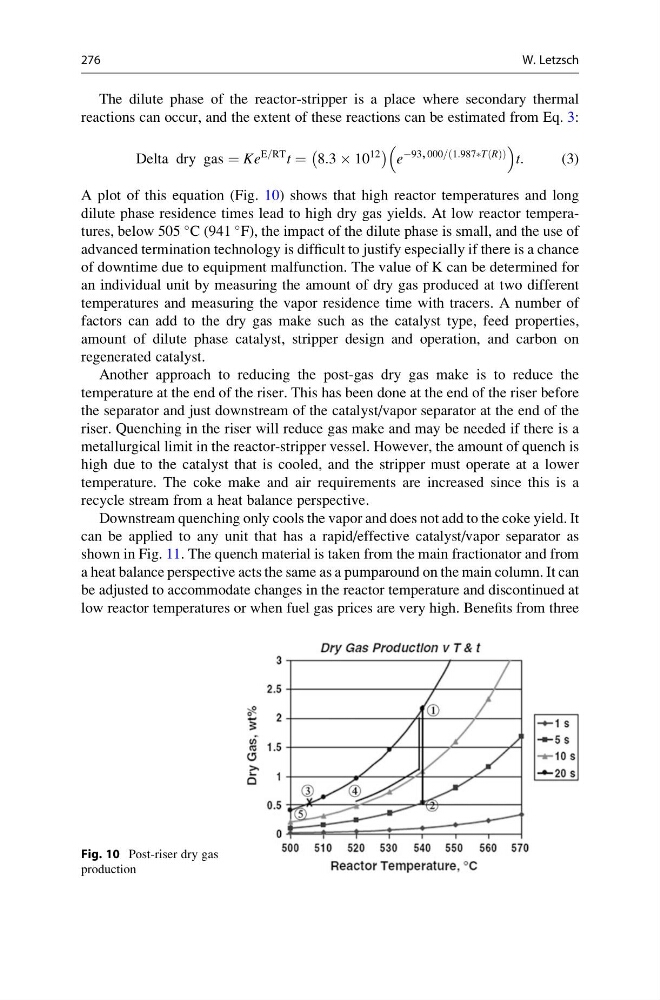
A plot of this equation (Fig. 10) shows that high reactor temperatures and long
dilute phase residence times lead to high dry gas yields. At low reactor temperatures, below 505
C (941
F), the impact of the dilute phase is small, and the use of
advanced termination technology is difficult to justify especially if there is a chance
of downtime due to equipment malfunction. The value of K can be determined for
an individual unit by measuring the amount of dry gas produced at two different
temperatures and measuring the vapor residence time with tracers. A number of
factors can add to the dry gas make such as the catalyst type, feed properties,
amount of dilute phase catalyst, stripper design and operation, and carbon on
regenerated catalyst.
Another approach to reducing the post-gas dry gas make is to reduce the
temperature at the end of the riser. This has been done at the end of the riser before
the separator and just downstream of the catalyst/vapor separator at the end of the
riser. Quenching in the riser will reduce gas make and may be needed if there is a
metallurgical limit in the reactor-stripper vessel. However, the amount of quench is
high due to the catalyst that is cooled, and the stripper must operate at a lower
temperature. The coke make and air requirements are increased since this is a
recycle stream from a heat balance perspective.
Downstream quenching only cools the vapor and does not add to the coke yield. It
can be applied to any unit that has a rapid/effective catalyst/vapor separator as
shown in Fig. 11. The quench material is taken from the main fractionator and from
a heat balance perspective acts the same as a pumparound on the main column. It can
be adjusted to accommodate changes in the reactor temperature and discontinued at
low reactor temperatures or when fuel gas prices are very high. Benefits from three
Fig. 10 Post-riser dry gas
production
276
W. Letzsch
reactions can occur, and the extent of these reactions can be estimated from Eq. 3:
Delta dry gas ¼ Ke
E=RT t ¼ 8:3 Â 10
12
À
Á
e
À93, 000= 1:987ÃT R
ð Þ
ð
Þ
t:
(3)
A plot of this equation (Fig. 10) shows that high reactor temperatures and long
dilute phase residence times lead to high dry gas yields. At low reactor temperatures, below 505
C (941
F), the impact of the dilute phase is small, and the use of
advanced termination technology is difficult to justify especially if there is a chance
of downtime due to equipment malfunction. The value of K can be determined for
an individual unit by measuring the amount of dry gas produced at two different
temperatures and measuring the vapor residence time with tracers. A number of
factors can add to the dry gas make such as the catalyst type, feed properties,
amount of dilute phase catalyst, stripper design and operation, and carbon on
regenerated catalyst.
Another approach to reducing the post-gas dry gas make is to reduce the
temperature at the end of the riser. This has been done at the end of the riser before
the separator and just downstream of the catalyst/vapor separator at the end of the
riser. Quenching in the riser will reduce gas make and may be needed if there is a
metallurgical limit in the reactor-stripper vessel. However, the amount of quench is
high due to the catalyst that is cooled, and the stripper must operate at a lower
temperature. The coke make and air requirements are increased since this is a
recycle stream from a heat balance perspective.
Downstream quenching only cools the vapor and does not add to the coke yield. It
can be applied to any unit that has a rapid/effective catalyst/vapor separator as
shown in Fig. 11. The quench material is taken from the main fractionator and from
a heat balance perspective acts the same as a pumparound on the main column. It can
be adjusted to accommodate changes in the reactor temperature and discontinued at
low reactor temperatures or when fuel gas prices are very high. Benefits from three
Fig. 10 Post-riser dry gas
production
276
W. Letzsch