

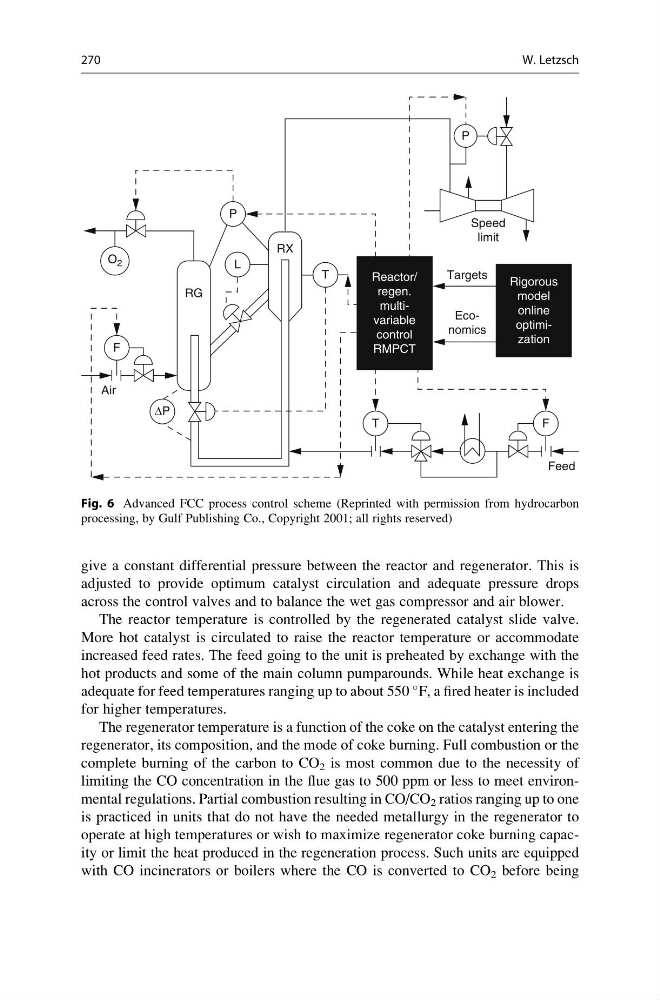
give a constant differential pressure between the reactor and regenerator. This is
adjusted to provide optimum catalyst circulation and adequate pressure drops
across the control valves and to balance the wet gas compressor and air blower.
The reactor temperature is controlled by the regenerated catalyst slide valve.
More hot catalyst is circulated to raise the reactor temperature or accommodate
increased feed rates. The feed going to the unit is preheated by exchange with the
hot products and some of the main column pumparounds. While heat exchange is
adequate for feed temperatures ranging up to about 550
F, a fired heater is included
for higher temperatures.
The regenerator temperature is a function of the coke on the catalyst entering the
regenerator, its composition, and the mode of coke burning. Full combustion or the
complete burning of the carbon to CO 2 is most common due to the necessity of
limiting the CO concentration in the flue gas to 500 ppm or less to meet environmental regulations. Partial combustion resulting in CO/CO 2 ratios ranging up to one
is practiced in units that do not have the needed metallurgy in the regenerator to
operate at high temperatures or wish to maximize regenerator coke burning capacity or limit the heat produced in the regeneration process. Such units are equipped
with CO incinerators or boilers where the CO is converted to CO 2 before being
P
L
RX
RG
F
T
F
P
T
Speed
limit
Targets
Economics
Reactor/
regen.
multivariable
control
RMPCT
Rigorous
model
online
optimization
Feed
Air
ΔP
O 2
Fig. 6 Advanced FCC process control scheme (Reprinted with permission from hydrocarbon
processing, by Gulf Publishing Co., Copyright 2001; all rights reserved)
270
W. Letzsch
adjusted to provide optimum catalyst circulation and adequate pressure drops
across the control valves and to balance the wet gas compressor and air blower.
The reactor temperature is controlled by the regenerated catalyst slide valve.
More hot catalyst is circulated to raise the reactor temperature or accommodate
increased feed rates. The feed going to the unit is preheated by exchange with the
hot products and some of the main column pumparounds. While heat exchange is
adequate for feed temperatures ranging up to about 550
F, a fired heater is included
for higher temperatures.
The regenerator temperature is a function of the coke on the catalyst entering the
regenerator, its composition, and the mode of coke burning. Full combustion or the
complete burning of the carbon to CO 2 is most common due to the necessity of
limiting the CO concentration in the flue gas to 500 ppm or less to meet environmental regulations. Partial combustion resulting in CO/CO 2 ratios ranging up to one
is practiced in units that do not have the needed metallurgy in the regenerator to
operate at high temperatures or wish to maximize regenerator coke burning capacity or limit the heat produced in the regeneration process. Such units are equipped
with CO incinerators or boilers where the CO is converted to CO 2 before being
P
L
RX
RG
F
T
F
P
T
Speed
limit
Targets
Economics
Reactor/
regen.
multivariable
control
RMPCT
Rigorous
model
online
optimization
Feed
Air
ΔP
O 2
Fig. 6 Advanced FCC process control scheme (Reprinted with permission from hydrocarbon
processing, by Gulf Publishing Co., Copyright 2001; all rights reserved)
270
W. Letzsch