

Process Comparison and Economics
From both an economic and technical perspective, continuous reforming processes
are superior to the SR and cyclic reforming processes. Thus, the CCR Platforming
unit allows for significantly lower pressure operation leading to higher yields.
At CCR conditions, the SR catalyst would be completely deactivated after only a
few days of operation. The total aromatics, hydrogen, and C 5 + yields are maximized with the CCR Platforming process. Since the number of cyclic reformers is
small relative to CCR Platforming process units and SR process units, the following
comparison will focus on contrasting CCR Platforming units and SR units.
Obtaining high yields that are constant over time is important in the economics
of reforming. As the catalyst is deactivated by coke deposition in the SR
Platforming process, the yields begin to decline. With the CCR Platforming process, the reformate, aromatics, and hydrogen yields remain consistent and constant.
This is particularly important for downstream users. The CCR section ensures
proper redispersion of the metals and chloride balance to maintain fresh catalyst
activity. CCR Platforming units have higher on-stream efficiency and are able to
handle upset scenarios without long-term shutdown or significant decline in
performance.
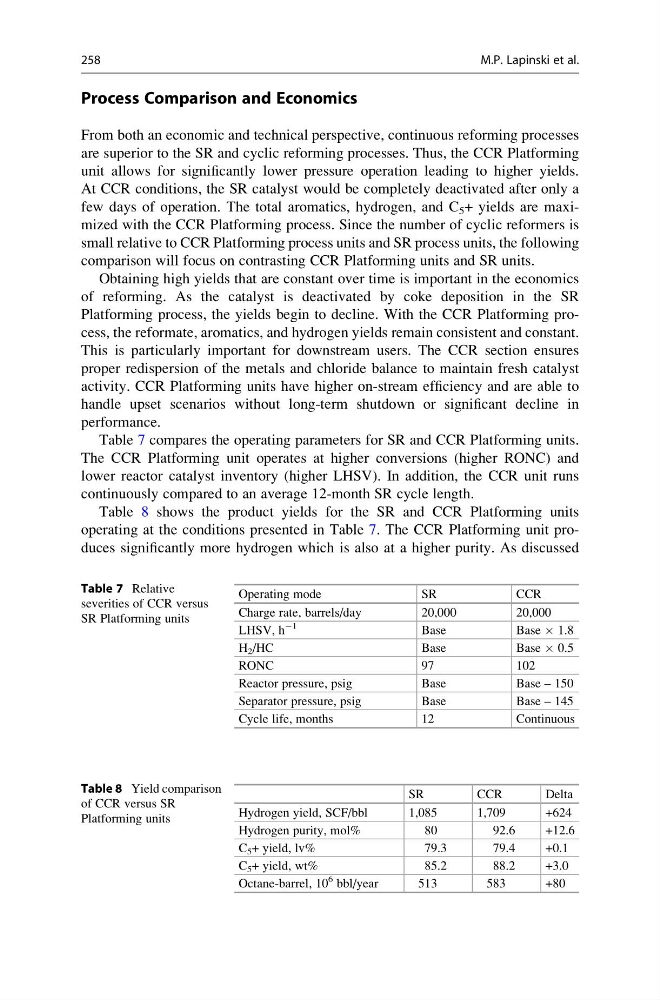
Table 7 compares the operating parameters for SR and CCR Platforming units.
The CCR Platforming unit operates at higher conversions (higher RONC) and
lower reactor catalyst inventory (higher LHSV). In addition, the CCR unit runs
continuously compared to an average 12-month SR cycle length.
Table 8 shows the product yields for the SR and CCR Platforming units
operating at the conditions presented in Table 7. The CCR Platforming unit produces significantly more hydrogen which is also at a higher purity. As discussed
Table 7 Relative
severities of CCR versus
SR Platforming units
Operating mode
SR
CCR
Charge rate, barrels/day
20,000
20,000
LHSV, h
À1
Base
Base  1.8
H 2 /HC
Base
Base  0.5
RONC
97
102
Reactor pressure, psig
Base
Base – 150
Separator pressure, psig
Base
Base – 145
Cycle life, months
12
Continuous
Table 8 Yield comparison
of CCR versus SR
Platforming units
SR
CCR
Delta
Hydrogen yield, SCF/bbl
1,085
1,709
+624
Hydrogen purity, mol%
80
92.6
+12.6
C 5 + yield, lv%
79.3
79.4
+0.1
C 5 + yield, wt%
85.2
88.2
+3.0
Octane-barrel, 10
6 bbl/year
513
583
+80
258
M.P. Lapinski et al.
From both an economic and technical perspective, continuous reforming processes
are superior to the SR and cyclic reforming processes. Thus, the CCR Platforming
unit allows for significantly lower pressure operation leading to higher yields.
At CCR conditions, the SR catalyst would be completely deactivated after only a
few days of operation. The total aromatics, hydrogen, and C 5 + yields are maximized with the CCR Platforming process. Since the number of cyclic reformers is
small relative to CCR Platforming process units and SR process units, the following
comparison will focus on contrasting CCR Platforming units and SR units.
Obtaining high yields that are constant over time is important in the economics
of reforming. As the catalyst is deactivated by coke deposition in the SR
Platforming process, the yields begin to decline. With the CCR Platforming process, the reformate, aromatics, and hydrogen yields remain consistent and constant.
This is particularly important for downstream users. The CCR section ensures
proper redispersion of the metals and chloride balance to maintain fresh catalyst
activity. CCR Platforming units have higher on-stream efficiency and are able to
handle upset scenarios without long-term shutdown or significant decline in
performance.
Table 7 compares the operating parameters for SR and CCR Platforming units.
The CCR Platforming unit operates at higher conversions (higher RONC) and
lower reactor catalyst inventory (higher LHSV). In addition, the CCR unit runs
continuously compared to an average 12-month SR cycle length.
Table 8 shows the product yields for the SR and CCR Platforming units
operating at the conditions presented in Table 7. The CCR Platforming unit produces significantly more hydrogen which is also at a higher purity. As discussed
Table 7 Relative
severities of CCR versus
SR Platforming units
Operating mode
SR
CCR
Charge rate, barrels/day
20,000
20,000
LHSV, h
À1
Base
Base  1.8
H 2 /HC
Base
Base  0.5
RONC
97
102
Reactor pressure, psig
Base
Base – 150
Separator pressure, psig
Base
Base – 145
Cycle life, months
12
Continuous
Table 8 Yield comparison
of CCR versus SR
Platforming units
SR
CCR
Delta
Hydrogen yield, SCF/bbl
1,085
1,709
+624
Hydrogen purity, mol%
80
92.6
+12.6
C 5 + yield, lv%
79.3
79.4
+0.1
C 5 + yield, wt%
85.2
88.2
+3.0
Octane-barrel, 10
6 bbl/year
513
583
+80
258
M.P. Lapinski et al.