

system. Replacement with the latest software and hardware platforms can enable
longer trouble-free on-stream operations.
Since reforming catalysts contain chlorided alumina catalysts, some Cl can leave
the regeneration system in the regen vent gas. Earlier CCR reforming designs
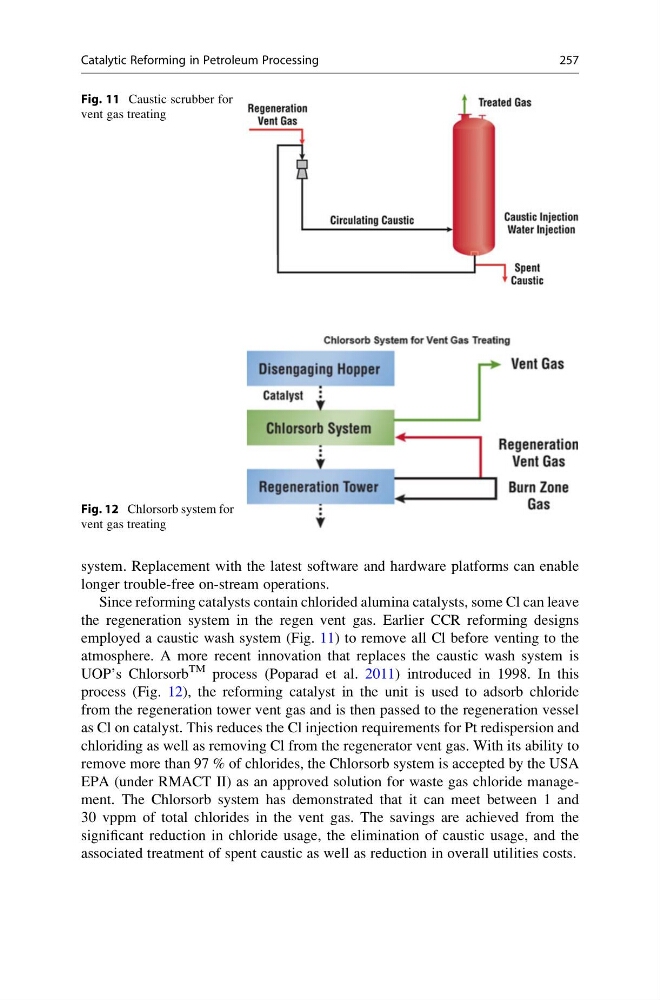
employed a caustic wash system (Fig. 11) to remove all Cl before venting to the
atmosphere. A more recent innovation that replaces the caustic wash system is
UOP’s Chlorsorb
TM process (Poparad et al. 2011) introduced in 1998. In this
process (Fig. 12), the reforming catalyst in the unit is used to adsorb chloride
from the regeneration tower vent gas and is then passed to the regeneration vessel
as Cl on catalyst. This reduces the Cl injection requirements for Pt redispersion and
chloriding as well as removing Cl from the regenerator vent gas. With its ability to
remove more than 97 % of chlorides, the Chlorsorb system is accepted by the USA
EPA (under RMACT II) as an approved solution for waste gas chloride management. The Chlorsorb system has demonstrated that it can meet between 1 and
30 vppm of total chlorides in the vent gas. The savings are achieved from the
significant reduction in chloride usage, the elimination of caustic usage, and the
associated treatment of spent caustic as well as reduction in overall utilities costs.
Fig. 11 Caustic scrubber for
vent gas treating
Fig. 12 Chlorsorb system for
vent gas treating
Catalytic Reforming in Petroleum Processing
257
longer trouble-free on-stream operations.
Since reforming catalysts contain chlorided alumina catalysts, some Cl can leave
the regeneration system in the regen vent gas. Earlier CCR reforming designs
employed a caustic wash system (Fig. 11) to remove all Cl before venting to the
atmosphere. A more recent innovation that replaces the caustic wash system is
UOP’s Chlorsorb
TM process (Poparad et al. 2011) introduced in 1998. In this
process (Fig. 12), the reforming catalyst in the unit is used to adsorb chloride
from the regeneration tower vent gas and is then passed to the regeneration vessel
as Cl on catalyst. This reduces the Cl injection requirements for Pt redispersion and
chloriding as well as removing Cl from the regenerator vent gas. With its ability to
remove more than 97 % of chlorides, the Chlorsorb system is accepted by the USA
EPA (under RMACT II) as an approved solution for waste gas chloride management. The Chlorsorb system has demonstrated that it can meet between 1 and
30 vppm of total chlorides in the vent gas. The savings are achieved from the
significant reduction in chloride usage, the elimination of caustic usage, and the
associated treatment of spent caustic as well as reduction in overall utilities costs.
Fig. 11 Caustic scrubber for
vent gas treating
Fig. 12 Chlorsorb system for
vent gas treating
Catalytic Reforming in Petroleum Processing
257