

previously, raising the RONC will lead to a lower C 5 + reformate yield at constant
pressure, but since the CCR unit operates at much lower pressure, the C 5 + wt%
yield is actually significantly higher for the CCR unit at 102 RONC versus the SR
unit at 97 RONC. In addition, the reformate from the CCR unit contains more
aromatics making the liquid product more dense. However, in the example case, the
liquid reformate volume (lv%) of the CCR reformate is still slightly larger than the
liquid reformate volume from the SR unit. Taking into account both the higher
octane value and the increased on-stream efficiency of the CCR Platforming unit,
80 million more octane-barrels, or 11.4 million more metric octane-tons, are
produced per year with the CCR unit than with the SR unit.
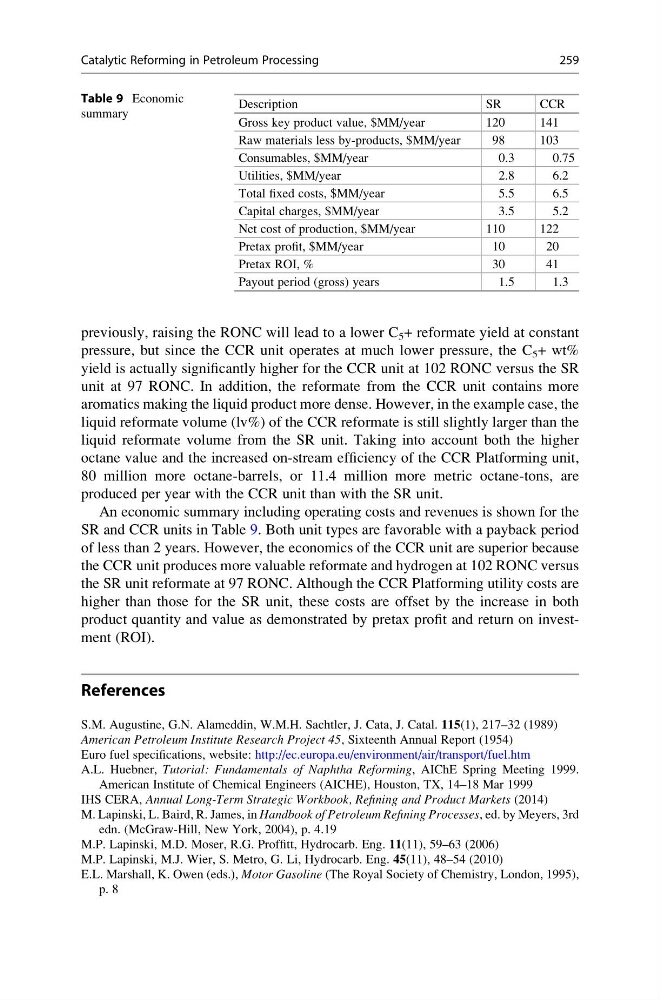
An economic summary including operating costs and revenues is shown for the
SR and CCR units in Table 9. Both unit types are favorable with a payback period
of less than 2 years. However, the economics of the CCR unit are superior because
the CCR unit produces more valuable reformate and hydrogen at 102 RONC versus
the SR unit reformate at 97 RONC. Although the CCR Platforming utility costs are
higher than those for the SR unit, these costs are offset by the increase in both
product quantity and value as demonstrated by pretax profit and return on investment (ROI).
References
S.M. Augustine, G.N. Alameddin, W.M.H. Sachtler, J. Cata, J. Catal. 115(1), 217–32 (1989)
American Petroleum Institute Research Project 45, Sixteenth Annual Report (1954)
Euro fuel specifications, website: http://ec.europa.eu/environment/air/transport/fuel.htm
A.L. Huebner, Tutorial: Fundamentals of Naphtha Reforming, AIChE Spring Meeting 1999.
American Institute of Chemical Engineers (AICHE), Houston, TX, 14–18 Mar 1999
IHS CERA, Annual Long-Term Strategic Workbook, Refining and Product Markets (2014)
M. Lapinski, L. Baird, R. James, in Handbook of Petroleum Refining Processes, ed. by Meyers, 3rd
edn. (McGraw-Hill, New York, 2004), p. 4.19
M.P. Lapinski, M.D. Moser, R.G. Proffitt, Hydrocarb. Eng. 11(11), 59–63 (2006)
M.P. Lapinski, M.J. Wier, S. Metro, G. Li, Hydrocarb. Eng. 45(11), 48–54 (2010)
E.L. Marshall, K. Owen (eds.), Motor Gasoline (The Royal Society of Chemistry, London, 1995),
p. 8
Table 9 Economic
summary
Description
SR
CCR
Gross key product value, $MM/year
120
141
Raw materials less by-products, $MM/year
98
103
Consumables, $MM/year
0.3
0.75
Utilities, $MM/year
2.8
6.2
Total fixed costs, $MM/year
5.5
6.5
Capital charges, $MM/year
3.5
5.2
Net cost of production, $MM/year
110
122
Pretax profit, $MM/year
10
20
Pretax ROI, %
30
41
Payout period (gross) years
1.5
1.3
Catalytic Reforming in Petroleum Processing
259
pressure, but since the CCR unit operates at much lower pressure, the C 5 + wt%
yield is actually significantly higher for the CCR unit at 102 RONC versus the SR
unit at 97 RONC. In addition, the reformate from the CCR unit contains more
aromatics making the liquid product more dense. However, in the example case, the
liquid reformate volume (lv%) of the CCR reformate is still slightly larger than the
liquid reformate volume from the SR unit. Taking into account both the higher
octane value and the increased on-stream efficiency of the CCR Platforming unit,
80 million more octane-barrels, or 11.4 million more metric octane-tons, are
produced per year with the CCR unit than with the SR unit.
An economic summary including operating costs and revenues is shown for the
SR and CCR units in Table 9. Both unit types are favorable with a payback period
of less than 2 years. However, the economics of the CCR unit are superior because
the CCR unit produces more valuable reformate and hydrogen at 102 RONC versus
the SR unit reformate at 97 RONC. Although the CCR Platforming utility costs are
higher than those for the SR unit, these costs are offset by the increase in both
product quantity and value as demonstrated by pretax profit and return on investment (ROI).
References
S.M. Augustine, G.N. Alameddin, W.M.H. Sachtler, J. Cata, J. Catal. 115(1), 217–32 (1989)
American Petroleum Institute Research Project 45, Sixteenth Annual Report (1954)
Euro fuel specifications, website: http://ec.europa.eu/environment/air/transport/fuel.htm
A.L. Huebner, Tutorial: Fundamentals of Naphtha Reforming, AIChE Spring Meeting 1999.
American Institute of Chemical Engineers (AICHE), Houston, TX, 14–18 Mar 1999
IHS CERA, Annual Long-Term Strategic Workbook, Refining and Product Markets (2014)
M. Lapinski, L. Baird, R. James, in Handbook of Petroleum Refining Processes, ed. by Meyers, 3rd
edn. (McGraw-Hill, New York, 2004), p. 4.19
M.P. Lapinski, M.D. Moser, R.G. Proffitt, Hydrocarb. Eng. 11(11), 59–63 (2006)
M.P. Lapinski, M.J. Wier, S. Metro, G. Li, Hydrocarb. Eng. 45(11), 48–54 (2010)
E.L. Marshall, K. Owen (eds.), Motor Gasoline (The Royal Society of Chemistry, London, 1995),
p. 8
Table 9 Economic
summary
Description
SR
CCR
Gross key product value, $MM/year
120
141
Raw materials less by-products, $MM/year
98
103
Consumables, $MM/year
0.3
0.75
Utilities, $MM/year
2.8
6.2
Total fixed costs, $MM/year
5.5
6.5
Capital charges, $MM/year
3.5
5.2
Net cost of production, $MM/year
110
122
Pretax profit, $MM/year
10
20
Pretax ROI, %
30
41
Payout period (gross) years
1.5
1.3
Catalytic Reforming in Petroleum Processing
259