

where:
ϕi = the relative volatility of component i
xiF = the mole fraction of component i in the feed
B = the factor that forces the expression to zero
The second part of the equation is expressed as follows:
R mþ1
ð
Þ ¼
X
ϕi
ð Þ Á xiD
ð Þ
ð
ÞÄ xiD
ð ÞÀB
ð
Þ Þ
(4)
where:
R m = minimum reflux at infinite number of trays
xiD = the mole fraction of i in the distillate
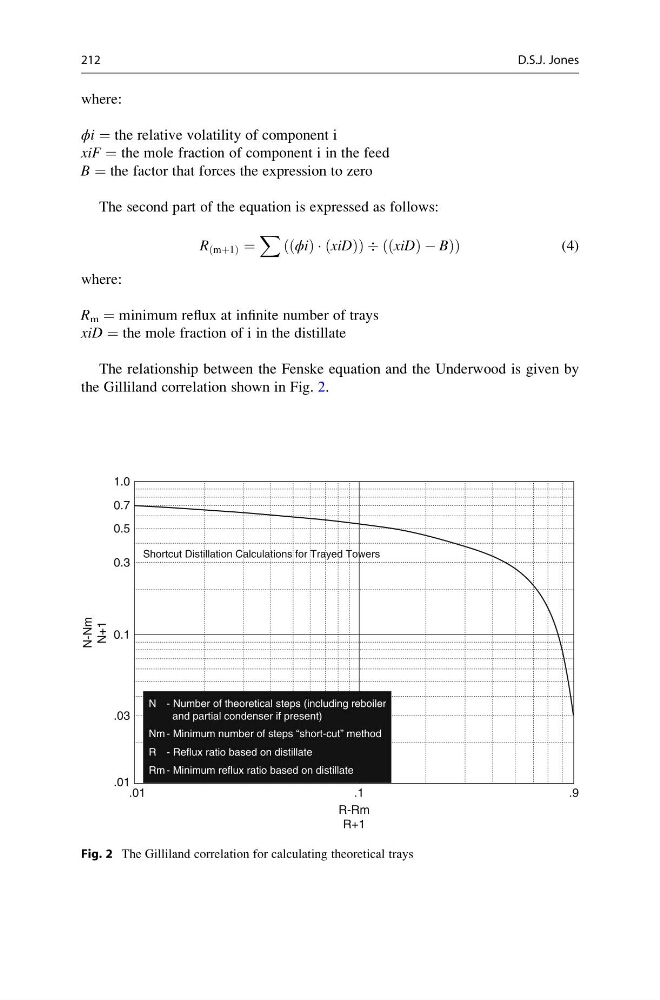
The relationship between the Fenske equation and the Underwood is given by
the Gilliland correlation shown in Fig. 2.
- Number of theoretical steps (including reboiler
and partial condenser if present)
- Minimum number of steps “short-cut” method
- Reflux ratio based on distillate
- Minimum reflux ratio based on distillate
N
Nm
R
Rm
Shortcut Distillation Calculations for Trayed Towers
1.0
0.7
0.5
0.3
0.1
N-Nm
N+1
.03
.01
.01
.1
R-Rm
R+1
.9
Fig. 2 The Gilliland correlation for calculating theoretical trays
212
D.S.J. Jones
ϕi = the relative volatility of component i
xiF = the mole fraction of component i in the feed
B = the factor that forces the expression to zero
The second part of the equation is expressed as follows:
R mþ1
ð
Þ ¼
X
ϕi
ð Þ Á xiD
ð Þ
ð
ÞÄ xiD
ð ÞÀB
ð
Þ Þ
(4)
where:
R m = minimum reflux at infinite number of trays
xiD = the mole fraction of i in the distillate
The relationship between the Fenske equation and the Underwood is given by
the Gilliland correlation shown in Fig. 2.
- Number of theoretical steps (including reboiler
and partial condenser if present)
- Minimum number of steps “short-cut” method
- Reflux ratio based on distillate
- Minimum reflux ratio based on distillate
N
Nm
R
Rm
Shortcut Distillation Calculations for Trayed Towers
1.0
0.7
0.5
0.3
0.1
N-Nm
N+1
.03
.01
.01
.1
R-Rm
R+1
.9
Fig. 2 The Gilliland correlation for calculating theoretical trays
212
D.S.J. Jones