

liquid/vapor traffic in the tower. An acceptably accurate “short-cut” method to
arrive at the number of theoretical trays is given here. The estimate of the liquid/
vapor traffic is discussed later in this chapter.
The Short-Cut Method for Predicting Number of Theoretical Trays
Three calculations or relationships are used to determine the number of theoretical
trays in this method. These are:
The Fenske calculation to determine the minimum number of trays at total reflux
The Underwood calculation to determine the minimum reflux at infinite number of
trays
The Gilliland correlation which uses the result of the two calculations to give the
theoretical number of trays
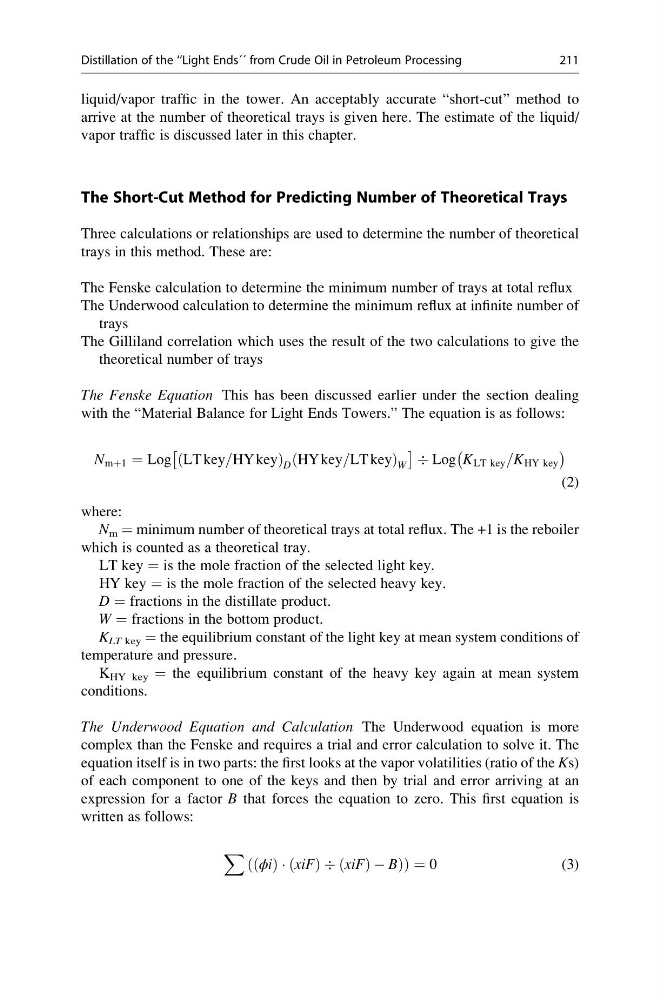
The Fenske Equation This has been discussed earlier under the section dealing
with the “Material Balance for Light Ends Towers.” The equation is as follows:
N mþ1 ¼ Log LT key=HY key
ð
Þ D HY key=LT key
ð
Þ W
Â
Ã Ä Log K LT key =K HY key
À
Á
(2)
where:
N m = minimum number of theoretical trays at total reflux. The +1 is the reboiler
which is counted as a theoretical tray.
LT key = is the mole fraction of the selected light key.
HY key = is the mole fraction of the selected heavy key.
D = fractions in the distillate product.
W = fractions in the bottom product.
K LT key = the equilibrium constant of the light key at mean system conditions of
temperature and pressure.
K HY key = the equilibrium constant of the heavy key again at mean system
conditions.
The Underwood Equation and Calculation The Underwood equation is more
complex than the Fenske and requires a trial and error calculation to solve it. The
equation itself is in two parts: the first looks at the vapor volatilities (ratio of the Ks)
of each component to one of the keys and then by trial and error arriving at an
expression for a factor B that forces the equation to zero. This first equation is
written as follows:
X
ϕi
ð Þ Á xiF
ð ÞÄ xiF
ð ÞÀB
ð
Þ Þ ¼ 0
(3)
Distillation of the ‘‘Light Ends´´ from Crude Oil in Petroleum Processing
211
arrive at the number of theoretical trays is given here. The estimate of the liquid/
vapor traffic is discussed later in this chapter.
The Short-Cut Method for Predicting Number of Theoretical Trays
Three calculations or relationships are used to determine the number of theoretical
trays in this method. These are:
The Fenske calculation to determine the minimum number of trays at total reflux
The Underwood calculation to determine the minimum reflux at infinite number of
trays
The Gilliland correlation which uses the result of the two calculations to give the
theoretical number of trays
The Fenske Equation This has been discussed earlier under the section dealing
with the “Material Balance for Light Ends Towers.” The equation is as follows:
N mþ1 ¼ Log LT key=HY key
ð
Þ D HY key=LT key
ð
Þ W
Â
Ã Ä Log K LT key =K HY key
À
Á
(2)
where:
N m = minimum number of theoretical trays at total reflux. The +1 is the reboiler
which is counted as a theoretical tray.
LT key = is the mole fraction of the selected light key.
HY key = is the mole fraction of the selected heavy key.
D = fractions in the distillate product.
W = fractions in the bottom product.
K LT key = the equilibrium constant of the light key at mean system conditions of
temperature and pressure.
K HY key = the equilibrium constant of the heavy key again at mean system
conditions.
The Underwood Equation and Calculation The Underwood equation is more
complex than the Fenske and requires a trial and error calculation to solve it. The
equation itself is in two parts: the first looks at the vapor volatilities (ratio of the Ks)
of each component to one of the keys and then by trial and error arriving at an
expression for a factor B that forces the equation to zero. This first equation is
written as follows:
X
ϕi
ð Þ Á xiF
ð ÞÄ xiF
ð ÞÀB
ð
Þ Þ ¼ 0
(3)
Distillation of the ‘‘Light Ends´´ from Crude Oil in Petroleum Processing
211