

Calculating the Tower Bottom Conditions for Light Ends Towers
The calculation to establish the tower bottom conditions for all light ends towers is
the same. Only the values for pressure and composition change. The temperature of
the product leaving the bottom of the tower will be at its bubble point at the tower
bottom pressure. Consider the debutanizer column whose material balance was
given in Table 2.
The number of actual trays (estimated) to accomplish the separation between the
C 4 s and the C 5 s is 30. The pressure drop for fully loaded trays can be taken as being
between 0.15 and 0.2 psi. Assume then a pressure drop of 0.17 psi per tray. The
tower top pressure calculated earlier is 125 psia, and then the bottom pressure is
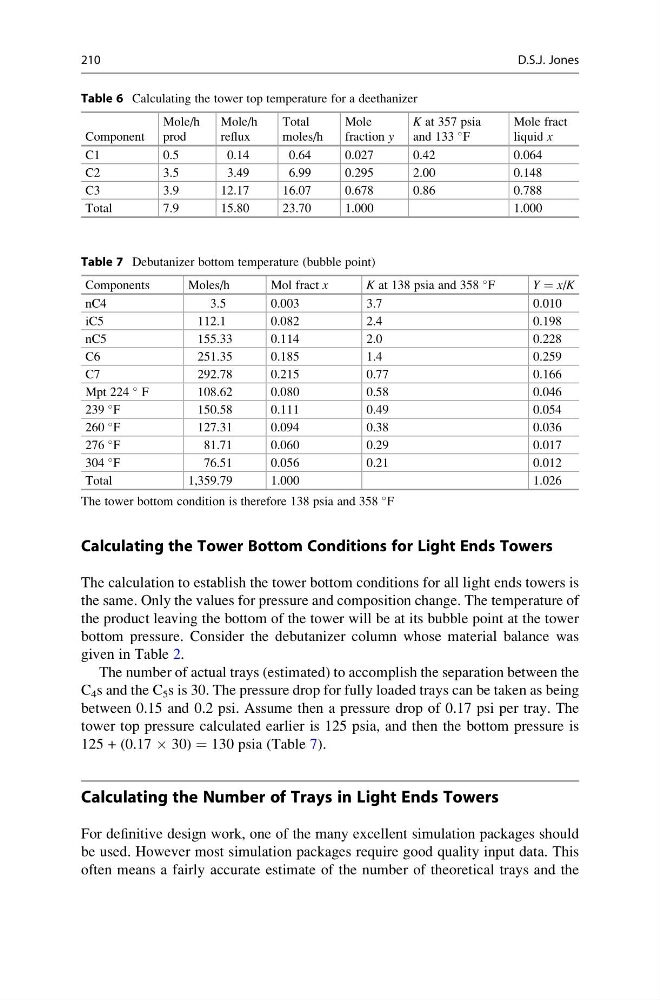
125 + (0.17 Â 30) = 130 psia (Table 7).
Calculating the Number of Trays in Light Ends Towers
For definitive design work, one of the many excellent simulation packages should
be used. However most simulation packages require good quality input data. This
often means a fairly accurate estimate of the number of theoretical trays and the
Table 6 Calculating the tower top temperature for a deethanizer
Component
Mole/h
prod
Mole/h
reflux
Total
moles/h
Mole
fraction y
K at 357 psia
and 133
F
Mole fract
liquid x
C1
0.5
0.14
0.64
0.027
0.42
0.064
C2
3.5
3.49
6.99
0.295
2.00
0.148
C3
3.9
12.17
16.07
0.678
0.86
0.788
Total
7.9
15.80
23.70
1.000
1.000
Table 7 Debutanizer bottom temperature (bubble point)
Components
Moles/h
Mol fract x
Kat 138 psia and 358
F
Y = x/K
nC4
3.5
0.003
3.7
0.010
iC5
112.1
0.082
2.4
0.198
nC5
155.33
0.114
2.0
0.228
C6
251.35
0.185
1.4
0.259
C7
292.78
0.215
0.77
0.166
Mpt 224
F
108.62
0.080
0.58
0.046
239
F
150.58
0.111
0.49
0.054
260
F
127.31
0.094
0.38
0.036
276
F
81.71
0.060
0.29
0.017
304
F
76.51
0.056
0.21
0.012
Total
1,359.79
1.000
1.026
The tower bottom condition is therefore 138 psia and 358
F
210
D.S.J. Jones
The calculation to establish the tower bottom conditions for all light ends towers is
the same. Only the values for pressure and composition change. The temperature of
the product leaving the bottom of the tower will be at its bubble point at the tower
bottom pressure. Consider the debutanizer column whose material balance was
given in Table 2.
The number of actual trays (estimated) to accomplish the separation between the
C 4 s and the C 5 s is 30. The pressure drop for fully loaded trays can be taken as being
between 0.15 and 0.2 psi. Assume then a pressure drop of 0.17 psi per tray. The
tower top pressure calculated earlier is 125 psia, and then the bottom pressure is
125 + (0.17 Â 30) = 130 psia (Table 7).
Calculating the Number of Trays in Light Ends Towers
For definitive design work, one of the many excellent simulation packages should
be used. However most simulation packages require good quality input data. This
often means a fairly accurate estimate of the number of theoretical trays and the
Table 6 Calculating the tower top temperature for a deethanizer
Component
Mole/h
prod
Mole/h
reflux
Total
moles/h
Mole
fraction y
K at 357 psia
and 133
F
Mole fract
liquid x
C1
0.5
0.14
0.64
0.027
0.42
0.064
C2
3.5
3.49
6.99
0.295
2.00
0.148
C3
3.9
12.17
16.07
0.678
0.86
0.788
Total
7.9
15.80
23.70
1.000
1.000
Table 7 Debutanizer bottom temperature (bubble point)
Components
Moles/h
Mol fract x
Kat 138 psia and 358
F
Y = x/K
nC4
3.5
0.003
3.7
0.010
iC5
112.1
0.082
2.4
0.198
nC5
155.33
0.114
2.0
0.228
C6
251.35
0.185
1.4
0.259
C7
292.78
0.215
0.77
0.166
Mpt 224
F
108.62
0.080
0.58
0.046
239
F
150.58
0.111
0.49
0.054
260
F
127.31
0.094
0.38
0.036
276
F
81.71
0.060
0.29
0.017
304
F
76.51
0.056
0.21
0.012
Total
1,359.79
1.000
1.026
The tower bottom condition is therefore 138 psia and 358
F
210
D.S.J. Jones