

In certain processes where a high tower pressure (and consequently high
temperature) may cause deterioration of one or more of the products from the
tower, the tower pressure is reduced by condensing only a fraction of the overhead
distillate product. For this purpose, a vaporization curve for the distillate product
is constructed at a selected reflux drum temperature. This curve is developed by
calculating a series of equilibrium compositions of the distillate product at the
reflux drum temperature but over a pressure range. A reflux drum pressure can
then be selected from the curve that satisfies an acceptable tower pressure profile.
A final equilibrium calculation is then made at this pressure to provide the
component and quantity composition of the liquid and vapor streams leaving
the reflux drum.
An example of deethanizer overhead operating conditions is given below:
Assume that the overhead vapor from the reflux drum, which is the product in
this case, has the following molar composition:
Mole
Fraction
C 1
0.063
C 2
0.443
C 3
0.494
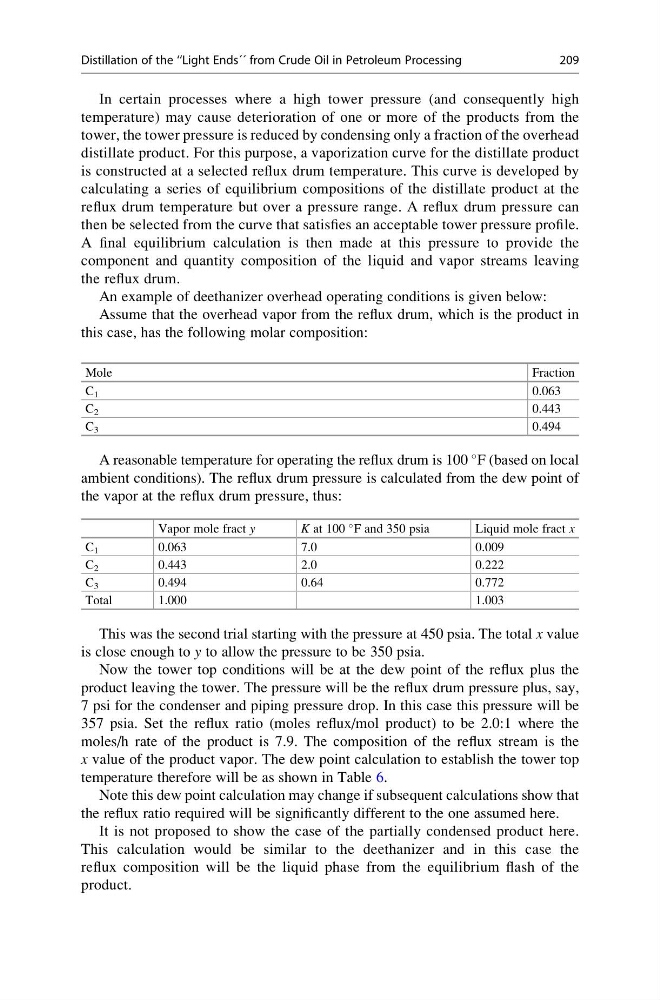
A reasonable temperature for operating the reflux drum is 100
F (based on local
ambient conditions). The reflux drum pressure is calculated from the dew point of
the vapor at the reflux drum pressure, thus:
Vapor mole fract y
Kat 100
F and 350 psia
Liquid mole fract x
C 1
0.063
7.0
0.009
C 2
0.443
2.0
0.222
C 3
0.494
0.64
0.772
Total
1.000
1.003
This was the second trial starting with the pressure at 450 psia. The total x value
is close enough to y to allow the pressure to be 350 psia.
Now the tower top conditions will be at the dew point of the reflux plus the
product leaving the tower. The pressure will be the reflux drum pressure plus, say,
7 psi for the condenser and piping pressure drop. In this case this pressure will be
357 psia. Set the reflux ratio (moles reflux/mol product) to be 2.0:1 where the
moles/h rate of the product is 7.9. The composition of the reflux stream is the
x value of the product vapor. The dew point calculation to establish the tower top
temperature therefore will be as shown in Table 6.
Note this dew point calculation may change if subsequent calculations show that
the reflux ratio required will be significantly different to the one assumed here.
It is not proposed to show the case of the partially condensed product here.
This calculation would be similar to the deethanizer and in this case the
reflux composition will be the liquid phase from the equilibrium flash of the
product.
Distillation of the ‘‘Light Ends´´ from Crude Oil in Petroleum Processing
209
temperature) may cause deterioration of one or more of the products from the
tower, the tower pressure is reduced by condensing only a fraction of the overhead
distillate product. For this purpose, a vaporization curve for the distillate product
is constructed at a selected reflux drum temperature. This curve is developed by
calculating a series of equilibrium compositions of the distillate product at the
reflux drum temperature but over a pressure range. A reflux drum pressure can
then be selected from the curve that satisfies an acceptable tower pressure profile.
A final equilibrium calculation is then made at this pressure to provide the
component and quantity composition of the liquid and vapor streams leaving
the reflux drum.
An example of deethanizer overhead operating conditions is given below:
Assume that the overhead vapor from the reflux drum, which is the product in
this case, has the following molar composition:
Mole
Fraction
C 1
0.063
C 2
0.443
C 3
0.494
A reasonable temperature for operating the reflux drum is 100
F (based on local
ambient conditions). The reflux drum pressure is calculated from the dew point of
the vapor at the reflux drum pressure, thus:
Vapor mole fract y
Kat 100
F and 350 psia
Liquid mole fract x
C 1
0.063
7.0
0.009
C 2
0.443
2.0
0.222
C 3
0.494
0.64
0.772
Total
1.000
1.003
This was the second trial starting with the pressure at 450 psia. The total x value
is close enough to y to allow the pressure to be 350 psia.
Now the tower top conditions will be at the dew point of the reflux plus the
product leaving the tower. The pressure will be the reflux drum pressure plus, say,
7 psi for the condenser and piping pressure drop. In this case this pressure will be
357 psia. Set the reflux ratio (moles reflux/mol product) to be 2.0:1 where the
moles/h rate of the product is 7.9. The composition of the reflux stream is the
x value of the product vapor. The dew point calculation to establish the tower top
temperature therefore will be as shown in Table 6.
Note this dew point calculation may change if subsequent calculations show that
the reflux ratio required will be significantly different to the one assumed here.
It is not proposed to show the case of the partially condensed product here.
This calculation would be similar to the deethanizer and in this case the
reflux composition will be the liquid phase from the equilibrium flash of the
product.
Distillation of the ‘‘Light Ends´´ from Crude Oil in Petroleum Processing
209